
Robot Hears Music, Opens New Medical Frontiers
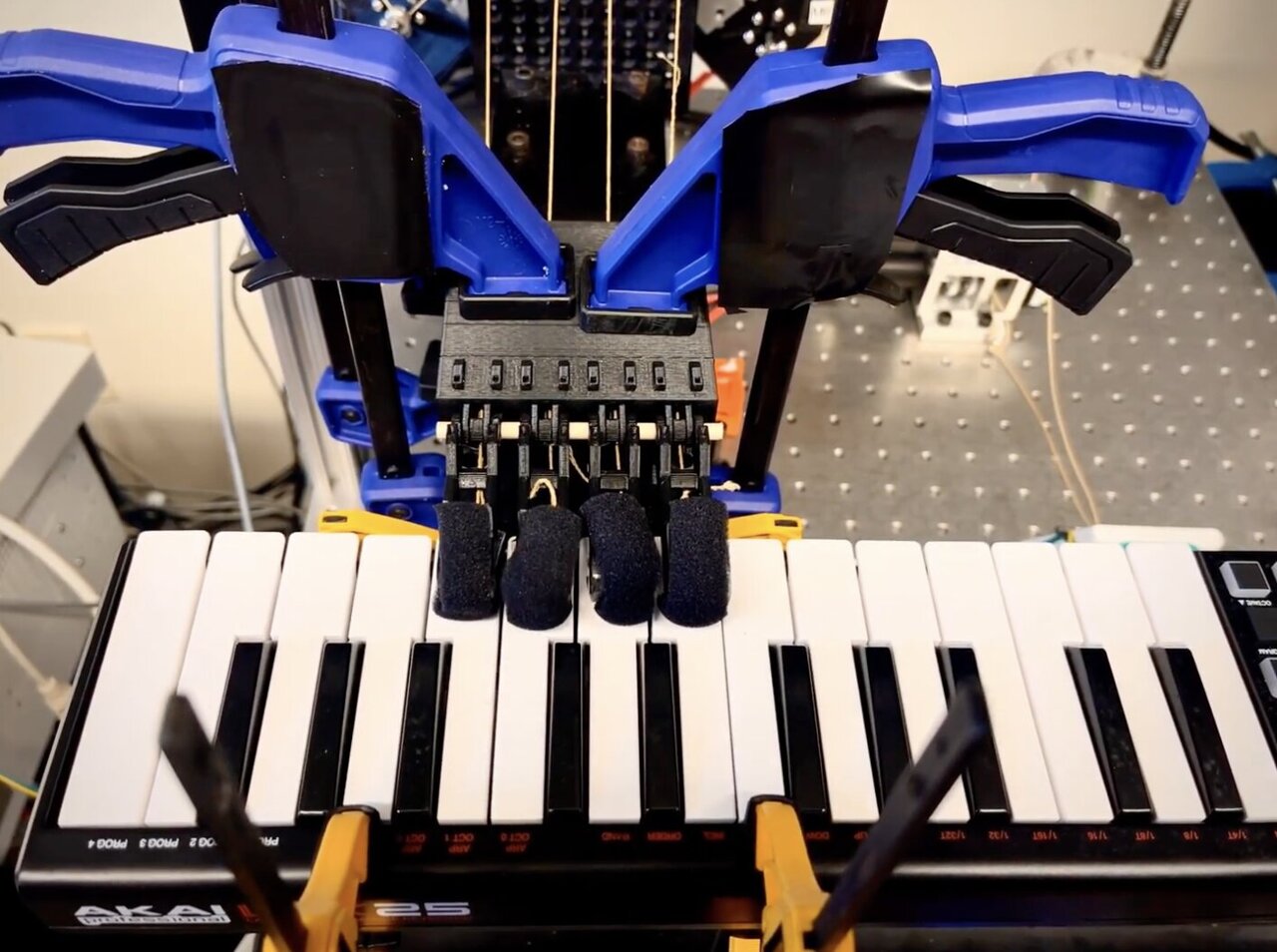
Researchers from the USC Viterbi School of Engineering have created a robotic hand capable of listening to a tune and reproducing it after only two minutes of self-learning on a keyboard, without the need for sheet music or pre-set instructions.
Subscribe to our newsletterfor the most recent science and technology news updates.
No extended training periods, no extensive data sets—just two minutes of spontaneous drawing on the keys, as any child might do.
The hand became so skilled that it "auditioned" in front of two music judges who listened to its performance without knowing it was a machine, along with four human pianists. The judges occasionally couldn't tell the difference between them.
The device, known as the Musician Hand, was developed by Hesam Azadjou, a PhD student at USC Viterbi and the USC Alfred E. Mann School of Pharmacy and Pharmaceutical Sciences, under the supervision of Francisco Valero-Cuevas, a professor of biomedical engineering, aerospace, and mechanical engineering at USC Viterbi and the study's lead author.
The results were released in theJournal of the Royal Society of Interface.
By imitating how the brain and body work together to refine fine motor skills through experimentation instead of following set instructions, the robot presents a novel approach for how machines—and medical practices—could handle complicated movements.
How it works
Unlike standard robots that depend on extensive coding and large training data sets, the Musician Hand learned through a process researchers refer to as "motor babbling—the identical investigative process through which babies learn to manage their limbs. For two minutes, the robotic hand randomly struck piano keys, while capturing the resulting sounds and the movements needed to produce them.
Following a short period of independent practice, the robot successfully detected and replicated a new melody consisting of around 30 notes in one go, without needing any adjustments.
The hand uses four tendon-driven fingersoperated by tiny electric motors that replicate the movement of a human hand. Neural networks process the sound of a tune and transform it into the motor signals required to recreate it.
The weak point of conventional robotics is the belief that complete information is required to perform effectively," Valero-Cuevas stated. "Animals don't function like that. They sense; they make educated guesses, typically accurate; and they adjust. We aimed to demonstrate that a robot could achieve the same.
Applications far beyond music
The music-playing machine serves as an example of what scientists refer toperceptual robotics- a system that senses its surroundings, tries different movements, and adjusts itself without needing large amounts of training data. They believe this method might one day assist humans in more personalized and natural ways compared to today's task-focused robots.
Think about Parkinson's disease: as the illness advances, a person's ability to move worsens—and current assistive technology often struggles to match this progression.
Picture it, if when you were first diagnosed, you had on anexoskeleton—a wearable robotic exoskeleton—and it learned how you move with just a few days of training," Valero-Cuevas said.
You instruct it: This is how I walk; this is how I reach; this is how I live. As your condition advances, you can wear it once more, but in assistance mode: It aids you in regaining your unique movement style. It doesn't have to be tailored for you personally. It has learned you.
Azadjou, whose work centers on neural engineering and computational neuroscience, recognizes potential uses inphysical therapyRobots that acquire a therapist's methods and subsequently assist patients with tailored exercises at home, adjusting instantly based on how each individual moves and reacts.
Currently, the Musician Hand is a prototype. However, the researchers believe that the same principles used to teach it to play the piano could, over time and with sufficient funding, enable robots to aid a stroke patient, work alongside a construction worker, or support an elderly individual in staying in their home.
Using just two minutes of training and a basic laptop, this system was able to perform an inherently human task: creating art," Valero-Cuevas remarked. "This serves as a challenge to conventional robotics that deserves serious consideration.
More information:Hesam Azadjou et al., Perception in action: a robotic system capable of learning to play music by ear in a melodious manner,Journal of the Royal Society of Interface (2026). DOI: 10.1098/rsif.2025.0909
Supplied by University of Southern California
This narrative was first released onTech Xplore.
Post a Comment for "Robot Hears Music, Opens New Medical Frontiers"