
The fading legacy of the Bengali bhadralok
The Legacy of the Bengali Bhadralok
I grew up in Kolkata at a time when public life carried a certain dignity. Politics was not merely a contest for power; it was also an exercise in restraint, language, and moral posture. Disagreement could be sharp, even uncompromising, but it rarely descended into vulgarity. There existed an unspoken understanding that how one conducted oneself in public mattered as much as what one believed. That sensibility was shaped by a political culture associated with what came to be known as the Bengali bhadralok. The term is often misunderstood.
It did not simply denote privilege or social standing, though privilege certainly played a role. More importantly, it described an ethos: a belief that education carried responsibility, that power demanded self-discipline, and that public disagreement required civility. Many of the political figures of that era had been educated in England. While deeply rooted in Bengal’s intellectual and cultural traditions, they had absorbed a regard for institutional conduct and ethical restraint from British parliamentary culture. Debate mattered. Language mattered. Conduct mattered. Politics was adversarial, but it was not brutal.
Political Figures of a Bygone Era
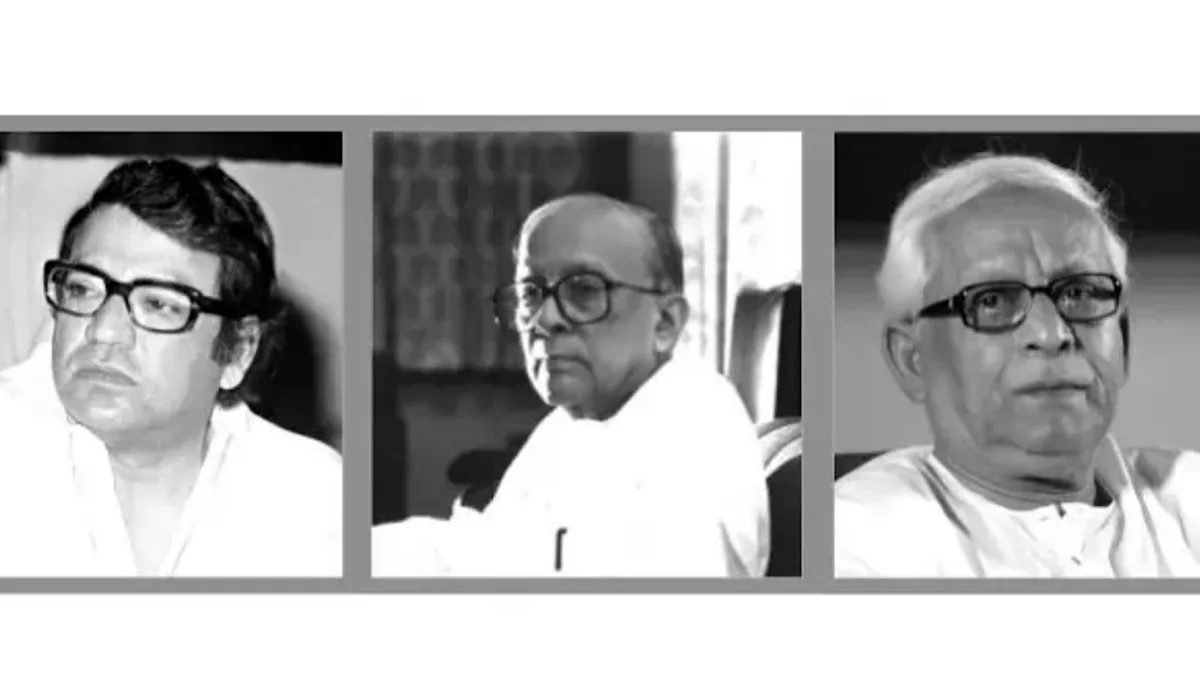
As a student, I was particularly struck by figures such as Jyoti Basu and Siddhartha Shankar Ray. Ideologically, they stood on opposite ends of the political spectrum – Basu a committed Marxist, Ray a loyal Congressman. Yet their political rivalry never curdled into personal hostility. They disagreed passionately, often sharply, but they did not dehumanize one another. What is often forgotten today is that beyond the public stage, Basu and Ray shared a genuine personal warmth. They visited one another’s homes, lingered over conversation and their favorite Scotch, and sustained friendships that transcended political alignment.
Their ideological differences did not foreclose intimacy; rather, it was precisely their mutual respect that made such intimacy possible. They embodied a truth now too easily forgotten -that disagreement need not extinguish fellowship, and that political opposition need not erase human connection. They also shared a cultural universe. Both were deeply read, intellectually curious, and attuned to literature, history, and the arts. Their disagreements unfolded within a shared moral and intellectual grammar. Politics, for them, was not an arena for humiliation but a forum for persuasion. To defeat an opponent did not require diminishing his dignity.
Another figure who embodied this ethos was Buddhadeb Bhattacharjee. Whatever one’s assessment of his political record, he represented a rare synthesis of political authority and cultural seriousness. A poet, playwright, and translator, he moved with ease between governance and literature. His engagement with writers such as Gabriel García Márquez and Vladimir Mayakovsky reflected a conviction that politics must remain in dialogue with imagination and ethical reflection. Power, in his view, did not absolve one from thoughtfulness; it demanded it.
The Changing Political Landscape
This is not an exercise in nostalgia, nor an attempt to canonize a vanished elite. It is simply an acknowledgment that a certain civic temperament once existed – and that its absence today is keenly felt. The political culture of West Bengal has undergone a profound transformation, much like the rest of India. Public discourse has grown harsher, more performative, and increasingly intolerant of nuance. Language once considered unacceptable has become routine. Insults now travel faster than ideas; volume frequently substitutes for reason. The space for thoughtful disagreement has narrowed, and with it the possibility of mutual respect.
To observe this is not to deny the necessity of social change. The older bhadralok order was exclusionary in important ways, and the democratization of political power was long overdue. Groups historically denied voice have rightly claimed political agency. That transformation deserves acknowledgment and respect. Yet inclusion need not come at the cost of civility. The expansion of political participation should enrich democratic culture, not impoverish it. What is troubling today is not the presence of new social actors, but the erosion of ethical norms that once governed public life.
The Ethical Challenge Ahead
The problem is not who speaks, but how we speak to one another. The decline of the bhadralok, then, is less about the fall of a social class than about the erosion of a civic ethic. It marks the fading of a tradition that valued restraint over rage, argument over intimidation, and persuasion over spectacle. When these norms weaken, politics becomes loud but hollow – animated by grievance rather than guided by reason. The consequences are not merely stylistic.
When public discourse loses its moral compass, institutions erode, trust dissipates, and cynicism takes root. Citizens withdraw or harden. Dialogue gives way to shouting. Democracy becomes a performance rather than a practice. Yet this moment also carries possibility. The responsibility now rests with the younger generation – those who inherit a society fractured by noise yet rich with potential. They are more connected, more informed, and more globally aware than any generation before them.
They also inherit institutions weakened by mistrust and a public culture fatigued by confrontation. The task before them is not to resurrect the past, but to recover what was ethically valuable within it. They need not imitate the bhadralok, but they might learn from its better instincts: the discipline of thought, the respect for disagreement, and the belief that power must answer to conscience.
If they choose this path, they can help restore a politics grounded not in outrage but in responsibility, not in spectacle but in seriousness. They can insist that disagreement need not mean dehumanization, and that civility is not weakness but strength. The future of Bengal will not be secured by nostalgia or noise. It will be shaped by those willing to combine conviction with humility, and passion with reflection. If such a generation emerges, it may yet renew the moral imagination of the state – and with it, the promise of a more dignified public life.
Post a Comment for "The fading legacy of the Bengali bhadralok"