
Small brains, big talents: Bees reveal unexpected tool skills
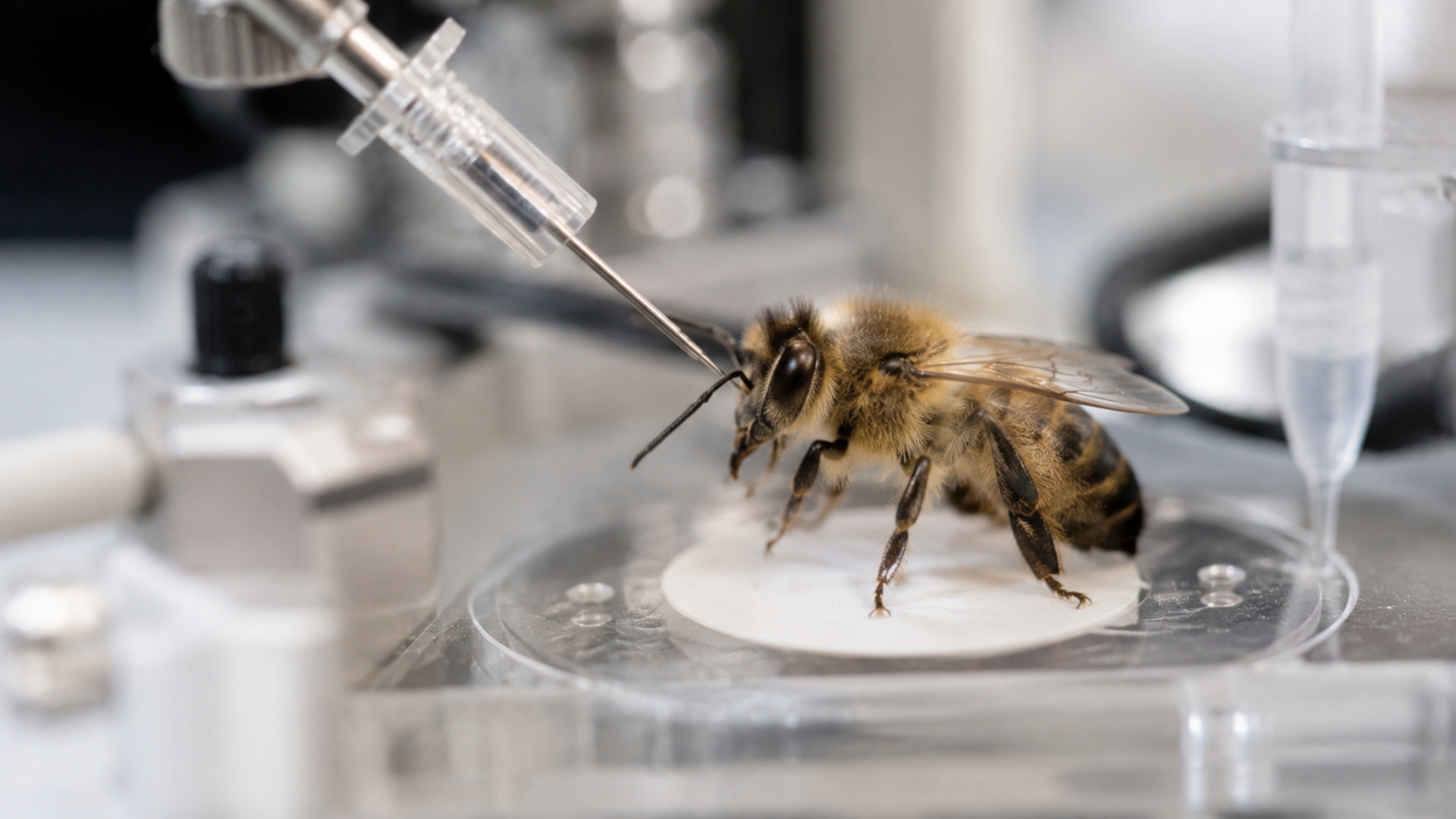
Bees May Be Smarter Than Their Tiny Brains Suggest
For decades, tool use was considered one of the clearest signs of advanced intelligence. Humans use tools constantly, and scientists have documented similar abilities in chimpanzees, crows, dolphins, elephants, and several other highly intelligent animals. Insects, by contrast, were often viewed as creatures driven largely by instinct. New research is challenging that assumption.
Scientists have found evidence that bees can learn to manipulate objects in ways that resemble simple tool use, suggesting these insects may possess a greater capacity for problem-solving than previously believed. The findings add to a growing body of research showing that complex behavior does not necessarily require a large brain.
What Counts as Tool Use?
Tool use is generally defined as the manipulation of an external object to achieve a goal. In the animal kingdom, examples include chimpanzees using sticks to extract termites, sea otters cracking shellfish with rocks, and crows fashioning hooked tools to retrieve food. The new study explored whether bees could perform a similar task.
Researchers presented the insects with a challenge that required moving an object in order to access a reward. Rather than relying on a natural behavior already found in the wild, the task involved a novel problem that the bees had never encountered before. The insects were able to learn the solution and use the object to obtain food.
Learning Through Observation
One of the most intriguing aspects of the research was the role of learning. Scientists found that some bees could acquire the behavior after observing demonstrations. This suggests the insects were not simply acting through trial and error but could use information gathered from watching others.
Social learning has long been associated with animals possessing relatively large brains. Finding evidence of similar processes in insects raises fascinating questions about how intelligence evolves and how different species solve problems using very different neural architectures. It also reinforces the idea that sophisticated behavior can emerge from surprisingly compact nervous systems.
Small Brains, Complex Behavior
Bees have fewer than a million neurons, a tiny number compared with mammals and birds. Yet they routinely perform tasks that appear remarkably complex. They navigate vast landscapes, communicate information about food sources, recognize patterns, learn from experience, and adapt to changing conditions.
Previous studies have shown that bees can distinguish shapes, remember locations, and even understand simple concepts related to quantity. The new findings fit into a broader scientific trend: discovering that insects are capable of far more flexible behavior than once assumed. Rather than functioning as simple biological machines, bees appear able to learn, innovate, and adjust their actions when faced with new challenges.
Why Intelligence Doesn't Always Require Size
The research highlights an important lesson in biology. Intelligence is not determined solely by brain size. Instead, what matters is how nervous systems are organized and how efficiently they process information. Evolution has produced many different solutions to the challenges of survival.
Some species developed large brains capable of advanced reasoning. Others evolved smaller but highly efficient neural systems that still allow impressive forms of learning and adaptation. Bees demonstrate that even miniature brains can achieve sophisticated outcomes when shaped by millions of years of evolutionary refinement.
Pollinators Under Pressure
The findings arrive at a time when bees are already receiving increased attention because of their ecological importance. As pollinators, bees support the reproduction of countless flowering plants and contribute significantly to agriculture and natural ecosystems. Many species face pressures from habitat loss, pesticide exposure, disease, and climate change.
Understanding their behavior is therefore important not only from a scientific perspective but also from a conservation standpoint. The more researchers learn about bees, the clearer it becomes that these insects play roles far more complex than simply moving pollen from flower to flower.
Rethinking Animal Intelligence
Historically, scientists often ranked animals according to perceived intelligence, placing humans and other large-brained species near the top while insects occupied the lower end of the scale. Modern research is increasingly revealing that intelligence is not a single trait that can be easily measured.
Instead, different species have evolved specialized abilities suited to their environments and lifestyles. A bee does not think like a crow, dolphin, or primate, but it may still possess forms of learning and problem-solving that are remarkably effective. Studies like this encourage a broader understanding of what cognition can look like across the animal kingdom.
Why the Discovery Matters
The image of a bee using a tool challenges one of the most persistent assumptions in biology: that complex behavior requires a large brain. While researchers continue to explore exactly how insects process information and solve problems, the evidence increasingly suggests that bees are capable of more than instinct alone.
Their achievements may not rival human technology or the sophisticated tools used by primates, but they reveal something equally fascinating. Inside a brain smaller than a grain of rice exists the capacity to learn, adapt, and tackle unfamiliar challenges.
For scientists studying animal intelligence, that is a reminder that nature often finds extraordinary solutions in the most unexpected places.
Post a Comment for "Small brains, big talents: Bees reveal unexpected tool skills"