
Space station's uncertain future as astronauts brace for evacuation
The Future of the International Space Station is Uncertain
The future of the International Space Station (ISS) is now in question after a recent incident involving an air leak that forced astronauts to take shelter. NASA astronauts were temporarily instructed to move into the SpaceX Crew Dragon “Freedom” spacecraft, which serves as a “safe haven,” while Russian cosmonauts worked on repairs. Although the crew has since returned to normal operations, the event has raised concerns about the aging space station’s structural integrity.
The leaks were discovered in the Russian segment of the ISS, specifically in the Zvezda service module, which was launched 26 years ago. This section of the station has been a source of concern for some time, with minor leaks occurring frequently and causing issues for over seven years. Recently, the rate of air loss increased from one pound per day to two pounds, prompting urgent action.
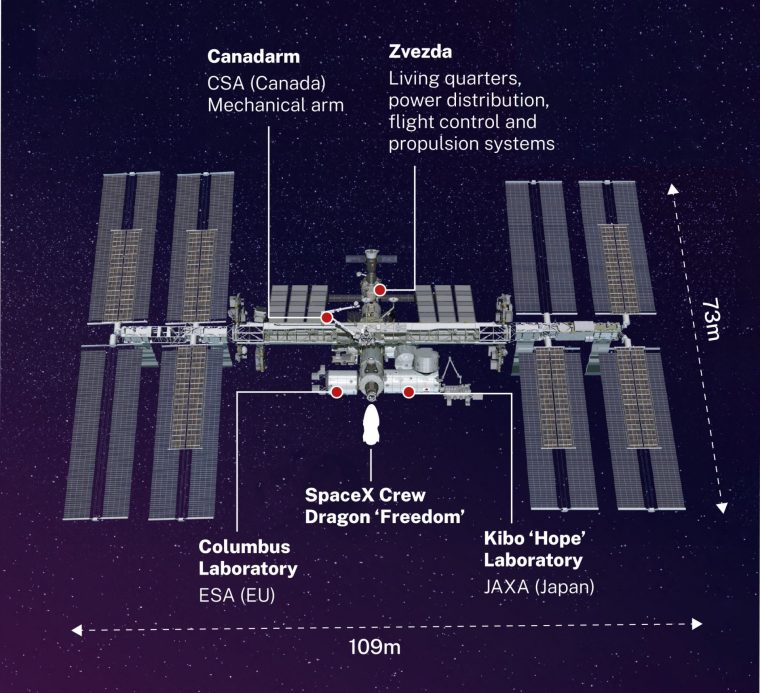
Russian cosmonauts attempted to access the leak using a saw, which led NASA to initiate safety protocols. While repairs were paused and the crew returned to the station, it remains unclear whether the issue has been permanently resolved. The situation highlights the challenges faced by the ISS, which is set to cease operations in 2030.
The Aging ISS and Its Fate
The ISS is due to be decommissioned in 2030, at which point it will be intentionally guided back into Earth’s atmosphere. Most of the station is expected to burn up upon re-entry, with the remaining debris crashing into a remote area of the Pacific Ocean. In its place, several commercially operated space stations are planned, developed by companies such as SpaceX, Boeing, and Blue Origin. These new facilities could serve as destinations for space tourists and continue scientific research.
Despite these plans, the current state of the ISS raises questions about its long-term viability. The Zvezda module, being the oldest part of the station, has endured significant wear and tear over the past 26 years. Dr. Megan Argo, an astrophysicist at the University of Lancaster, explained that the module has been subjected to mechanical stresses, micrometeorite impacts, and the harsh conditions of low Earth orbit.
Emergency Protocols and Crew Safety
In the event of a serious leak or other emergency, the ISS is equipped with enough spacecraft to safely return all crew members to Earth. However, such scenarios are rare and require precise coordination. During the recent incident, five astronauts took shelter in the Crew Dragon, while two cosmonauts worked on the leak. Dr. Argo emphasized the importance of having lifeboats available in space, noting that the station must always be prepared for unexpected situations.
“Having enough spacecraft docked to the ISS is crucial,” she said. “You don’t want to leave people stranded on a leaking station.”
Recent Incidents and Crew Details
This is not the first time the ISS has experienced technical difficulties. In 2024, NASA astronauts Butch Wilmore and Sunita Williams were unexpectedly stranded aboard the station for 286 days after their mission to test Boeing’s Starliner was disrupted by propulsion failures and helium leaks.
Currently, there are seven astronauts living and working aboard the ISS. They include three NASA astronauts, three Russian cosmonauts from Roscosmos, and one French astronaut from the European Space Agency. The crew consists of:
- Christopher Williams – NASA
- Jessica Meir – NASA
- Jack Hatahway – NASA
- Sergey Mikayev – Roscosmos
- Sergey Kud-Sverchkov – Roscosmos
- Andrei Fedyaev – Roscosmos
- Sophie Adenot – ESA
During the recent incident, Williams, Meir, Hatahway, Adenot, and Fedyaev were the ones who took shelter, while Mikayev and Kud-Sverchkov attempted to fix the leak.
Ongoing Challenges and Future Prospects
The ISS has been continuously occupied for over 25 years, making it the longest continuous human presence in low Earth orbit. However, its age and the ongoing technical challenges highlight the need for a transition to newer space habitats. As the station approaches its end-of-life, the focus will shift to ensuring a smooth handover to commercial space stations, which are expected to play a key role in future space exploration.
Post a Comment for "Space station's uncertain future as astronauts brace for evacuation"