
Airlines Sell Business Class Seats Like Smartphones: Inches and 4K Screens Replace Comfort
The Rise of Hardware as a Differentiator in Premium Aviation
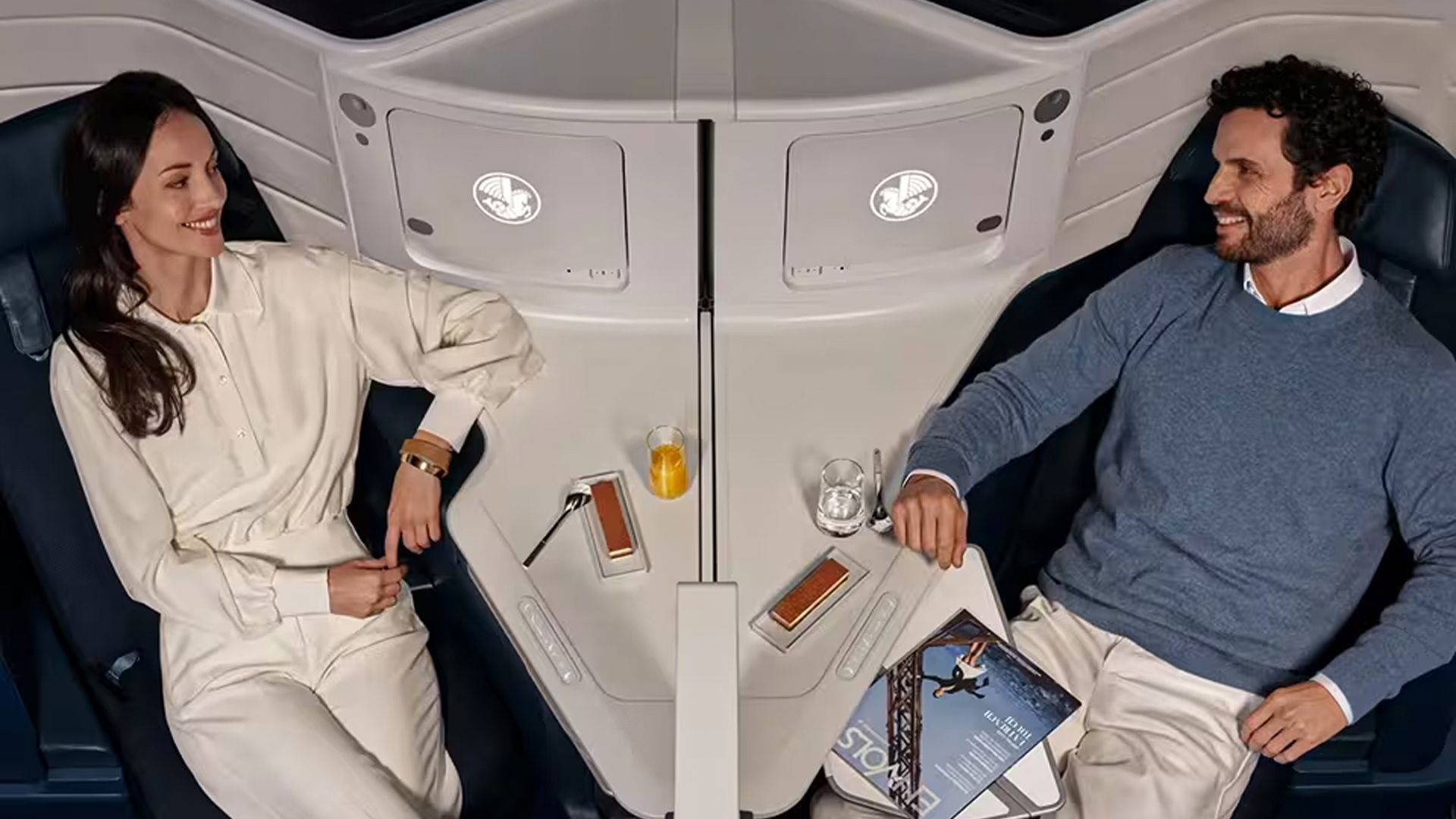
Air France's La Première first class suite was awarded the 2026 iF Design Award for its modular architecture, material craftsmanship, and multi-zone layout. While the jury did not specifically highlight the technical features, Air France has consistently emphasized that each of the four suites includes two 32-inch (81-cm) 4K screens. One screen faces the seat, and the other faces the chaise longue. This specification is a clear indicator that premium aviation has entered a new phase of competition, where measurable hardware becomes a key factor in passenger decision-making.
The question this shift raises is not whether premium hardware has replaced soft service, but rather how it has become one of the most visible languages of business class differentiation. Over the past three years, screen diagonals and connectivity features have gained prominence in how airlines market their premium cabins. This change affects how airlines launch new products, as they no longer lead with a single defining feature.
Why Two 32-Inch Screens Became the Benchmark
La Première's previous configuration featured a single 24-inch (61-cm) screen. The 2025 redesign introduced two 32-inch (81-cm) 4K anti-glare displays, one per zone within the suite. According to Air France's official press release, the second screen was added because the seat and the chaise longue face opposite directions, allowing passengers to enjoy over 1,500 hours of entertainment in optimal conditions from their seat, chaise longue, or bed.
While the functional rationale is valid, the marketing impact is equally significant. Two 32-inch 4K screens are easy to compare on a spreadsheet, and comparison tables are now a primary tool for evaluating premium cabins. This trend is evident across the industry:
- United Airlines' Polaris Studio leads with its 27-inch (68.6-cm) 4K OLED.
- Qatar Airways' Qsuite highlights its 79-inch (200-cm) lie-flat bed and 21.5-inch (55-cm) touchscreen.
- All Nippon Airways' "The Room" emphasizes a 38-inch (96.5-cm) shoulder width.
The screen has become the most visible proxy for cabin quality, as it is the first specification passengers encounter when choosing seats on comparison sites.
The Supply Side: Enabling Spec-Sheet Marketing
The convergence of in-flight entertainment (IFE) platform technology around scalable systems has enabled this shift. Panasonic Avionics' Astrova platform, which delivers 4K HDR10+ screens, Bluetooth audio pairing, 67-watt (W) USB-C charging, and onboard Spatial Audio, is being fitted on multiple aircraft, including Air France La Première, Qatar Airways Airbus A350-1000, and Lufthansa Airbus A380.
This platform is the first designed to support Bluetooth codec profiles that match the audio quality available on premium consumer wireless headphones. This detail matters commercially, as passengers can now compare their experience on different airlines, creating a new standard for competition.
What Happens to Airlines Without a Leading Specification?
Airlines operating legacy business class cabins from the 2014–2019 period are particularly exposed to this shift. These cabins were primarily focused on lie-flat beds and direct aisle access, with 1080p screens and wired headphone jacks as competitive advantages. While these products remain functionally comfortable, the commercial consequences are evident.
According to AwardFares' 2025 analysis, cabins with new specification-led products consistently outperform legacy cabins on the same route by premium load factor. This effect is most pronounced on transatlantic corridors, where product differentiation is highest.
The Fleet-within-a-Fleet Problem
Airlines mid-retrofit operate two or three distinct cabin products on the same aircraft type, creating inconsistency that can affect both operational and reputational performance. Passengers often discover at check-in that their aircraft has an older configuration, leading to dissatisfaction and pressure on airlines to complete retrofit programs quickly.
The Spec Race and Its Limits
The spec race has a natural upper limit defined by the physical boundaries of the aircraft cabin. However, within business class, there is still room for growth. United's 27-inch (68.6-cm) OLED is currently the largest business-class seatback display offered by a US carrier. The gap between 27 and 32 inches represents the next specification frontier, with at least two carriers studying it for widebody programs entering the design phase in 2027.
Premium Economy Enters the Race
As business class specifications continue to evolve, premium economy is also experiencing a parallel spec-sheet competition. Premium economy screens that were 10 to 11 inches (25 to 28 cm) in 2018 are now 13 to 15 inches (33 to 38 cm) on the best products, with Bluetooth audio and wireless charging following a similar diffusion path.
First Class Must Evolve
When every business class suite has a sliding door and a 4K screen, what does first class sell? Air France’s answer lies in geometry unavailable in business class: a 2-meter (78.7-inch) chaise longue that converts to a fully flat bed, five windows per suite, and a separate armchair facing opposite the bed, requiring two screens due to spatial separation.
The Spec Sheet Has Reached the Top
The spec-sheet era in premium aviation is now the operative marketing reality. Airlines that introduced new business class products without exact hardware specs struggled to stand out on comparison platforms, social media, or travel media cycles. Those that led with a screen diagonal, a door mechanism, or a charging standard generated coverage; those that led with service philosophy did not.
The structural test will come in 2027 and 2028, when the next wave of business class introductions, including Singapore Airlines’ rumored new suite for the A350 and 777-9, enters the market. If Singapore Airlines or a Gulf competitor crosses 32 inches in business class, the delta to La Première’s first class product narrows to nothing measurable on a spec sheet.
Whether the soft product can reassert itself as a primary booking driver, or whether the spec-sheet logic now governs every tier from premium economy to first class, is the question that airlines running retrofit programs through 2028 will effectively be answering with every seat they install.
Post a Comment for "Airlines Sell Business Class Seats Like Smartphones: Inches and 4K Screens Replace Comfort"