
Doomsday Diner Review: Great Idea Ruined by Crashes and Jank
Doomsday Diner: A Game Designed for Chaos, Not Consistency
Doomsday Diner launched on Steam on July 23, 2026, with a premise sharp enough to stop a scroll mid-finger: run the last functioning hot dog stand at the end of the world, serve post-apocalyptic customers in bottle caps, and when raiders walk in looking to rob the place, shoot them and grind them into the meat supply. The Auckland, New Zealand studio Space Rock Games spent years building it for their Steam community, and UNIKAT Label published it for $9.99 with a 15% launch discount that runs through August 6. Whether it is worth $8.49 to you depends almost entirely on whether you plan to play it — or watch someone else play it while you laugh.
That is not a rhetorical device. It is the central design fact that the game's first two critical reviews, published ahead of launch on July 22, independently identified and then split over: Doomsday Diner was designed primarily as content for variety streamers. When you understand that, everything else the critics report — the jank, the repetition, the instability — stops being a list of complaints and becomes a coherent engineering portrait of what happens when a small studio builds the wrong product for a paying audience.
Doomsday Diner Is Designed for a Crowd, Not a Solo Player
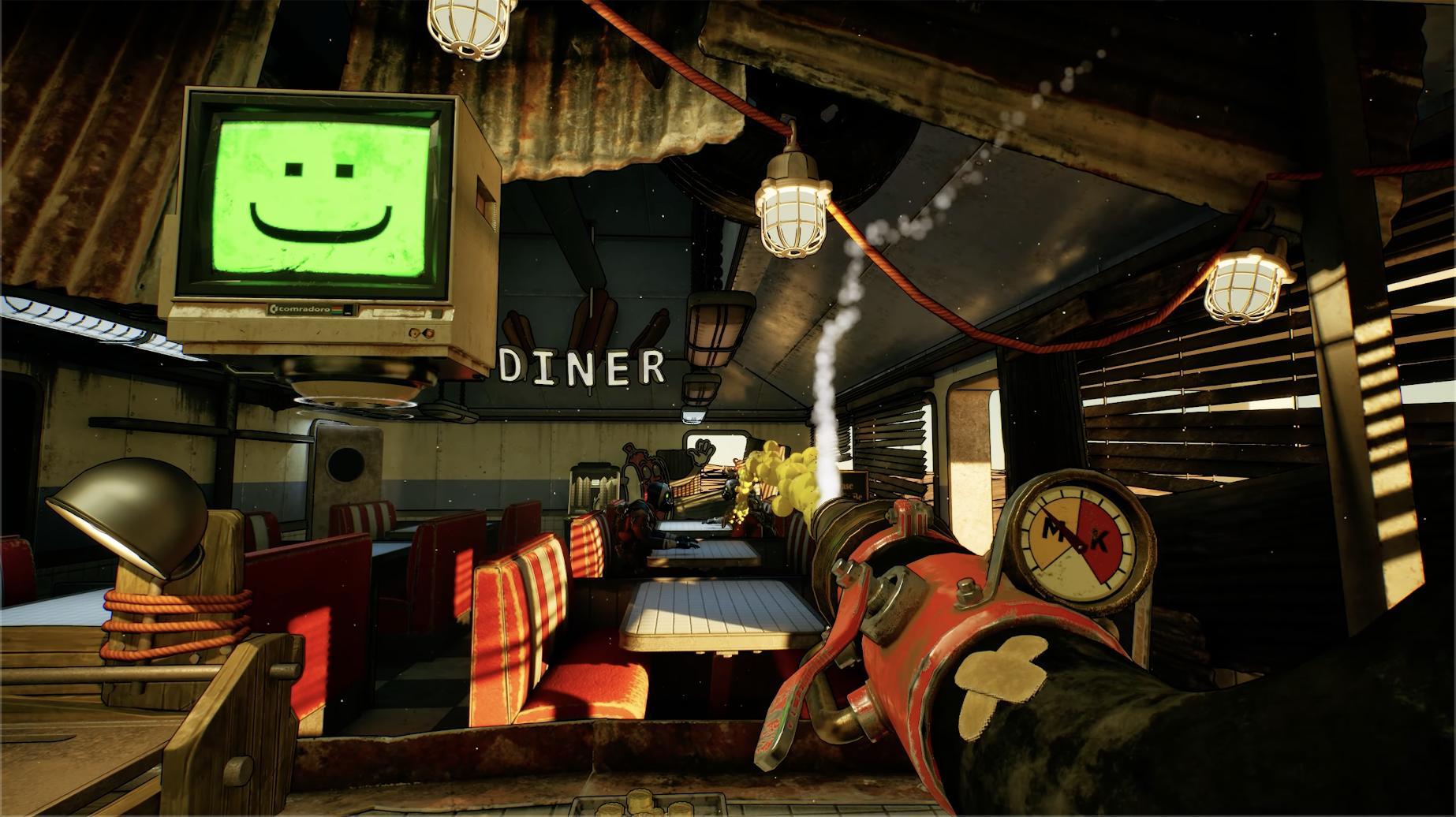
The game's core loop is a first-person diner management sim layered over light FPS combat. Customers arrive and order hot dogs — dressed with mustard, ketchup, or both, served rare or charred, sometimes in combinations that bend physics and common sense — along with coffee and the occasional absurd special request. The player cooks the order, slides it across the counter, earns bottle caps, and holds the diner against daily waves of raiders who would rather take the caps at gunpoint. Between shifts, they spend the caps on upgrades ranging from the useful (larger capacity griddle, better pistol) to the deliberately chaotic: the Sauce Hose, which continuously fires condiments across the kitchen and, as a bonus, cooks sausages and burns bandits.
Nearly every object in the diner is physics-simulated. Sausages have jiggle physics and skitter unpredictably across the griddle. Items fly when dropped near other objects. Condiment aiming requires deliberate effort to avoid misfires. The game's press materials described its controls as chaotic and unpredictable, and the developer noted that a correctly thrown sausage can even ricochet off incoming bullets. On a stream, at ten minutes in, this is genuinely funny to watch. That is exactly what the game is designed to deliver — and it delivers it.
Cubed3's Luna Eriksson, who reviewed the full release, put the structural problem into one sentence: the physics-based controls are "the sole reason the game is challenging at all," and while the sausages rolling around makes the streamer look like a mess, adding to viewers' pleasure, the experience of the person holding the mouse is a different matter.
Critics Are Split, and the Gap Is Enormous
GameGrin's Dylan Pamintuan scored the game 55 out of 100, describing it as "a fine game" that "offers nothing special to the table" — a plain frankfurter metaphor that accurately captures the review's tone: mild disappointment, not condemnation. Pamintuan noted the post-apocalyptic visual design is "rather grimy in a good way," the '50s-inspired jukebox soundtrack sets a comfortable mood, and the moment-to-moment act of cooking while simultaneously fighting off raiders creates a kind of Waffle House-under-siege energy that is occasionally entertaining. He experienced the game running at 50 FPS under heavy load without performance drops. His verdict: it gets repetitive within 90 minutes, with the only incentive to continue being achievement unlocks and upgrade progression, and he does not expect to return to it.
Cubed3's Eriksson scored it 2 out of 10 and identified something Pamintuan's review did not: what happens when you push past the first hour. Past approximately in-game day 15, the game begins crashing frequently. Past day 20, those crashes become severe. This matters mechanically because Doomsday Diner uses a roguelite structure — death or forced shutdown costs the player everything they have earned in that run. A crash, which is not the player's fault, triggers the same loss condition. The coffee mechanic makes this worse: coffee builds a bullet-time resource that slows time briefly during combat. That meter resets completely on every crash, wiping progress on a resource players have spent real time accumulating.
The GameGrin/Cubed3 divergence is best explained by session depth. Pamintuan's review reflects a shorter play window, during which the game runs adequately. Eriksson's reflects deeper progression, where compounding game state — more simultaneous raiders, more physics objects active at once, more upgrade interactions running in parallel — eventually exceeds what the physics engine handles stably. This is a documented failure mode for small-studio physics implementations: the engine holds at low object counts and breaks under compound load, a threshold the game's progression system is designed to cross.
What the Physics Engine Is Actually Doing
The diner's physics simulation is the product's main differentiator from genre competitors like Overcooked! (cooperative, tile-based, no physics) and Cooking Simulator (physics-based but single-player cooking without combat). In those games, the challenge comes from designed systems. In Doomsday Diner, the challenge comes substantially from physics unpredictability itself — sponges that go missing, objects that catapult when dropped, orders that fail for unexplained reasons mid-execution.
The specific physics implementation was not publicly identified by the developer in materials available at launch. Space Rock Games specializes in Unreal Engine development and their larger cooperative title Criminals Within is built in Unreal 5, but whether Doomsday Diner uses the same engine has not been confirmed in available press materials. The crash pattern — stable at low object counts, unstable under compounding simulation load — is consistent with how under-optimized physics implementations behave across multiple engines, not unique to any one.
One detail survives both reviews as genuinely charming: a properly thrown sausage can ricochet off an incoming bullet, changing the projectile's trajectory. In the context of everything else, this single interaction captures exactly what Doomsday Diner is reaching for and why its failure stings — the design imagination is present; the engineering stability is not.
Where the Game Stands Right Now
Doomsday Diner launched with two critic reviews and sits at a Metacritic score that does not yet exist: the platform requires a minimum of four critic reviews to generate an aggregated score. Steam user reviews total four at launch, below the threshold needed for Steam to display a summary rating. The pre-release demo, which covered the game's opening days, earned 90% positive ratings from 21 user reviewers. Those early days represent the part of the game that works.
Space Rock Games is a fully remote studio founded in 2020 in Auckland that raised $1.2 million from Hillfarrance Venture Capital and New Zealand Growth Capital Partners to develop Criminals Within, a cooperative action game that remains in development. Doomsday Diner — published through UNIKAT Label rather than self-published under the larger studio's flagship project — represents the studio's first shipped commercial game. No developer response to the crash reports in Cubed3's review was found in available materials at publication time.
Whether Space Rock Games releases a patch addressing the progression-dependent crash behavior and physics instability will determine whether Doomsday Diner finds an audience beyond the streamers it was designed for. At $8.49 with the current launch discount, the game delivers a visually committed, atmospherically convincing first hour. What it cannot deliver, at any price, is a stable experience for the player willing to push past day fifteen.
Frequently Asked Questions
Is Doomsday Diner worth buying for $9.99?
For variety streamers or content creators who want a short, visually chaotic session to entertain an audience, probably yes — the physics-based cooking and combat is genuinely funny to watch for the first hour. For solo players buying it to play through on their own, the answer is more complicated: the game becomes repetitive within 90 minutes according to GameGrin, and Cubed3 documents frequent crashes past in-game day 15 that wipe progress and reset the bullet-time coffee mechanic. If you are a solo player, waiting to see whether Space Rock Games releases a stability patch may be the better move.
Does Doomsday Diner crash?
Yes, according to Cubed3 reviewer Luna Eriksson, who experienced frequent crashes beginning around in-game day 15, with the problem worsening significantly past day 20. GameGrin's Dylan Pamintuan, whose review reflects a shorter play session, did not report crashes. The divergence suggests the instability is progression-dependent — triggered by the compounding physics simulation load that accumulates as the game advances — rather than a launch-day crash on startup.
What is Doomsday Diner's Metacritic score?
No Metacritic score is currently available. The platform requires a minimum of four critic reviews before calculating an aggregated score, and Doomsday Diner launched with two. The two published scores are a 55 from GameGrin and a 20 from Cubed3 — a 35-point gap that reflects the extent to which the game's appeal depends on how much of it the reviewer actually played.
Why does Doomsday Diner feel designed for streamers rather than solo players?
Because it largely is. The physics-based cooking — sausages that jitter, objects that fly, condiments that spray — is chaotic in a way that is visually entertaining for an audience watching a stream but frustrating for the person trying to execute a timed order under fire. Cubed3 noted this directly: the physics controls "add to the viewers' pleasure" while feeling "horrible to try to play." This is a structural tension in a growing category of indie games that are marketed and priced as solo PC purchases but designed primarily as streaming content — and it is the clearest explanation for why Doomsday Diner's two reviews sit 35 points apart.
Related Articles
Mumbai Chef Junk Food Simulator Ditches Countdown Clocks for Mini-Game Cooking
15 Must-Play Indie Games in 2026: Trending Indie Video Games and Top Indie Releases Gaining Serious Buzz
Post a Comment for "Doomsday Diner Review: Great Idea Ruined by Crashes and Jank"