
How AI is Revolutionizing In-Store Retail
The Rise of AI in Retail and Its Impact on Consumer Behavior
As retailers and brands continue to invest heavily in artificial intelligence (AI), the transformation it brings to the shopping experience and consumer behavior is becoming increasingly evident. Two recent research reports highlight this shift, revealing both the opportunities and challenges that come with AI integration.
In a consumer survey conducted by Bloomreach, an AI company specializing in digital commerce personalization, 4,000 shoppers in the U.S. and U.K. were surveyed. The findings indicate that AI adoption in retail has accelerated rapidly over the past year, moving from a novelty to a necessity. This shift reflects a significant change in consumer preferences, with the report noting that if forced to choose, 42% of consumers would prefer to shop through an AI tool rather than a retailer's website, which accounted for 38% of responses. This marks a notable departure from previous surveys where 58.9% preferred brand websites directly, compared to 41.1% who favored AI tools.
Another survey, conducted by VoCoVo among 250 U.S. retail executives and 500 U.S. consumers, highlights how AI is reshaping brick-and-mortar retailing. While AI was previously used mainly for e-commerce and marketing, it is now being integrated into physical stores for various purposes, including loss prevention, inventory visibility, checkout optimization, and store associate communications.
However, the rapid adoption of AI has also created a tension between technological ambition and emotional readiness. Retailers are leveraging automation to address labor pressures, rising theft, and operational costs, while consumers seek faster and easier experiences without sacrificing human connection or privacy. This gap is becoming a central issue for U.S. retailers.
The survey revealed that 94% of retail leaders consider operational improvements important. Surprisingly, 43.6% of executives reported that operating conditions have worsened due to labor shortages and rising costs. Many see AI as a potential solution, with nearly 44% planning to implement AI within the next year and 28.1% already using it.
On the consumer side, 42% of shoppers identified faster checkout as their top improvement priority. When it comes to the human touch, 62% of consumers said they ask staff for help when they cannot find an item. Despite this, 80% of shoppers expressed uncertainty about how AI is used and discomfort when it feels like surveillance. Additionally, 37% of consumers believe shoplifting has increased and associate it with stressful store environments.
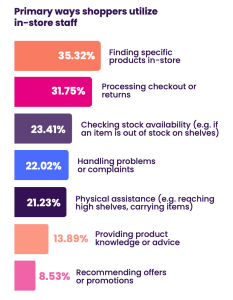
Both groups share a common theme: the value of human support. The report's authors noted that consumers do not want fewer staff, and retailers view AI as a tool for augmentation, not replacement. However, the adoption of AI is accelerating, but transparency, trust, and emotional comfort are lagging behind.
Using AI for inventory assessments is also key. One in four consumers (25%) said real-time stock visibility would significantly improve their in-store experience, reflecting growing intolerance for empty shelves, locked cases, and uncertainty about product availability. When shoppers cannot trust inventory accuracy, frustration escalates quickly, and reliance on staff increases.
Raj De Datta, co-founder and CEO of Bloomreach, emphasized that consumers today are no longer experimenting with AI; they are relying on it. "And beyond that... they're enjoying it," De Datta said. "Most say AI shopping experiences are meeting or exceeding their expectations. The way consumers search and shop has changed, and brands have to adapt accordingly."
Bloomreach's survey showed that 75.4% of respondents had used AI tools such as Claude, ChatGPT, and Gemini to assist with shopping or purchase decisions. Moreover, 80.4% of consumer respondents said AI shopping experiences have already met or exceeded their expectations.
While AI adoption by retailers and consumers is rising rapidly, there are still challenges on the business side. A poll by ManpowerGroup Talent Solutions revealed a significant barrier to AI transformation: workforce readiness and a leader's ability to guide employees through change. Only 3% of organizations reported that their leaders are highly prepared to manage AI-enabled ways of working, with 78% indicating employee concerns about how AI will impact their jobs.
The integration of AI in retail continues to evolve, presenting new opportunities and challenges. As the industry moves forward, balancing technological innovation with consumer trust and human connection will be essential for long-term success.
Post a Comment for "How AI is Revolutionizing In-Store Retail"