
Opinion: Is This Our Future?
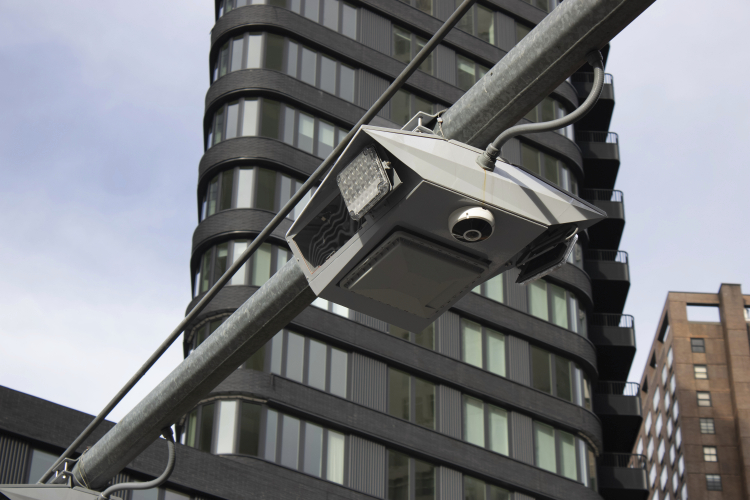
The Invisible Watchers at Your Doorstep
There is likely a camera on a pole at the entrance to your neighborhood. You’ve probably stopped noticing it. It’s small, solar-powered, and unremarkable, but it photographs every car that passes: yours, your neighbor’s, and even your teenager’s. It reads the license plate, logs the time, and files the record in a national database. This technology is operated by a company called Flock Safety, which was founded in 2017 and valued at $7.5 billion. It now operates in more than 5,000 communities across 49 states, scanning roughly 20 billion vehicles a month.
Twenty billion. Each month. For context, there are about 290 million registered vehicles in the United States. That means the average American car is photographed, catalogued, and made searchable hundreds of times each year. Not because of a federal, state, or local warrant, not by court order, but by a subscription service your city council approved in the middle of a tedious meeting never covered by any news organization and attended by a few bored citizens.
The license plates were just the beginning. Flock Safety now sells cameras that automatically zoom in on faces, audio sensors that listen for gunshots, and, as per an October company announcement, human screams. It also offers drones and a “public safety data platform” called Nova that merges plate reads with data-breach records and public files into a single searchable profile.
The Electronic Frontier Foundation calls Nova a “dystopian panopticon.” In September 2024, Oracle’s Larry Ellison described where all this is headed with admirable candor: “Citizens will be on their best behavior, because we’re constantly recording and reporting everything that’s going on.” And he meant it as a selling point.
A Slow Decline
It’s worth recalling how we got here, because the road, while sadly well-worn, is instructive. In April 2004, Google launched Gmail, and Americans in some quarters had a minor conniption. Google scanned the text of your email to place ads beside it; no human read anything, the company insisted, but 31 privacy organizations demanded the launch be suspended. A California state senator introduced a bill to stop it. Editorial pages lectured. The idea that a corporation would read your correspondence to sell you shoes struck ordinary Americans as self-evidently creepy.
That was the high-water mark of our resistance. Google’s Eric Schmidt later described the company’s policy as getting “right up to the creepy line and not cross it.” But the creepy line, it turns out, is not a line at all. It is a treadmill. Each incursion recalibrates what counts as normal, and the next one starts from the new baseline. We accepted the scanned inbox, then the tracked search history, then the phone that logs our location every few seconds, then the doorbell that streams to a server, then the speaker that listens in the kitchen. Every step was convenient. Every step was voluntary, more or less. And each step made the next one unremarkable.
So, when a private company wired up 6,000 municipalities with AI-powered cameras and made every American’s driving history searchable by tens of thousands of police officers – plus, as audits kept revealing, federal agencies that were never supposed to have access – there was no 2004-style temper tantrum. There couldn’t be. The capacity for that outrage was slowly spent over 20 years.
This is what a slow decline looks like. Not a boot, not a coup, but a subscription.
The Promise of Liberation
The surveillance is only half the issue. Read what Silicon Valley’s most powerful men say they are building, and a familiar image emerges. Some predict AI will deliver universal high income and a world of such abundance that saving for retirement won’t matter. Bill Gates, when not rationalizing his time with Jeffrey Epstein, muses that humans won’t be needed “for most things,” and floats the two-day work week. Sam Altman writes of a coming age in which intelligence is too cheap to meter and the machines handle the tedium while we flourish. Work becomes optional. Leisure becomes universal. The algorithms will manage things.
Set aside whether any of it is true. Notice what kind of promise it is: You will be freed from the burdens of running your own life, because a smarter class of managers – made of silicon, this time – will run it for you. Your commute will be optimized. Your neighborhood watched. Your needs anticipated. Your income guaranteed. All you must do is surrender the management of it all. And in so doing, your civil rights – and your humanity itself.
We have heard this promise before, almost word for word … a hundred years ago.
The Progressive Trade-Off
The progressives of the early 20th century were not villains in the classic sense of the word. They were, by their own lights, humanitarians armed with the newest science. Herbert Croly, Woodrow Wilson, and the so-called reformers around them looked at the messy, inefficient business of American self-government and offered a deal: Hand the complicated questions to trained experts. They’d be nonpartisans, they said, scientific, disinterested. Government would finally run like the modern machine it ought to be. Wilson said the Constitution’s clunky separation of powers belonged to the age of Newton; government, he argued, was a living thing that must evolve past such complicating checks. The citizen’s job would shrink, pleasantly. The expert’s job would grow, efficiently. Everyone would have more time for the higher things, the greater good.
It was the same trade-off the so-called “tech bros” now pitch, with slide rules instead of servers: liberation through management.
The Soft Despotism of the Modern Age
Tocqueville could not have foreseen the license plate reader. But “citizens will be on their best behavior, because we’re constantly recording” is soft despotism wrapped in a marketing pitch. Best behavior is not the behavior of free citizens; it is the behavior of the supervised. A republic does not require subjects who behave because they are watched. Those people belong in Russia or Iran or China. A republic requires citizens who govern themselves because they are free. The habit of self-government, like any habit, atrophies when someone else does the governing.
The Pushback Begins
Is there any hope? Perhaps. A Flock backlash has emerged, and it is working through the channels the Founders left us. Since early 2025, dozens of cities have canceled or suspended their Flock contracts: Flagstaff, Santa Cruz, Cambridge, Eugene, Austin (progressive outposts, interestingly). The Los Angeles Police Department halted its use of the cameras. A Virginia judge ruled that warrantless dragnet plate collection looks like a Fourth Amendment search, and the Institute for Justice is litigating the point. City council meetings in Berkeley to Redwood City are packed with residents asking the oldest American question: Who gave you the authority?
This pushback is not being initiated by a federal privacy czar, not a blue-ribbon commission of experts, but town councils, local judges, aggrieved neighbors organizing. It turns out that remedy for the managerial promise is the very thing it proposes to replace. Imagine that.
The cameras are not the disease. They are a symptom of a century-old habit of trading self-government for the promise of being well-managed. A promise that has never once been kept, and whose down payment is always the same: watch me, regulate me, decide for me, and in exchange I will finally be comfortable. The progressives called it “administration.” The tech bros call it “abundance.” Tocqueville called it, more honestly, a kind of servitude that “does not break wills, but softens them, bends them, and directs them.”
The camera on the pole at the entrance to your neighborhood is asking you a question to challenge you. It is the same question the republic has always asked. Not, “Are you behaving?” Larry Ellison is free to own that one. The question is whether you are still willing to govern yourself.
Post a Comment for "Opinion: Is This Our Future?"