
Scientists Capture Rare Giant Bigfin Squid in Deep-Sea Discovery
A Rare Encounter in the Depths of the Atlantic
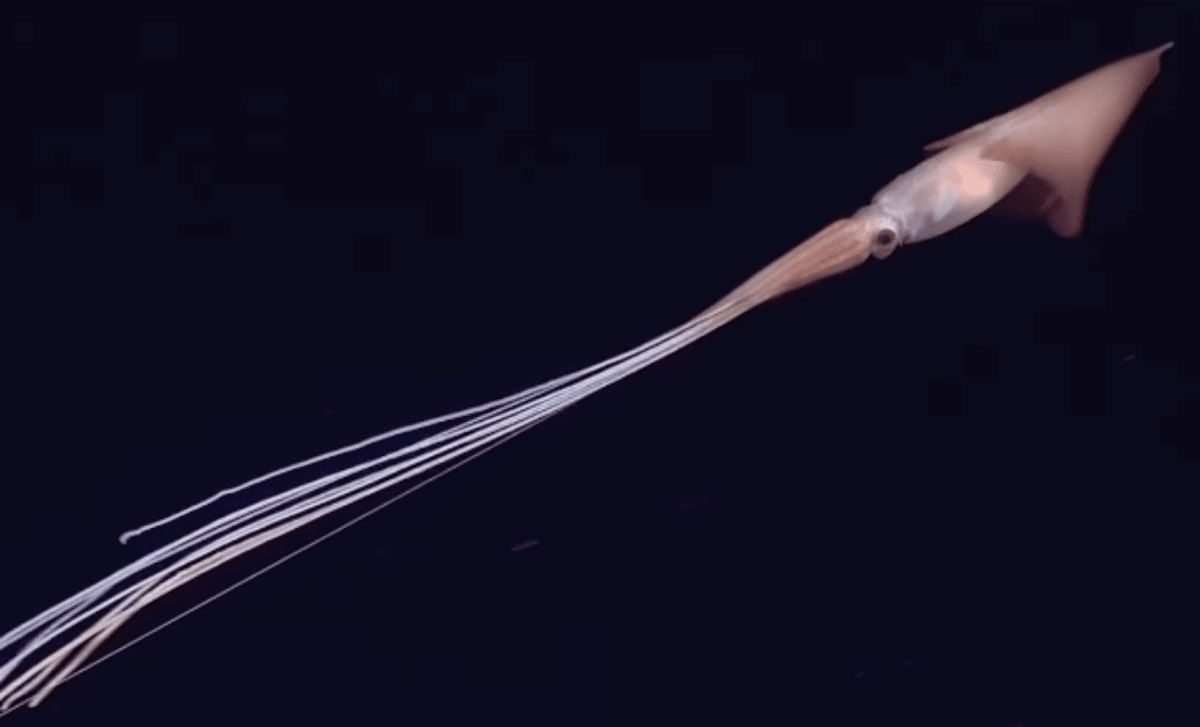
One of the rarest animals in the deep ocean has been captured in extraordinary detail after researchers recorded two giant bigfin squid swimming together more than 4,300 meters (14,100 feet) beneath the Atlantic Ocean. The remarkable footage, released by the Schmidt Ocean Institute, provides one of the clearest views ever obtained of these elusive cephalopods and marks an exceptionally uncommon observation that is already drawing attention from marine scientists around the world.
A Once-In-A-Lifetime Encounter in One of the Atlantic’s Least Explored Regions
The discovery took place during an expedition to the Doldrums Fracture Zone, a remote geological region located just north of the equator where sections of the Earth’s tectonic plates meet beneath the Atlantic Ocean. This underwater landscape is defined by vast volcanic ridges, deep fractures, and rugged seafloor terrain that has remained largely unexplored despite decades of oceanographic research.
While remotely operating the research vehicle SuBastian, scientists unexpectedly encountered not one, but two members of the elusive Magnapinna genus, commonly known as giant bigfin squid. Even a single sighting is considered exceptional. Fewer than a few dozen confirmed observations have been documented worldwide since the animals were first recognized, making the appearance of two individuals in the same location an extraordinarily rare scientific event.
The footage also stands out because of its exceptional clarity. Earlier videos of bigfin squid often appeared grainy and poorly illuminated, contributing to the creatures’ reputation as eerie, almost extraterrestrial animals. The new recording presents them in sharp detail, allowing researchers and the public to observe their distinctive anatomy with far greater precision than ever before. Released by the Schmidt Ocean Institute, the video offers an unprecedented opportunity to examine one of the least understood inhabitants of the deep ocean in its natural environment.
The Giant Bigfin Squid Remains One of Marine Science’s Greatest Mysteries
The giant bigfin squid belongs to the genus Magnapinna, a name derived from Latin meaning “great fin.” The species is instantly recognizable thanks to its oversized, heart-shaped fins and remarkably long, thread-like arms and tentacles that extend for several meters below the body in graceful, almost geometric lines.
The largest documented individual measured approximately 6.4 meters (21 feet) in total length, with tentacles reaching about 6.1 meters (20 feet). Despite their impressive size, remarkably little is known about their biology. Scientists still cannot confidently explain many aspects of their feeding behavior, reproduction, growth, lifespan, or population size because encounters are so infrequent.
Currently, only three described species are recognized: Magnapinna atlantica, Magnapinna pacifica, and Magnapinna talismani. Marine biologists believe additional species may still await discovery in the world’s deep oceans, where exploration remains extremely limited. Every new observation contributes valuable information that helps researchers better understand the diversity and evolution of these unusual cephalopods.
The clear imagery from this expedition may allow scientists to examine subtle behavioral characteristics and body movements that were impossible to analyze from previous recordings. Such observations could improve future identification efforts and provide fresh clues about how these enigmatic animals survive in one of Earth’s most extreme environments.
New Footage Challenges the Creature’s “Alien” Reputation
Public fascination with the giant bigfin squid surged after a now-famous 2007 video recorded near an oil drilling operation in the Gulf of Mexico. Poor lighting, green-tinted imagery, and low-resolution cameras created an unsettling visual effect that transformed the squid into one of the internet’s most recognizable deep-sea mysteries.
The latest footage tells a different story. Instead of appearing frightening, the animals move with remarkable elegance through the dark water. Their enormous fins pulse gently while their impossibly long appendages trail behind them in delicate curves, revealing an animal that appears highly adapted to life in the deep sea rather than monstrous.
This clearer perspective demonstrates how advances in underwater imaging technology are changing scientific understanding of elusive marine life. High-definition cameras and sophisticated remotely operated vehicles are allowing researchers to document behaviors and anatomical details that remained hidden for decades. As exploration technology improves, previously mysterious species can be studied with increasing accuracy, replacing speculation with direct observation.
Every Expedition Continues to Reveal New Secrets of the Deep Ocean
The encounter also highlights how much of the deep ocean remains unexplored, even in regions that have attracted scientific attention for many years. The Doldrums Fracture Zone has been investigated because of its complex geology, yet discoveries like this demonstrate that significant biological surprises still await researchers beneath the surface.
As Dr. Aaron Micallef, Chief Scientist of the Doldrums expedition and senior scientist at MBARI, explained, “Even in the Atlantic Ocean, where plate boundaries have been studied for decades, there are still places where the first close look can reveal something entirely new.”
He added, “This expedition showed that even in one of the most remote corners of the ocean, our planet remains alive, dynamic, and full of surprises.”
Those remarks capture the broader significance of the discovery. Beyond the excitement of observing two giant bigfin squid together, the footage serves as a reminder that much of Earth’s largest habitat remains largely unknown. Every successful deep-sea expedition expands scientific knowledge, revealing ecosystems, geological features, and remarkable species that continue to reshape our understanding of life beneath the ocean’s surface.
Post a Comment for "Scientists Capture Rare Giant Bigfin Squid in Deep-Sea Discovery"