
South Africa Liberalizes FMD Vaccine Imports
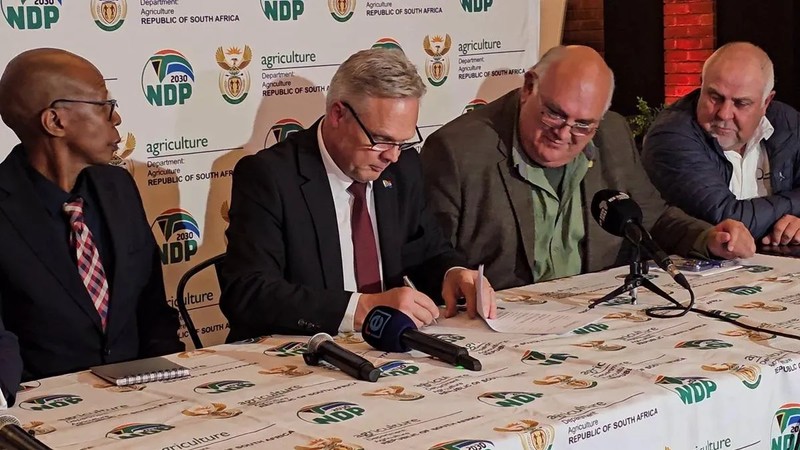
Government Ends Monopoly on FMD Vaccine Imports
The South African government has ended its monopoly over the importation of Foot-and-Mouth Disease (FMD) vaccines, allowing livestock farmers and private companies to procure and administer vaccines through a newly opened private system. This development follows a landmark settlement agreement announced in Pretoria, resolving a legal dispute between the Department of Agriculture and agricultural organizations such as Sakeliga, the South African Agri Initiative (SAAI), and Free State Agriculture.
The agreement is expected to significantly speed up access to vaccines as the country continues to deal with recurring outbreaks of this highly contagious animal disease. Agriculture Minister Willie Aucamp described the settlement as a turning point for the livestock industry, highlighting it as a new era of cooperation between the government and the private sector.
"Today's settlement is not only a win for the parties involved in the case but is a win for all South African farmers, as this sector contributes significantly to the country's job creation efforts and GDP," Aucamp stated.
Key Changes in Vaccine Distribution
Under the agreement, owners and managers of cloven-hoofed livestock will be allowed to voluntarily vaccinate their animals, provided they comply with prescribed biosecurity measures, traceability requirements, and reporting obligations. One of the most significant changes is that the Department of Agriculture and Onderstepoort Biological Products (OBP) have relinquished their exclusive rights to import and distribute FMD vaccines.
"We now need to enable the private sector to import at scale, and it is for this reason that the department and OBP have expressly relinquished sole rights to the import and distribution of FMD vaccines," Aucamp said.
He emphasized that the agreement takes effect immediately, and the government will do everything in its power to support the private sector in importing vaccines. "Going forward, the private sector will be more capacitated to import at scale so that we can get as many vaccines as possible into the country."
Importance of Partnership
Aucamp acknowledged that the government alone could not contain the disease and stressed the importance of stronger partnerships with the agricultural sector. "There is absolutely no way in which the government on its own would have been able to solve the Foot-and-Mouth Disease crisis. If we take hands with the private sector and agricultural organisations, we will be able to win this fight."
FMD affects cattle, sheep, goats, and pigs, and is one of the most economically damaging diseases in the livestock industry. South Africa has experienced repeated outbreaks in recent years, leading to livestock movement restrictions, trade disruptions, and significant financial losses for farmers.
Legal Challenge and Resolution
The legal challenge arose after farming organizations argued that limiting vaccine imports and distribution to the government and OBP delayed access to vaccines during outbreaks, preventing farmers from responding quickly enough to protect their livestock.
SAAI Chairperson Theo de Jager said the settlement removes a major obstacle that had prevented farmers from acting swiftly against the disease. "The most important player in this war is the owner of livestock... Let's get the vaccines into their hands. Let's get them registered as authorised persons. The challenge now is to get as many vaccines into the country as we can and get the shortest route between the harbour and the cattle," De Jager said.
He urged farmers to comply fully with the conditions attached to the new system. "When you apply for the vaccine, make sure you play by the rules. Five days before you vaccinate, you notify. When you do vaccinate, you scan the QR code, and within two weeks, you complete the reporting. The ball is now in our hands."
Conditions for Vaccination
Under the agreement, livestock owners wishing to vaccinate their animals will have to comply with strict conditions, including notifying authorities before vaccination, ensuring traceability of vaccinated animals, and submitting reports after the process. Farmers will also have to become authorised persons before they can obtain vaccines through the private system.
Free State Agriculture President Francois Wilken said the organizations had approached the courts in search of practical solutions rather than confrontation. "It has been a long road, but today we have reached an agreement that will change the path forward for the agricultural sector. There are no winners or losers in this court case. The only winners are the farmers and their cattle," Wilken said.
Positive Outcomes for Farmers
Sakeliga Chief Executive Piet le Roux welcomed the outcome, stating that the legal proceedings had achieved their primary objective. "The purpose of the legal proceedings was to enable farmers to vaccinate their cattle and obtain the vaccines needed for that. This has now been achieved by agreement between the parties."
Le Roux added that litigation should not be viewed as hostile confrontation but as a legitimate way of resolving disagreements. "The courts are a respected platform for settling disputes, and today's outcome shows that parties can find common ground in a way that benefits everyone."
Western Cape Agriculture Minister Ivan Meyer said the agreement demonstrated how collaboration could produce better outcomes for farmers. "What has happened here is that the rule of law and constitutionalism have come together... There is now a spirit of cooperation and partnership. Farmers can build this country if we are united," Meyer said.
Future Implications
While private companies will now be able to import and distribute FMD vaccines, the government said it would continue procuring vaccines for state vaccination programmes, particularly in outbreak areas and for farmers unable to afford privately supplied doses.
Aucamp said opening the market would encourage healthy competition while improving access to vaccines. "The more authorised companies we can get to import vaccines, the more vaccines we will have in the country," he said, adding that the new arrangement would allow the government and the private sector to operate in parallel to strengthen South Africa's response to future FMD outbreaks.
Post a Comment for "South Africa Liberalizes FMD Vaccine Imports"