
Robert Jobson: "When William Needed to Talk, Carole Was His Go-To"
A Bond Beyond Tradition: Prince William and Carole Middleton’s Unbreakable Connection
Few relationships in the modern British royal family have captured public imagination quite like that between Prince William and his mother-in-law, Carole Middleton. While the dynamics between royals and their in-laws are often scrutinized, William’s connection with Carole stands out not only for its warmth but for its depth—rooted in mutual respect, emotional support, and shared family life. This bond has evolved over more than two decades, shaped by love, loyalty, and moments of quiet solidarity during some of the most challenging chapters in the Prince’s life.
The foundation of this relationship was laid early on. As soon as William began dating Catherine Middleton in the early 2000s, he didn’t just fall for her—he embraced her entire family. According to royal commentator Tina Brown, who chronicled the inner workings of the House of Windsor in her 2022 book The Palace Papers: Inside the House of Windsor – The Truth and the Turmoil, William “adopted” the Middletons almost immediately. “Not only did he fall for her,” one acquaintance told Brown, “but them. A warm nest with a complete nuclear family and seemingly wonderfully uncomplicated.” The image painted is one of domestic harmony—Carole as the energetic, nurturing “county’s tiger mum,” Michael as the steady patriarch, and the children, including James, seamlessly integrated into a loving unit. For William, raised in a household marked by absence and complexity, this felt like a sanctuary.
It wasn’t just a matter of affection—it was a lifestyle. William reportedly preferred weekends at the Middleton home in Bucklebury, West Berkshire, over any royal residence. There, he enjoyed simple pleasures: tennis matches on the lawn, evenings watching TV, and, most importantly, Carole’s signature comfort food—cheese on toast, prepared just how he liked it. He even transferred his quadbike from Highgrove to the Middleton estate, a small but telling gesture of belonging. His presence became so regular that he joined the family on holidays, including trips to Mustique—a tropical retreat once favored by Princess Margaret and now a cherished destination for the Middletons.
His commitment to the family was further demonstrated when he chose to spend Christmas 2011 at the Bucklebury mansion instead of attending royal festivities with his own family. That decision sent a clear message: the Middletons were no longer just Kate’s parents—they were his chosen family.
When tragedy struck in 2023, with Kate’s cancer diagnosis, the depth of William’s reliance on Carole became undeniable. During what he later described as a “brutal” time, Carole was a constant presence—not only supporting her daughter but also offering solace to her son-in-law. She took him out to pubs, where they sat quietly, talking through the weight of uncertainty. These were not grand gestures, but intimate, human moments of respite. “She’s been as solid as a rock,” said royal author Robert Jobson. “When everything was falling apart and he needed someone to talk to, she was the one.”
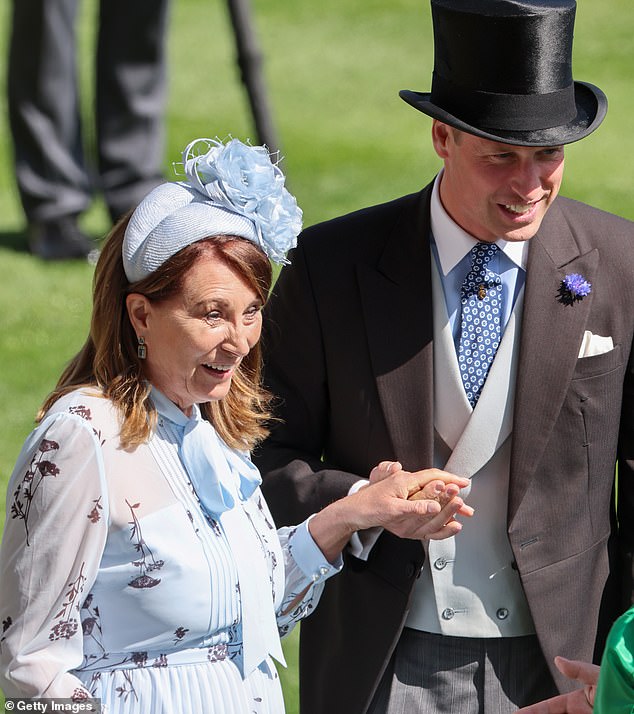
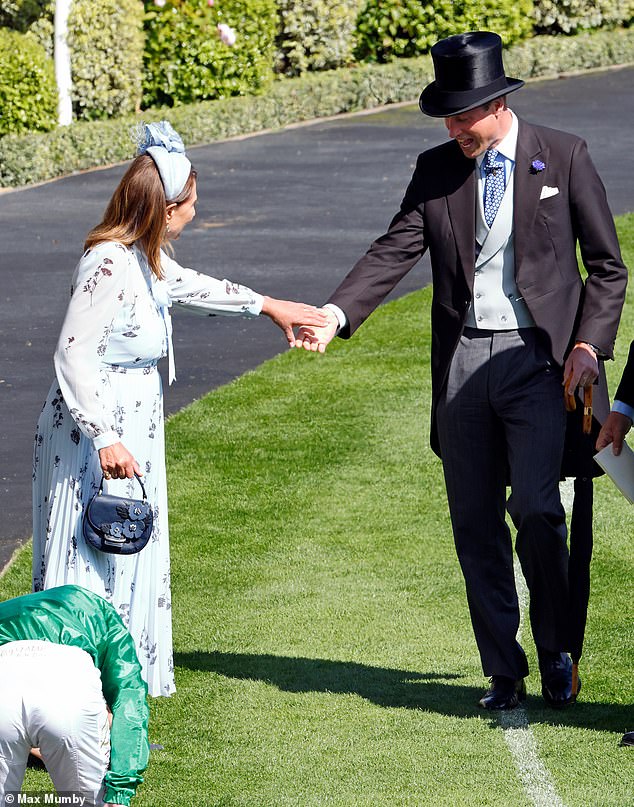
This closeness reached a poignant peak at Royal Ascot in 2024, when Carole’s heel caught in the grass. Without hesitation, William stepped forward, gently steadying her. The moment, captured in a series of charming photographs, revealed a tenderness rarely seen in formal royal settings. It wasn’t just duty—it was love. To many observers, it was clear: William viewed Carole not just as his mother-in-law, but as a second mother.
The support extended beyond emotional care. Carole and Michael played a vital role in helping William maintain his royal duties during Kate’s treatment. Their unwavering presence allowed him to continue fulfilling engagements, knowing his family was in capable hands. In April 2024, William was spotted again at a Norfolk pub with Carole—another sign of their enduring companionship. During the Easter school holidays that year, Carole stayed with the Wales family, a move that underscored her integral role in their lives.
Ingrid Seward, editor-in-chief of Majesty Magazine, emphasized the significance of this dynamic: “Carole and Michael are just as much family to William as they are to Catherine. He loves Carole being around to help as she has been with the children from the beginning… It is easy and reassuring having her invaluable help. Both with the children and keeping Catherine’s spirits up. She is a strong woman!”
The bond doesn’t end with the adults. Carole and Michael have formed deep connections with their grandchildren. They were the first to visit Prince George after his birth in 2013, and Michael famously volunteered to take the first photograph of his grandson—ensuring William and Kate could preserve the moment without external interference. In 2014, Carole accompanied the couple on their tour of Australia and New Zealand, joining nanny Maria Borrallo in caring for George.
Experts now suggest that this profound familial connection may reshape the monarchy’s future. With William’s increasing influence, there are growing indications he may “rewrite the fabric of the monarchy” to elevate the role of Kate’s parents. As Sarah Vine of the Daily Mail observed: “In the 21st century, royalty is about how you behave.” And in William’s case, that behavior is defined by love, loyalty, and a deep, abiding respect for the family he has chosen—both by blood and by heart.
The Middletons’ Enduring Influence on the Royal Family
The bond between Prince William and his parents-in-law, Carole and Michael Middleton, is not merely a matter of familial connection—it has become a defining element in shaping the modern royal family’s identity. In an era where tradition and relevance are constantly being reevaluated, the Middletons stand out as a symbol of how personal values, emotional authenticity, and family cohesion can reshape expectations within the monarchy.
Their influence was most visibly demonstrated in 2024 when Kate Middleton shared a deeply personal video message detailing her journey through cancer treatment. This three-minute clip marked a historic moment for the Royal Family—unprecedented in its raw honesty and intimate portrayal of private struggle. Unlike past royal communications, which have often been carefully curated and formal, this message broke new ground by centering on vulnerability, resilience, and love.
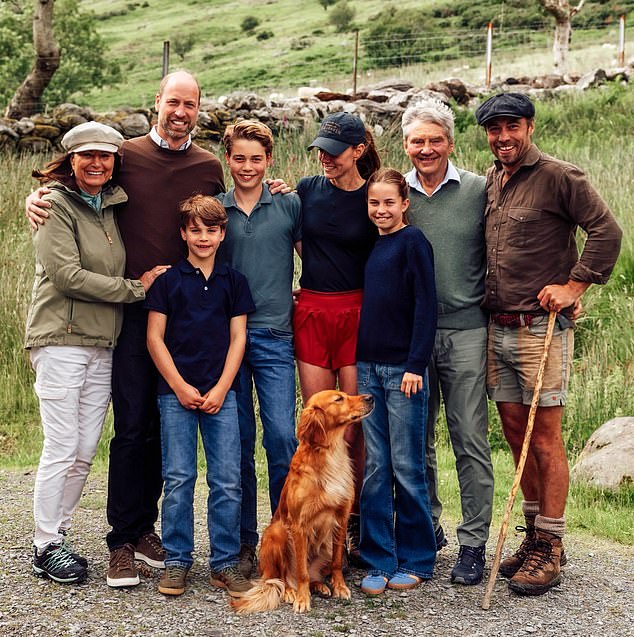
In the footage, William and Kate are seen spending time at their country home in Norfolk with their children—Prince George, Princess Charlotte, and Prince Louis. But what stood out even more was the presence of Carole and Michael Middleton, who were clearly integral to the family dynamic. The children could be seen hugging their grandparents, laughing over card games at the dinner table, and sharing quiet moments of comfort. The scene felt unscripted, warm, and deeply human—an image rarely captured in royal media.
This level of inclusion wasn’t accidental. According to Jo Elvin, former host of Daily Mail’s Palace Confidential, the decision to feature the Middletons so prominently speaks volumes about William’s values. “It just goes to show the influence that that family has on William, and how much he loves and respects them, that he doesn’t want them to be out of the loop in his family unit,” she said in the documentary The Middletons: Should They Be Working Royals?
Her observation underscores a significant shift in the monarchy’s internal structure. Traditionally, the royal family has operated with a clear hierarchy, where certain roles and responsibilities are reserved for blood relatives or those formally recognized through titles. Yet here, William chose to spotlight his in-laws—not as distant figures, but as active participants in his family life. Their presence wasn’t symbolic; it was foundational.
Still, the idea of Carole and Michael Middleton becoming official "working royals" remains highly controversial—and politically complex. Jack Royston, chief royal correspondent for Newsweek, noted that such a move would require William to “completely rewrite the entire fabric of the monarchy.” It would mean redefining what it means to be a royal, challenging long-standing norms around access, visibility, and duty.
Yet Royston also acknowledged the possibility. “But the guy does say he wants change. Anything is possible,” he remarked during a discussion on Channel 5’s The Middletons: Should They Be Working Royals?. His words reflect a growing sentiment among observers: that while the monarchy is rooted in tradition, it is not immune to evolution—especially when driven by personal conviction and public demand.
The 2024 video may have been a single moment, but it carried immense weight. It signaled that the next generation of royals is prioritizing emotional truth over ceremonial formality. It showed that family—not just lineage—is the true cornerstone of royal identity. And it revealed that William, despite the pressures of protocol, is determined to build a family culture centered on closeness, transparency, and inclusivity.
As debates continue about the future of the monarchy, one thing is clear: the Middletons are no longer just part of the background. They are now central to the narrative—one that blends personal history with national symbolism. Whether they eventually take on formal royal duties remains uncertain. But their role in shaping the heart of the royal family is already undeniable.
Post a Comment for "Robert Jobson: "When William Needed to Talk, Carole Was His Go-To""