
Why AMC’s Rebel Machine Was Killed After Just Three Years
The Rebel Machine: A Forgotten Legend of American Muscle
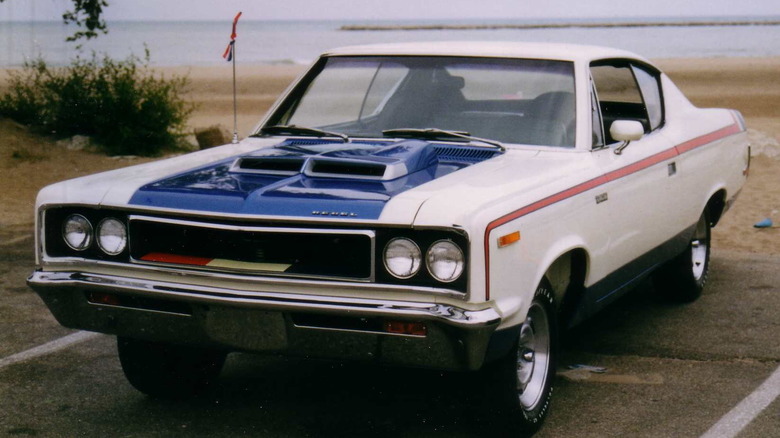
In the late 1960s, as the American muscle car era reached its peak, a bold new contender emerged from the underdog automaker American Motors Corporation (AMC). The Rebel Machine was not just another high-performance vehicle—it was AMC’s ambitious attempt to challenge the dominance of Ford, General Motors, and Chrysler in the muscle car arena. Designed for enthusiasts who wanted raw power without breaking the bank, the Rebel Machine promised performance, style, and value all rolled into one. Yet despite its impressive specs and passionate reception at launch, it would only live for a brief moment before fading into obscurity.
Launched at the 1969 NHRA World Championship, the Rebel Machine was positioned as the spiritual successor to two underappreciated but beloved AMC models: the Javelin and the AMX. It was developed in collaboration with Hurst Performance Inc., a name synonymous with racing excellence, which helped ensure that the car wasn’t just a showpiece but a serious contender on the track. With a starting price just under $3,500—remarkably affordable for a V8-powered muscle car at the time—the Rebel Machine offered an unmatched bang-for-your-buck proposition.
Its most iconic feature? The striking red-white-blue color scheme, reminiscent of the American flag. While this patriotic palette became synonymous with the model, it wasn’t the only option—owners could also choose from other vibrant shades, adding to the car’s visual appeal.
Despite being produced in limited numbers—only 2,362 units were ever built—the Rebel Machine quickly gained a cult following among muscle car aficionados. Its popularity has only grown over the decades, with collectors now recognizing it as a rare gem in the muscle car pantheon.
Under the Hood: Power That Defied Expectations
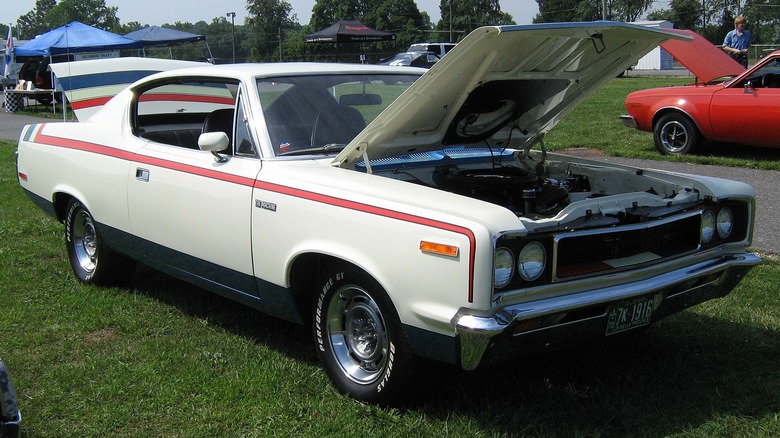
When it came to performance, the Rebel Machine didn’t hold back. At its heart was the AMC 390 V8 engine, the most powerful engine AMC had ever produced up to that point. This beast delivered 340 horsepower at 5,100 rpm and a stout 430 lb-ft of torque at 3,600 rpm, thanks to a Motorcraft four-barrel carburetor. The engine’s compression ratio stood at 10:1, a figure that reflected its high-performance orientation.
To maximize efficiency, engineers made strategic modifications to the intake and exhaust manifolds, boosting overall output. The boxy blue hood scoop wasn’t just for show—it was engineered to funnel cool, dense air directly into the carburetor, enhancing combustion and power delivery.
The powertrain was paired with a Borg-Warner 4-speed manual transmission, giving drivers full control over gear shifts. On the drag strip, the Rebel Machine could hit the quarter-mile mark in just 14 seconds, a respectable time for its era. Equipped with 5x7-inch wheels wrapped in E60/15 Polyglass Goodyear tires, the car offered strong traction and stability.
Even more impressive was the optional $500 service kit package, popular among racers. This upgrade added approximately 60 horsepower and shaved nearly two seconds off the quarter-mile time—bringing it down to around 12 seconds in ideal conditions. For a car that cost less than $3,500, this level of performance was nothing short of revolutionary.
Interior: Function Over Form
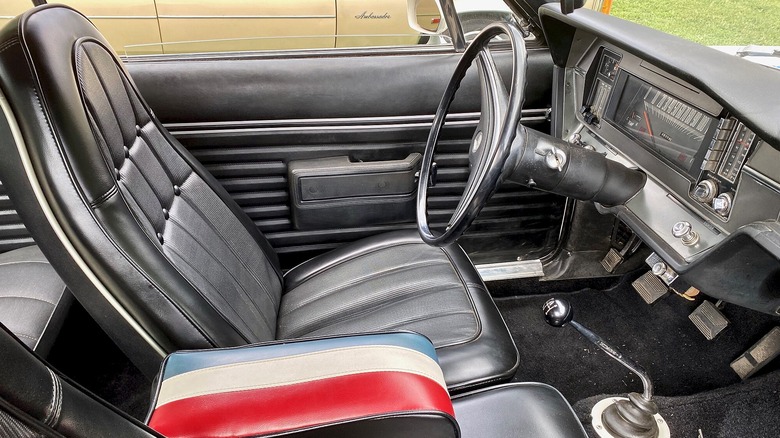
While the exterior and mechanical prowess of the Rebel Machine were undeniable, its interior told a different story. Far from luxurious or refined, the cabin leaned heavily toward function over comfort. The plain black leather bucket seats provided decent support, but the overall design felt utilitarian at best.
Plastic dominated much of the dashboard and trim, giving the cockpit a dated, budget-conscious feel. There were no premium materials, no wood accents, no plush carpets—just hard surfaces and minimal detailing. For many buyers, this lack of refinement was a drawback, especially when compared to the more opulent interiors found in competitors like the Mustang or Camaro.
Still, for those focused purely on performance, the spartan interior was a minor trade-off. The emphasis was clearly on speed, power, and track readiness—not luxury.
Why Did the Rebel Machine Disappear?
Despite its potential, the Rebel Machine never got the chance to shine for long. AMC was facing a perfect storm of internal challenges even before the car launched. Frequent labor strikes, mounting financial pressures, and constant leadership changes crippled the company’s ability to sustain innovation or scale production.
Moreover, the muscle car craze that had swept America through the '60s began to wane by the early '70s. Rising insurance costs, stricter emissions regulations, and shifting consumer preferences made muscle cars less appealing—and far more expensive—to own. Sales across the board declined, and AMC was forced to make tough decisions.
As a result, production of the Rebel Machine was halted after just 2,362 units, making it one of the rarest muscle cars of its time. Had it arrived a few years earlier—when demand for powerful, affordable performance machines was at its height—it might have become a household name.
Today, the Rebel Machine stands as a symbol of what could have been: a bold, affordable, high-performance machine from a company that dared to dream big. Though it never achieved mainstream fame, its legacy lives on in the hearts of classic car enthusiasts who appreciate its raw spirit, innovative engineering, and underdog story.
For those who seek the next great muscle car legend, the Rebel Machine remains a hidden treasure—one that deserves a second look.
Post a Comment for "Why AMC’s Rebel Machine Was Killed After Just Three Years"