
Mars Pyramid: Ancient Egyptian Echoes
The dusty, rusty planet of Mars might seem like a barren wasteland at first glance, but beneath its arid surface lies a dynamic world with geological phenomena that continue to captivate scientists and spark the public's imagination. Much of what makes Mars so intriguing revolves around its rocks. The Red Planet is abundant in rocky formations that have been subjected to countless eons of weathering, occasionally resulting in structures that, with a bit of imaginative interpretation, can resemble artificial or even biological formations. This phenomenon is akin to the "monkeys and typewriters" theory: while not likely to produce a Shakespearean masterpiece, the sheer volume of random occurrences can sometimes yield results that appear surprisingly ordered or familiar.
The Candor Tetrahedron: A Martian Enigma
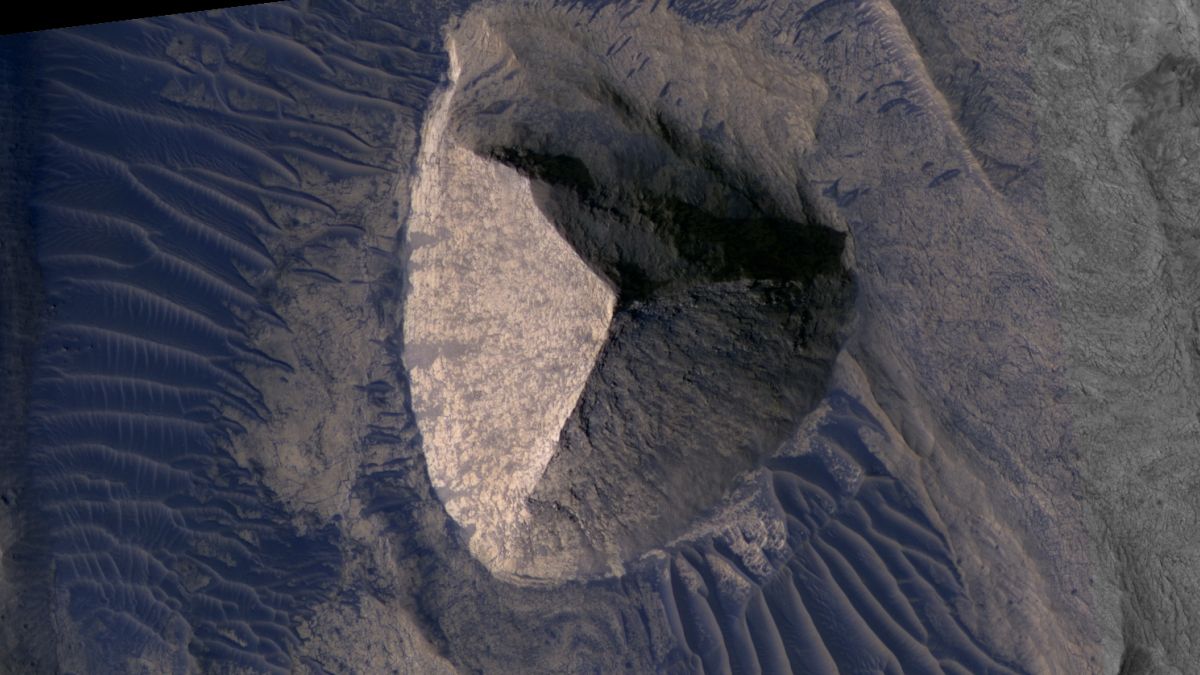
One of the most recent and widely discussed examples of this geological illusion is a striking formation dubbed the "Candor Tetrahedron." First identified in 2002, this feature is a three-sided pyramid-like structure situated within Candor Chasma, a vast canyon system on Mars.
The notion of artificial structures on Mars gained renewed attention when filmmaker Brian Cory Dobbs, known for promoting similar theories, shared images of the formation on social media. The post rapidly circulated, leading to cropped images of the pyramid appearing across various social media platforms and tabloid news outlets.
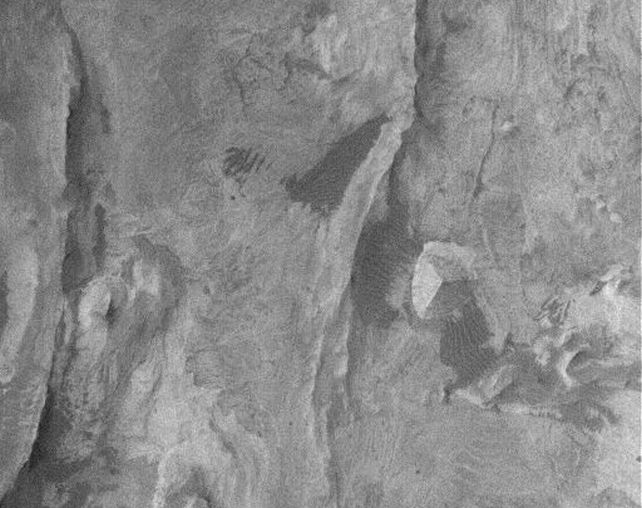
The images themselves are authentic data captured by NASA's orbiters, which first documented the region in 2001. The earliest recorded identification of this peculiar structure dates back to 2002, when independent researcher Wilmer Faust pointed out the anomaly in a Mars Global Surveyor (MGS) image designated E06-00269. While some later claims regarding earlier discoveries have been inconsistent, the "Candor Tetrahedron" has consistently remained a subject of fascination.
Unpacking the Geology: Erosion and Relief
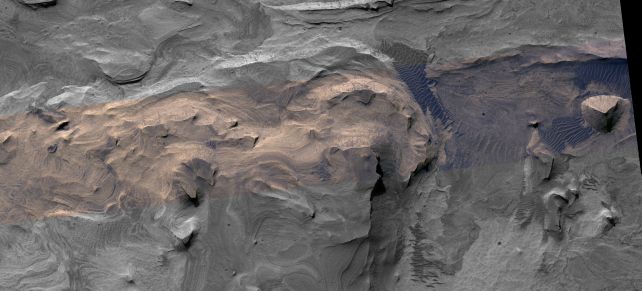
Subsequent missions have provided even more detailed views of the Candor Chasma region, notably through the high-resolution HiRISE camera aboard NASA's Mars Reconnaissance Orbiter. While these images offer stunning clarity, a broader perspective of the surrounding landscape begins to reframe the "tetrahedron." When viewed in its context, the formation appears less like an anomaly and more like a natural geological feature sculpted by the same erosional forces that shaped the immense canyons around it.
Candor Chasma is one of Mars' most extensive canyon systems, a testament to billions of years of geological activity involving water, landslides, wind, and possibly tectonic shifts. Within this grand landscape, scientists have identified geological formations referred to as "positive relief knobs." These are essentially ancient rock structures that were once buried but have proven more resistant to erosion than the surrounding bedrock. As the softer outer layers were gradually worn away, these durable rock cores were left standing, forming elevated features.
These relief knobs are not insignificant in size. They can span up to a kilometer (approximately 3,280 feet) in diameter and reach tens of meters in height. The Candor Tetrahedron, measuring around 290 meters in diameter and standing 145 meters tall, falls within this range. Its height is slightly greater than the typical knob, but it remains consistent with the broader geological pattern of layered rock being sculpted into isolated hills.
Natural Pyramids: Earthly Parallels
The concept of natural pyramid-like mountains is not unique to Mars. On Earth, numerous geological formations exhibit similar characteristics. For instance, Cerro Tusa in Colombia is a mountain that rises 457 meters above its surroundings and boasts a base spanning 1.8 kilometers. China's Guizhou province is also renowned for its breathtaking pyramid-shaped mountains, formed through natural geological processes.
The Power of Perception: Pareidolia and Martian Landscapes
A closer examination of the images reveals subtle details that further support a natural explanation for the Candor Tetrahedron. The formation is situated amidst a field of aeolian ripples – undulating ridges carved by the persistent winds of Mars, indicative of ongoing erosional processes. Furthermore, the "ridges" on the mountain are not geometrically perfect, as one might expect from an artificial construct. Instead, they appear uneven and irregular, and the three sides of the formation are not of equal dimension.
The human brain is remarkably adept at pattern recognition, a trait that can lead us to perceive meaning in random data. We are particularly inclined to identify shapes resembling faces or human figures, but geometric forms and structures can also capture our attention. This psychological phenomenon, known as pareidolia, plays a significant role in how we interpret ambiguous visual information.
However, Mars possesses an inherent fascination that transcends the need for embellished interpretations. Its unique geology and prevailing weather patterns have forged landscapes that are simultaneously familiar in their stark beauty and utterly alien compared to anything found on Earth.

Thanks to advanced technologies like the Mars Reconnaissance Orbiter, we are able to explore these alien terrains with unprecedented detail. These sophisticated instruments allow us to virtually traverse the soaring cliffs and rugged expanses of Mars, imagining ourselves standing amidst landscapes where, for billions of years, only the relentless winds have echoed.
Post a Comment for "Mars Pyramid: Ancient Egyptian Echoes"