
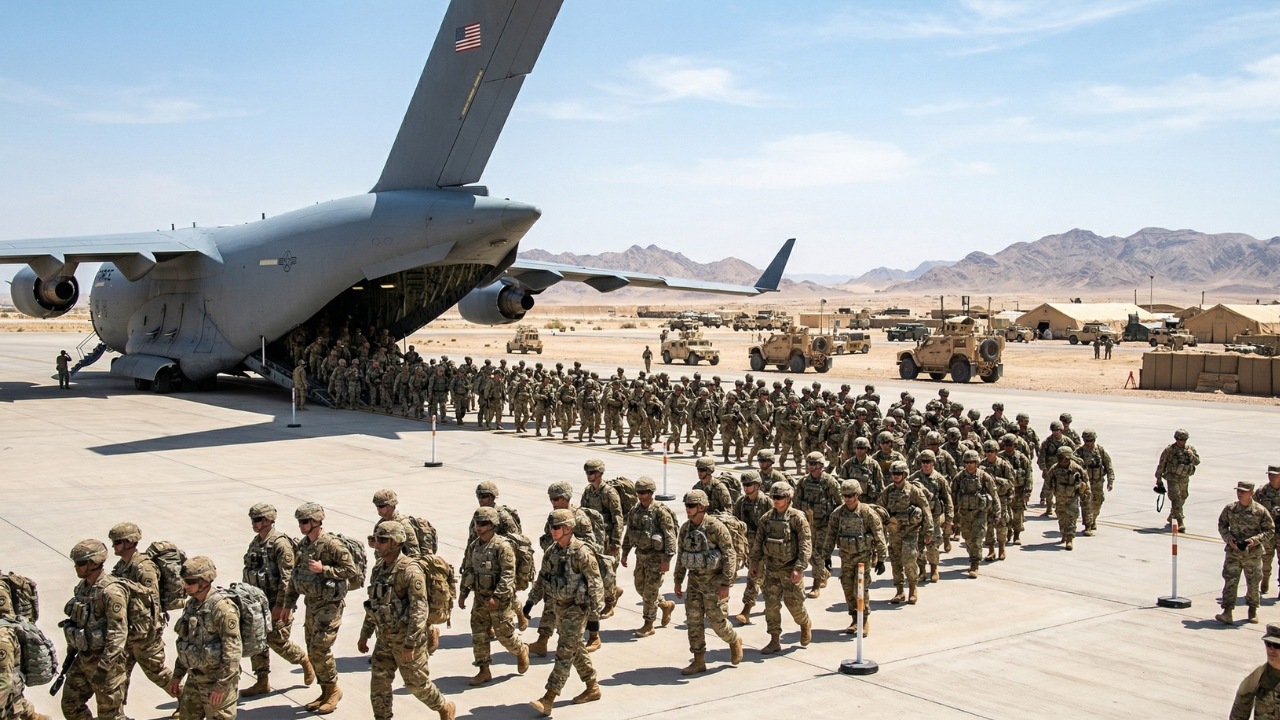
 Thousands of American soldiers, part of the U.S. Army’s 82nd Airborne Division, are now arriving in the Middle East. This significant deployment comes as the Trump administration contemplates its next steps in the ongoing conflict with Iran. The arrival of these airborne troops adds to an already substantial reinforcement effort, which includes thousands of sailors, Marines, and Special Operations forces. This build-up provides Washington with a wider array of military options at a critical juncture, as the conflict becomes increasingly perilous and less predictable.
This is far from a routine troop rotation. The incoming force comprises elements of the 82nd Airborne Division headquarters, essential logistics and support personnel, and a full brigade combat team. These paratroopers, typically based at Fort Bragg in North Carolina, signal Washington's intent to have ready forces in place, beyond mere symbolic presence, should the crisis escalate further.
A Substantial Reinforcement, Not Merely a Warning
The latest deployment follows a broader U.S. military build-up that has been underway for several days. Approximately 2,500 Marines arrived in the Middle East over the preceding weekend, with additional sailors, Marines, and Special Operations forces also being dispatched to the region. Collectively, these movements indicate a deliberate strategy by Washington to establish a more robust military presence around Iran, rather than relying solely on distant airstrikes and naval pressure.
The significance of this troop deployment lies in its ability to alter the dynamics of a crisis. While air and naval campaigns can convey messages and inflict damage, the presence of large ground formations suggests preparedness for a wider spectrum of contingencies. Even without an explicit order to enter Iran, positioning troops in proximity grants the White House greater flexibility and heightens the perception of potential escalation. This build-up appears designed to broaden operational choices.
Potential Roles for Deployed Troops
While no definitive decision has been made to deploy U.S. troops into Iran, sources suggest the build-up is intended to enhance capacity for potential future operations within the region. These options reportedly include ambitious missions such as seizing Kharg Island, the central hub for approximately 90% of Iran's oil exports, or deploying ground forces within Iran to secure highly enriched uranium. Another possibility is assisting in the safe passage of oil tankers through the Strait of Hormuz, which could involve deployments near Iran's coastline.
These are not minor or low-risk undertakings. Kharg Island, for instance, is vulnerable to Iranian missiles and drones, making any attempt to capture it an exceptionally hazardous endeavour. A mission to extract uranium would also entail significant risks, potentially placing American troops deeper within Iranian territory for extended periods, particularly if the material is stored underground and difficult to access.
Trump's Strategy: Maintaining Ambiguity and Options
The troop build-up aligns with the administration's overarching strategy of applying pressure while maintaining a degree of ambiguity. President Trump has indicated ongoing discussions with a "more reasonable regime" in Tehran, while simultaneously reiterating threats of action against Iran's oil wells and power plants if the Strait of Hormuz is not reopened. This approach underscores a dual strategy of diplomatic engagement backed by a visibly expanding military presence.
This pattern was reiterated recently, with the Defence Secretary suggesting that the coming days would be "decisive" in the conflict. He warned Tehran that the conflict would intensify if a deal was not reached, while also affirming President Trump's willingness to pursue an agreement but also readiness to continue hostilities if Iran did not comply.
Political Ramifications at Home
Beyond the military considerations, the deployment carries significant political weight domestically. Any deployment of U.S. ground troops, even for limited missions, could present substantial political risks for President Trump. Public support for military action against Iran is reportedly low, and Trump had pledged during his election campaign to avoid further entanglements in the Middle East. Consequently, each new troop arrival is not just a strategic battlefield manoeuvre but also a political signal. It suggests the administration may be inching closer to the very type of conflict Trump had previously sought to avoid.
Furthermore, the costs associated with the ongoing operations are already mounting. Since operations commenced on February 28th, the United States has reportedly struck over 11,000 targets as part of Operation Epic Fury. More than 300 U.S. troops have sustained injuries, and 13 service members have lost their lives. These figures clearly indicate that, from Washington's perspective, this is no longer a low-cost or low-visibility operation.
A War Expanding Across the Region
The current military build-up is occurring within the context of a conflict that has transcended direct strikes between the U.S. and Iran. The hostilities have, in fact, spread across the wider region. Iran has issued threats against U.S. companies, attacks on merchant shipping in the Gulf have continued, and fighting involving Hezbollah persists. Furthermore, Iran-aligned Houthi forces have joined the conflict by launching attacks towards Israel. Iran has also reportedly fired upon targets in Gulf Arab states where U.S. bases are located.
This broader regional landscape helps to contextualise Washington's substantial reinforcement efforts. The newly arriving troops are not entering a stable environment with a single active front. Instead, they are being deployed into a conflict zone that now impacts oil shipping routes, allied nations, U.S. military installations, and commercial interests spanning multiple countries.
The Crucial Question: What Are the Troops Preparing For?
Perhaps the most significant aspect of the current reporting is the undisclosed exact destination of the deployed soldiers. This uncertainty is crucial; it suggests the administration is prioritising flexibility and strategic ambiguity as it deliberates the force's purpose. Is the primary aim deterrence, support for existing operations, or the enablement of a much larger offensive should President Trump give the command?
As of now, the United States has not announced any plans for a ground invasion of Iran. However, the arrival of thousands of additional troops makes one point unequivocally clear: Washington is preparing for a conflict that possesses the potential to escalate in ways far more dangerous than initially anticipated. The war is already deepening, and this build-up indicates that the Pentagon is ensuring it has the capacity to expand operations further if necessary.


No comments:
Post a Comment