
CrowdStrike NG-SIEM: Design Effective Detection Rules
 Security teams leveraging modern Security Information and Event Management (SIEM) platforms quickly encounter a significant challenge: data inundation. Events stream in from a multitude of sources, including endpoints, identity systems, cloud workloads, network devices, and SaaS applications. While each event might initially appear important, the sheer volume can make triaging alerts a daunting task, with most alerts often resolving to routine activity. This is precisely why detection engineering is so crucial. Raw data, in its unrefined state, offers little practical value. Security teams require meticulously crafted rules that effectively highlight suspicious behavior without overwhelming their analysts.
The process of designing effective detection rules within the CrowdStrike NG-SIEM platform becomes particularly relevant due to its capacity to ingest vast quantities of Falcon data alongside a wide array of third-party data sources. The true power of such a platform is unleashed when its detection logic transforms these disparate signals into actionable, meaningful alerts. This isn't merely an academic exercise; poorly constructed rules lead to alert fatigue, while well-designed rules surface genuine attacker activity. The fundamental difference often lies in the sophistication of the detection logic.
Understanding Detection Rules in CrowdStrike NG-SIEM
Before delving into the practicalities of designing detection rules in CrowdStrike NG-SIEM, it's essential to grasp their fundamental function within the platform. CrowdStrike NG-SIEM acts as a sophisticated detection and correlation layer, operating over extensive datasets. It aggregates data from Falcon sensors, identity management systems, network monitoring tools, cloud infrastructure, and various external security products. Detection rules then analyze these incoming events in near real-time, searching for patterns indicative of malicious behavior.
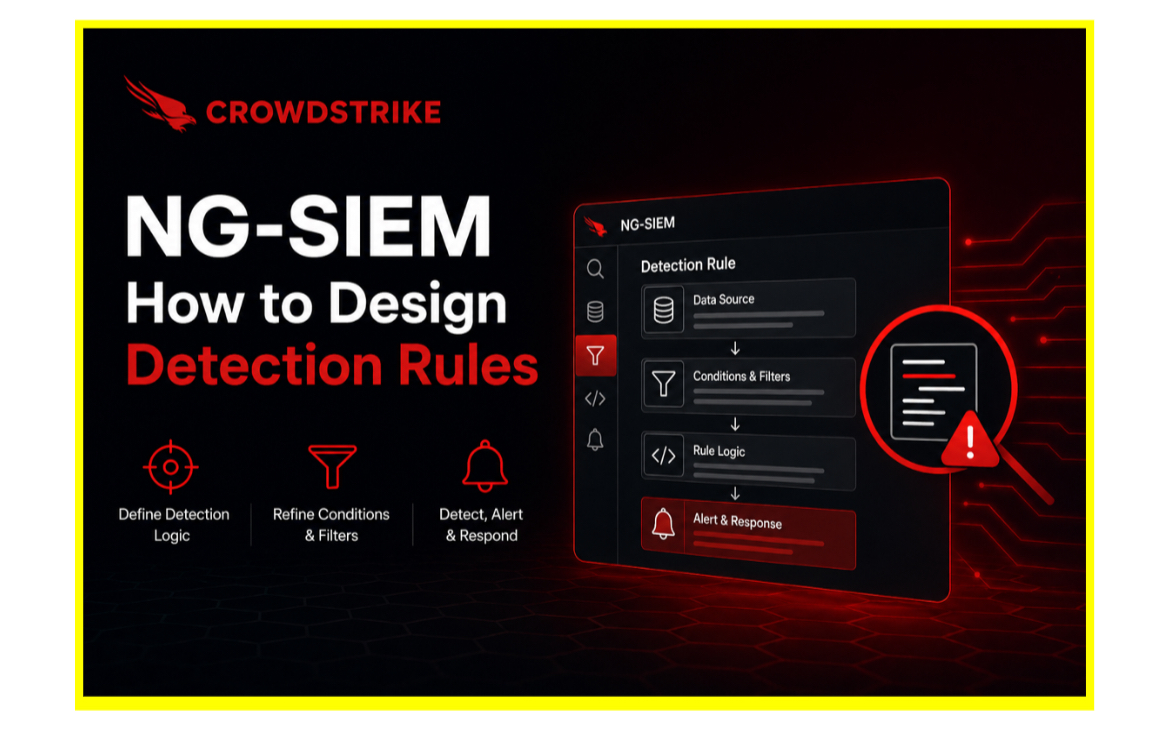
A typical detection rule comprises several key components:
- Event Source or Dataset: Specifies where the data originates.
- Filtering Logic: Narrows down the data to relevant events.
- Behavioral Conditions: Defines the specific actions or sequences of actions that are considered suspicious.
- Thresholds or Aggregation: Sets limits for event frequency or groups related events.
- Alert Generation Logic: Determines when and how an alert is triggered.
These rules examine incoming data, actively seeking patterns that signal malicious intent. These patterns can represent known adversary techniques, deviations from normal behavior, or combinations of activities that are highly unlikely to occur together in legitimate operations. In practice, detection rules rarely rely on a single, isolated event. Instead, they often correlate multiple signals to build confidence before generating an alert.
Consider this illustrative example: a rule might trigger if all of the following conditions are met:
- A suspicious PowerShell command is executed on an endpoint.
- The same endpoint subsequently contacts a known malicious domain.
- A privileged account logs into the system shortly after these events.
Individually, any one of these events might not raise significant concern. However, when observed in sequence and in combination, they become a strong indicator of potential compromise.
The Paramount Importance of Detection Engineering in NG-SIEM
Security teams often implement SIEM platforms with the expectation of immediate, comprehensive visibility into their environments. The reality, however, is often less straightforward. Without meticulous tuning and well-designed rules, SIEM environments can rapidly become overwhelmed with thousands of low-value alerts. The issue, more often than not, lies not with the platform itself but with the underlying rule logic.
When considering how to design detection rules in CrowdStrike NG-SIEM, the primary objective transcends simply detecting threats. The true goal is to identify and surface actionable signals that security analysts can effectively investigate. Several operational realities heavily influence this endeavor:
- Massive Data Volumes: The sheer scale of data generated creates inherent noise that must be filtered.
- Environmental Diversity: Different organizational environments exhibit unique behavioral baselines, requiring tailored detection strategies.
- Evolving Attack Techniques: Adversaries continuously adapt their methods, necessitating dynamic and adaptable detection rules.
Consequently, effective detection rules demand both deep technical knowledge and a keen understanding of operational realities. Security teams must possess a thorough grasp of attacker behavior, normal system operations, and the intricate workings of their organization's infrastructure. Only then can they create rules capable of reliably differentiating malicious activity from legitimate operations.
Mapping Detection Logic to Adversary Behavior
Detection rules achieve significantly greater effectiveness when they are architected around adversary techniques rather than isolated, ephemeral events. The MITRE ATT&CK framework frequently serves as an invaluable reference point for this approach. Instead of focusing on detecting specific commands or processes, rule logic can be designed to target behaviors directly associated with particular adversarial techniques.
For instance, a detection rule could be centered on:
- Credential dumping activities.
- Suspicious utilization of administrative tools.
- Patterns indicative of lateral movement across the network.
- Unusual authentication behaviors.
By anchoring rule logic to established attacker tactics, the process of how to design detection rules in CrowdStrike NG-SIEM helps to prevent the creation of narrow or fragile detections that are easily bypassed. A rule built on observable behavior is more likely to remain effective even if attackers alter their tools or command syntax. This behavioral-centric approach also facilitates a more organized and strategic approach to detections within the broader Security Operations Center (SOC) strategy.
Key Stages in Designing Detection Rules in CrowdStrike NG-SIEM
The process of designing effective detection rules involves several practical, sequential stages. The workflow described below reflects how many mature detection engineering teams structure their efforts:
-
Define the Threat Scenario: Every detection rule should originate from a clearly articulated threat scenario. The objective is to precisely understand what specific attacker activity the rule aims to detect. Examples might include suspicious privilege escalation attempts or the abnormal creation of services on endpoints. Vague threat descriptions invariably lead to weak and ineffectual rule logic.
-
Identify Relevant Data Sources: The subsequent step involves pinpointing which telemetry sources contain the necessary signals to detect the defined threat. Within CrowdStrike NG-SIEM, this could encompass Falcon endpoint data, authentication logs, cloud platform events, or network telemetry. Without reliable and comprehensive telemetry, even the most brilliantly designed rules are destined to fail.
-
Build Detection Logic: This critical stage translates the conceptual threat scenario into concrete query logic. Conditions typically include event filters, command patterns, behavioral indicators, and relationships between events. Detection engineers often engage in iterative experimentation, exploring multiple query variations before settling on a stable and effective rule.
-
Add Context and Correlation: Relying on single events seldom provides sufficient confidence for triggering an alert. Effective detection rules achieve greater accuracy by correlating multiple signals. CrowdStrike NG-SIEM offers robust capabilities for aggregation, sequence detection, and contextual enrichment, all of which serve to strengthen detection accuracy.
-
Test Against Historical Data: Rigorous testing is absolutely critical. Analyzing historical event data helps to ascertain whether the rule generates excessive noise or, conversely, misses relevant signals. Detection engineers frequently adjust thresholds and filters multiple times during this crucial testing phase.
-
Deploy and Monitor: Once a rule is deployed into the production environment, continuous monitoring is essential. Analysts review the generated alerts and provide feedback. The detection logic is then iteratively refined based on real-world operational experience. This iterative process is fundamental to mastering how to design detection rules in CrowdStrike NG-SIEM effectively.
Common Pitfalls in Detection Rule Design
Detection engineering can easily devolve into overly complex logic or poorly tuned alerts. Several common problems frequently emerge across SIEM environments:
- Overly Broad Rules: These rules capture an excessive number of events because their filters are not sufficiently precise. This forces analysts to spend valuable time investigating routine system activity, diminishing their efficiency.
- Tool-Specific Detections: Rules that focus on a particular malware family or a specific command string are easily circumvented. Attackers simply modify their tools slightly, rendering the rule obsolete.
- Ignoring Environmental Context: Detection rules that fail to account for environmental specifics often generate false positives. Administrative scripts, automation platforms, and routine IT maintenance tasks can trigger alerts unless properly excluded or accounted for.
Understanding these common pitfalls is key to improving how to design detection rules in CrowdStrike NG-SIEM in a manner that ensures long-term stability and effectiveness. Detection logic should remain adaptable and firmly grounded in observable behavior rather than relying on ephemeral, easily changed indicators.
Tuning Detection Rules for Real-World Environments
A detection rule rarely performs perfectly upon its initial deployment. Most rules necessitate subsequent tuning as analysts begin to interact with real-world alerts. This tuning process typically focuses on three primary areas:
- Noise Reduction: Security teams refine filters or adjust thresholds to eliminate expected, legitimate activity that might otherwise trigger alerts.
- Enrichment: Additional contextual information is integrated to enhance the speed and efficiency of investigations. Details such as host information, user identity, or asset criticality can significantly aid analysts in rapidly understanding the nature of an alert.
- Rule Refinement: Detection engineers may expand the rule logic to incorporate additional behavioral patterns that are discovered during incident investigations.
Continuous tuning is an indispensable component of maintaining an effective detection program. It plays a central role in refining the approach to how to design detection rules in CrowdStrike NG-SIEM as the operational environment evolves.
The Role of Detection Engineering in SOC Maturity
Modern Security Operations Center (SOC) operations increasingly rely on detection engineering as a core discipline. Security teams recognize that SIEM platforms alone do not inherently possess detection capabilities. Skilled analysts and engineers are required to build, test, and maintain the crucial detection logic.
In mature SOC environments, detection engineering operates as a continuous, cyclical process:
- Threat intelligence provides hypotheses for new detections.
- Detection engineers develop rules based on identified attacker behaviors.
- Analysts investigate alerts and provide critical feedback on their efficacy.
- Rules are continuously improved and refined over time.
This feedback loop directly enhances the effectiveness of how to design detection rules in CrowdStrike NG-SIEM, ensuring that detections remain relevant as attacker techniques advance. Detection engineering thus evolves into a dynamic operational capability rather than a static, one-time configuration task.
In conclusion, understanding how to design detection rules in CrowdStrike NG-SIEM is less about the intricacies of query writing and more about a deep comprehension of attacker behavior, available telemetry, and established operational workflows. Truly effective detection rules are rarely generated from generic templates; they are meticulously crafted through careful observation, rigorous testing, and constant refinement. Security teams that invest diligently in detection engineering typically witness significantly improved outcomes from their SIEM platforms. Alerts become more meaningful, investigations accelerate, and analysts dedicate less time to sifting through extraneous noise. However, the creation and ongoing maintenance of high-quality detection rules demand both platform expertise and practical, hands-on experience in threat detection. With a robust detection strategy in place, SIEM platforms transform from mere data collectors into potent, real-time security detection systems.
Post a Comment for "CrowdStrike NG-SIEM: Design Effective Detection Rules"