
Harley-Davidson announces "Back to the Bricks" business plan
The new CEO's plan for turning things around
Harley-Davidson announced its first quarter of 2026 results, with yet another revenue decline, and a year-over-year decrease in Q1 net income from $133.1 million to $24.8 million.
The results were not unexpected, as the company's downward trending figures have been much discussed, though it did come with some positive news in a net increase of 8% in retail motorcycle sales, and dealer inventory levels are down 22% year-over-year, even factoring the delivery of new 2026 model year products.
Read More:
- Harley-Davidson Is Bringing Back the Air-Cooled Sportster For 2027
- 2027 Harley-Davidson Sprint Won't Reach Sub-$6,000 Target Price
What mattered more than the latest balance sheet is the much anticipated new business plan from recently-appointed Chief Executive Officer Artie Starrs. Like predecessors Mark Levatich's "More Roads" plan, and Jochen Zeitz's "Rewire" and "Hardwire" plans, Starrs' strategy has a fancy name: "Back to the Bricks", a reference to the nickname of Harley-Davidson's Juneau Avenue headquarters in Milwaukee, "the Bricks." We've already reported on two important parts of the new plan in the return of the Sportster 883 and the new Sprint 440.
The More Roads plan was ambitious, perhaps too much so, with Harley-Davidson making bold moves to reach a broader audience by introducing the Revolution Max platform and the Pan America adventure bike, investing into electric motorcycles, and partnering with QJ Motors for what eventually became the X350. Zeitz replaced Levatich when the More Roads plan wasn't working as well as some members of Harley's board liked, and he introduced the Rewire to reset the playing field, followed by the Hardwire plan. That plan put more focus on the core large cruiser and touring motorcycle segments, and making Harley-Davidson an aspirational brand with premium prices.
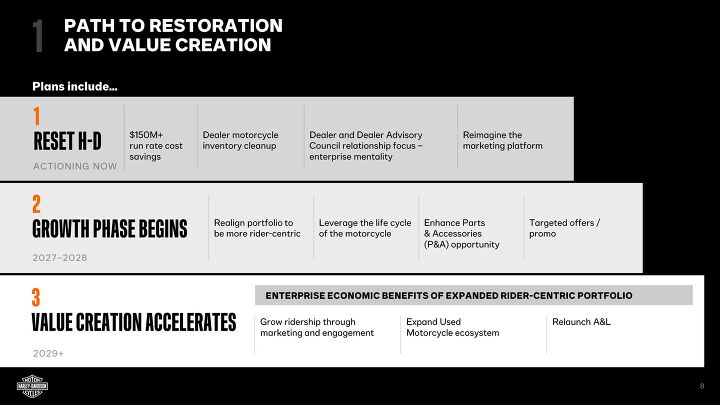
If we were to put Starrs' Back to the Bricks somewhere on a spectrum between Levatich and Zeitz's visions, it would probably be closer to the More Roads plan, but with one key difference. Like Levatich, Starrs has a goal of attracting customers with several new models over the next three years, but in a more conservative and "rider-centric" approach, filling gaps in the existing motorcycle lineup with more affordable products.
And by "products," Starrs means both brand new models and new trim levels of existing models. The new models will also be based on existing engines and platforms, which allows for product expansion without too much capital investment. Harley-Davidson is planning for 20 new models and trims over the next three years, with the graphic below showing how the 2027 and 2028 model years will fill out.
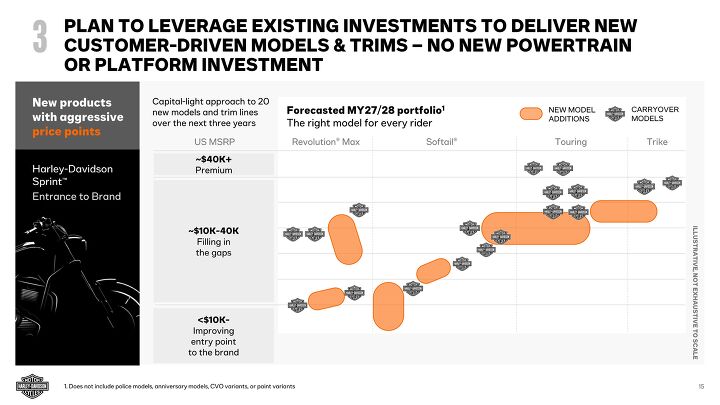
A couple of caveats about this graphic: a) it does not include CVO models, police models, or other special editions, and b) the price points are not drawn to scale, and c) the graphic is not exhaustive, meaning there will be other models and trims that aren't included. That said, we can make some inferences.
Starting from the right, it looks like Harley-Davidson will introduce at least one entry-level trike that will be priced below the $35,399 Road Glide 3. A new Freewheeler is the obvious option, as the fairing-less model didn't survive the change to the new trike platform. For the Touring family, we can probably expect some stripped down Street Glide and Road Glide trims, and perhaps the return of the Road King which was dropped from this year's lineup.
Looking at the Softail lineup, we can probably expect something to fill the price gap between the $14,999 Street Bob and the $18,999 Low Rider S. The orange region straddling the $10K priceline presumably includes the new Sprint and Sportster.
The Revolution Max column shows the widest price discrepancies of any of Harley-Davidson's product families, with the 975cc Nightster ($9,999) and Nightster Special ($12,499) priced well below the 1,250cc Pan America Special and ST ($19,999 each). The forecasted portfolio seems to call for another new 975cc model and likely a few new 1,250cc models falling somewhere in the $15,000 range. The Sportster S currently fills that slot, but we expect it will be repackaged in some fashion, and get a new name with the return of the air-cooled Sportster.
One of the keys to the Back to the Bricks plan is a focus on dealer economics. A couple of times during his presentation, Starrs emphasized that "when dealers win, we win." The 22% drop in dealer inventory mentioned earlier is a vital first step, as the sheer volume of unsold new motorcycles on the showroom floor was sinking dealerships in financing debt. In the first quarter of 2026, there were a total of 43,700 bikes and trikes, compared to 55,700 in the same quarter of 2025, and 68,900 in Q1 2024.
Once dealerships return to a healthier state, the Bricks plan calls for a more holistic approach to the OEM/Dealer relationship, recognizing that both parties rely on different levels of revenue streams. Zeitz's plan focused primarily on wholesale and retail motorcycle margins, with less attention to parts and accessories. The new plan looks for more opportunities for revenue across the life cycle of a motorcycle.
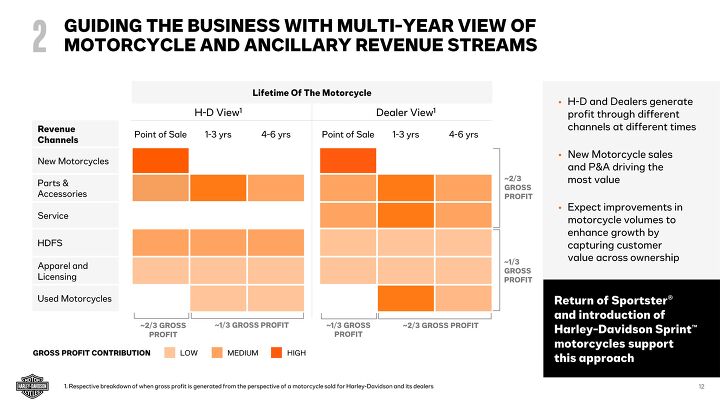
Starrs' plan calls for several dealer-centric actions including new promotional and incentive opportunities, standardized delete rebate programs, and a stronger relationship between Harley-Davidson and the Dealer Advisory Council.
Another important step is a revamped e-Commerce strategy. During Zeitz's tenure, dealers complained that Harley-Davidson's online store was cutting them out of a lot of sales and foot traffic, as customers could get products delivered straight to their homes. After Starrs took over in October 2025, one of the first things he did was stop online deliveries. Going forward, Harley-Davidson's store will shift to a "Buy Online, Pick Up In-Store" model, generating more traffic to dealerships, and more opportunities for further sales.
Harley-Davidson will also be introducing what it calls "blank canvas" models, new stripped down models that are designed for personalization. The new Sprint and the returning Sportster are prime examples, with both models offering customers opportunities to upgrade them however they like. This helps to first lower the starting price of these new models, and create secondary revenue streams years after the initial sale. We've already seen the beginnings of this plan in action with the introduction of solo trim options for existing models, and we can expect more blank canvas trims to flesh out the forecasted ‘27/'28 portfolio graphic mentioned earlier.
Starrs says Harley-Davidson will also be expanding its parts and accessories offerings, reinstating approximately 30% of previously discontinued products.
Another important aspect of the Back to the Bricks plan is a reset of the brand's image. In the past, Starrs has commented on how Harley-Davidson's marketing has been taking itself too seriously, and lacking the sense of fun and personality the brand showed in the past.
The new RIDE brand campaign, which launched last month, puts more emphasis on the joy of riding, with less focus on the motorcycles themselves and more on the riders and experiences they share. The goal is to breathe new life into the brand image, including an emphasis on the classic logo with "MOTOR" above, and "CYCLES" below the bar with "Harley-Davidson" instead of the wordless Bar and Shield.
Starrs was brought in to reverse Harley-Davidson's fortunes, bringing an outsider perspective from someone with more business than motorcycle experience. He has already taken several steps to reset the company's culture, but with the new RIDE campaign and reversing past work from home initiatives (bringing staff literally "back to the Bricks"). The first quarter figures were not great, but they reflected planned strategies to offer incentives to clear inventory, which explains the drop in revenue despite modest growth in sales volume. We won't really know if the Back to the Bricks plan will succeed until 2028 at the earliest.
Become a insider. Get the latest motorcycle news first by subscribing to our newsletter here.
Post a Comment for "Harley-Davidson announces "Back to the Bricks" business plan"