
5G Transforms Travel on Major China Sea Route

A New Era of Maritime Connectivity
Historically, travelers faced significant challenges when it came to maintaining cellular connectivity during maritime journeys. However, this is no longer the case for those traveling between Liaoning province in Northeast China and Shandong province in East China across the Bohai Sea. Passengers can now enjoy seamless 5G connectivity throughout their entire voyage, thanks to a groundbreaking initiative launched by China.
This achievement marks the launch of the country's first large-scale, continuous maritime 5G network, which covers the critical shipping corridor connecting Dalian to Yantai. The network was introduced in June 2024 and has since provided stable, high-speed internet along the entire 150-kilometre route, significantly enhancing the travel experience for passengers.
Enhanced Travel Experience
Passengers embarking on the six-hour journey can now engage in more than just making calls. Uninterrupted video chats and high-bandwidth online activities are now possible aboard major ferries, offering a much richer experience. To understand the impact of this network, a reporter from People's Daily recently boarded a vessel to witness firsthand how this technology is transforming the way people travel.
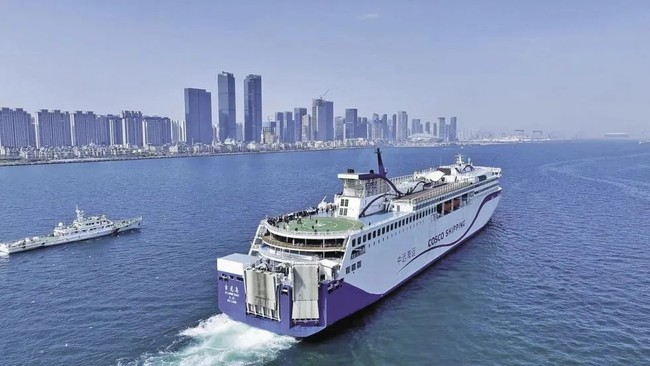
Mid-morning at Dalian Bay’s integrated transportation hub was bustling as summer travel approached. Vehicles streamed onto the lower deck of the Jilongdao, a large roll-on/roll-off (ro-ro) vessel operated by COSCO Shipping Ferry, while passengers boarded via gangways. Forty minutes later, the 208-metre-long ship departed for Yantai Port. Capable of carrying over 1,300 passengers and more than 500 vehicles, the Jilongdao is among the fastest ferries operating in Chinese waters.
Seamless Connectivity Onboard
Following the guidance of Hu Xiaofeng, general manager of COSCO Shipping Ferry, the reporter noticed a sign above a bedside table in one of the cabins that read "Passenger Wi-Fi." After connecting, messaging, photo sharing, and other online activities worked smoothly, showcasing the reliability of the network.
Transforming Passenger Experience
The upgrade has greatly enriched the passenger travel experience. Xu Hongwei, who has traveled regularly between the two regions for nearly a decade, shared her thoughts. "Before maritime 5G coverage, taking the ferry basically meant going offline for hours," she said. "I usually chose overnight sailings so I could sleep through the trip."
Since 5G coverage became available, she has increasingly opted for daytime crossings. "Now I can browse on my phone, stay connected, and enjoy the sea views along the way," she said. "I've actually come to enjoy the journey."
Operational Efficiency and Safety
Beyond enhancing passenger comfort, connectivity has significantly improved operational efficiency for crews and management. Previously, maintaining real-time communication with shore support was challenging. Today, crews can instantly access vital information on port conditions, navigation updates, cargo status, and weather, enabling better route planning and docking schedules. Medical emergencies benefit too, as shore-based medical assistance can be coordinated much faster.
For the ferry companies, it revolutionises management. "Tasks previously requiring manual forms or radios can now be handled through online systems," Hu explained, "dramatically improving our digital capability." Stable mobile payment services also facilitate a wider range of onboard retail offerings.
Perhaps most critically, the 5G network bolsters maritime emergency response. When vessels encounter difficulty, real-time distress information can be immediately relayed via the 5G network to rescue coordination centers. This enables rapid dispatch of drones, unmanned surface vessels, and other smart equipment, forming what officials describe as an integrated "smart safety net" for maritime operations.
Continuous Improvements and Expansion
"Over the past two years, this 5G network, covering more than 20,000 square kilometres of sea area, has undergone continuous optimisation and upgrading," said Li Wei, deputy director of the communications and information division of the Maritime Safety Administration's Northern Navigation Service Center. "It has truly achieved seamless capabilities for observation, communication, and data transmission."
The numbers tell the story. Following dozens of equipment upgrades, 5G coverage along the Liaoning-Shandong route has expanded by 30 percent, while signal reception strength has improved by 5 percent. Individual base stations now serve more than 2,500 users on peak days, and average daily data traffic exceeds 3 terabytes.
Stable high-bandwidth services, including messaging, voice communications, and video streaming, can be transmitted smoothly, serving more than 5 million passenger trips each year.
Future Plans for Maritime 5G
Building on this successful pilot, the Northern Navigation Service Center is working with maritime authorities in Tianjin, Liaoning, Hebei, and Shandong, as well as wireless carrier China Mobile, to expand maritime 5G coverage across the Bohai Sea.
"By making full use of existing maritime infrastructure and navigation support resources, while also leveraging offshore oil platforms, wind farms, and other facilities, we plan to build 48 additional 5G base stations across the Bohai Sea by the end of this year," Li said.
The ongoing expansion aims to deliver full, continuous 5G coverage over major Bohai Sea shipping routes, bringing reliable connectivity to even more vessels and passengers navigating China's northern waters.
Post a Comment for "5G Transforms Travel on Major China Sea Route"