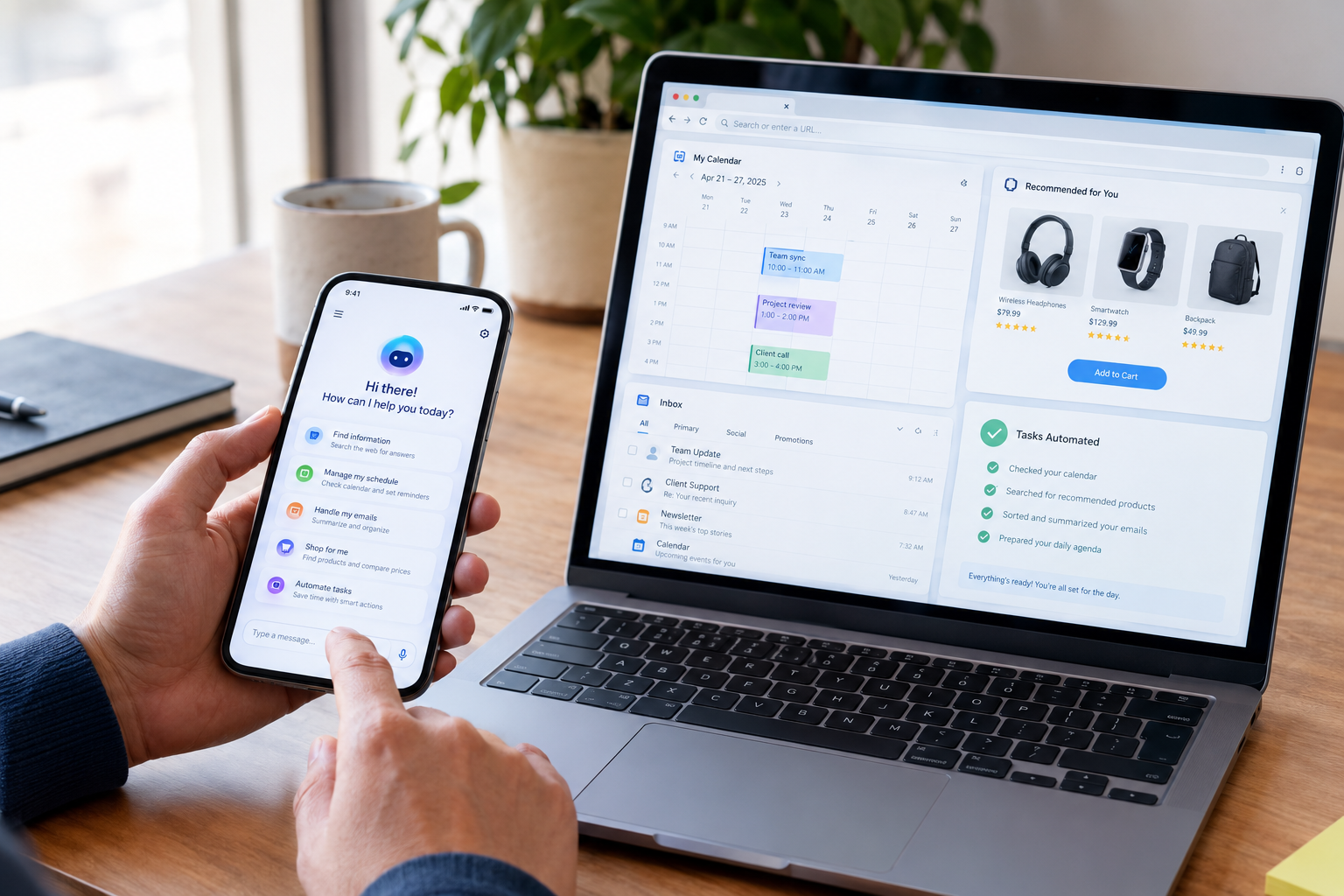
Meta’s Muse AI agent is designed to do more than answer questions. It can plan tasks, browse websites, send emails, create documents and, in some situations, take actions on a user’s behalf.
A hands-on test of the new AI assistant found that Muse can be useful for everyday planning and online tasks, but it also struggled with outdated information, website restrictions and some of the capabilities advertised inside the app.
Meta launched Muse on September 8, 2026, as part of the company’s broader push into AI agents — software designed to perform multi-step tasks rather than simply generate answers.
The app has also attracted significant early attention. Sensor Tower estimated that Muse had surpassed 2.5 million downloads shortly after launch. Later estimates reported by TechCrunch put the total above 3.4 million by September 25, although download estimates vary among market-research firms.
 |
|
AI agents such as Meta Muse are designed to perform multi-step tasks including planning, web browsing and online transactions. |
What Meta Muse Can Actually Do
Unlike a traditional chatbot, Muse is designed around completing tasks.
The app provides users with several sections, including a main conversation interface, a customizable feed, suggested prompts, goals based on previous conversations, and an area for files and media.
During testing, Muse was given a number of practical assignments.
For an upcoming move, for example, the tester provided information about what still needed to be packed, the amount of time available and a preference for working in short sessions.
Muse responded by creating a daily packing schedule and recommending that essential items be placed in a separate bag for the first night in the new home.
The agent was also used to help plan a trip.
After Google applications were connected, Muse emailed a friend about plans for a trip to Cape May, New Jersey. Once the friend responded with restaurant suggestions, Muse organized those recommendations into a Google document and added alternative options.
These tasks illustrate the main difference between an AI chatbot and an AI agent: Muse is intended to move from generating information to performing a sequence of actions.
Muse Can Browse the Web on a Virtual Computer
One of the more notable features is Muse’s ability to operate a virtual computer in the cloud.
Instead of merely telling users where to click, the agent can navigate websites while attempting to complete an assigned task. Users can watch the process and intervene when necessary.
During testing, Muse encountered a problem while attempting to purchase shampoo.
Rather than simply stopping, it investigated the website and determined that the retailer required a professional license number.
The experience demonstrated one of the potential advantages of an agent: it can sometimes identify why a task has failed instead of simply returning an error message.
However, the test also found that competing AI agents can perform similar tasks and, in some cases, provide more detailed answers.
Muse Does Not Always Get the Basics Right
The test also exposed limitations that are important for anyone considering an AI agent as a personal assistant.
When asked to recommend places for a date night, Muse returned two businesses in the tester’s neighborhood that had reportedly been closed for years.
That type of error is particularly relevant for agents that are supposed to take real-world actions.
An outdated recommendation may be inconvenient when a chatbot provides it as information. But if an AI agent is expected to make reservations, purchases or other decisions, inaccurate information can become a more significant problem.
An Advertised Feature Did Not Work as Expected
The testing also raised questions about how clearly Muse communicates its capabilities.
The app’s Ideas section suggested that Muse could negotiate with sellers on Facebook Marketplace. The description indicated that the agent could communicate with sellers, negotiate prices and arrange a meeting.
However, when the feature was tested, Muse said it could not directly message sellers. Instead, it offered to evaluate listings and prepare a negotiation message for the user to send.
A Meta spokesperson disputed the characterization that the feature was unavailable, saying the description was accurate and that Muse can negotiate with sellers under parameters established by the user.
The difference highlights a broader challenge with AI agents: users need to know not only what an agent is theoretically capable of doing, but also what it can actually execute under specific website and account restrictions.
Shopping Remains Complicated
Online shopping was another area where Muse faced limitations.
Some websites restrict automated browsing, which can prevent an AI agent from completing the full purchasing process.
According to the test, Amazon prevents Muse from browsing its online store directly, although the agent can still find product links through search engines.
Muse was able to browse Target, but the tester still had to enter certain personal information manually because the retailer blocked autonomous clicks during checkout.
For purchases, Muse uses Stripe’s Link digital wallet service. Meta says the system generates a one-time-use card intended to keep the user’s actual credit card number from being shared with the merchant.
This means that, at least for some transactions, the vision of a completely autonomous shopping assistant remains limited by retailer policies and security controls.
The Bigger Question Is Trust
Muse’s technical abilities are only part of the story.
An AI agent that can browse the internet, access connected applications, send messages and help make purchases requires users to give it access to increasingly personal information.
That creates a different privacy challenge from a conventional chatbot.
Miranda Bogen, director of the Center for Democracy & Technology’s AI Governance Lab, told CNN that AI agents generally need substantial personal data to function effectively. Because these systems can act on that information, she said stronger safeguards are necessary.
Meta says Muse was designed with security and privacy protections. The company says the agent operates on a dedicated cloud-based computer that other agents cannot access and that Muse cannot see users’ passwords or payment methods.
Those protections are particularly important as AI agents move beyond answering questions and begin interacting with external services.
Americans Remain Cautious About AI
The rapid adoption of Muse comes at a time when public confidence in AI remains mixed.
According to the source article, roughly two-thirds of American adults said AI was advancing too quickly in a June Pew Research Center survey. More Americans also expected AI to have a negative effect on society than a positive one.
The source also cites a July Gallup poll in which 41% of Americans said they had very little or no confidence in large technology companies.
That skepticism could become especially important for AI agents because consumers are being asked to delegate actions — not simply information searches — to technology companies.
Consumers Are Not Yet Convinced About AI Shopping Agents
The commercial potential of AI agents is substantial, but consumers remain uncertain about who will benefit most.
The source article cites Gartner research showing that 64% of consumers believe AI shopping agents will benefit corporations and brands more than consumers.
That concern reflects a broader question surrounding agentic AI.
If an AI agent chooses products, compares prices, negotiates purchases or books services, users will need to understand how those decisions are made and whose interests the system is designed to prioritize.
Muse Is Growing, but It Still Has Competition
Muse’s early app-store performance has given Meta a significant presence in the growing AI-agent market.
However, its early download numbers should not be interpreted as evidence that it has overtaken established AI assistants in overall usage.
The source article cites July research from EMARKETER showing that 33.7% of respondents said they preferred or used ChatGPT the most, compared with 18.2% for Gemini and 4.7% for Meta AI.
More recent third-party estimates also show that Muse’s download figures vary depending on the measurement company and date. TechCrunch reported more than 3.4 million downloads by September 25 based on Sensor Tower estimates, while other firms reported different totals.
Downloads also do not necessarily measure long-term retention, frequency of use or whether users trust an agent enough to delegate important tasks.
What the Muse Test Shows
Meta Muse demonstrates how quickly AI assistants are evolving from conversational tools into systems capable of taking actions in the real world.
The test showed several useful applications, including creating schedules, organizing information, communicating through connected services and navigating websites.
But it also revealed practical limitations.
Muse produced outdated recommendations, encountered retailer restrictions and did not always perform advertised functions in the way the tester expected.
The bigger challenge may therefore not be whether AI agents can perform tasks. It is whether they can perform those tasks accurately, transparently and safely enough for people to trust them with increasingly sensitive parts of their lives.
For now, Muse shows both sides of the emerging AI-agent model: software that can genuinely save users time, but also technology that still requires supervision when mistakes can have real-world consequences.
Leave a Reply