
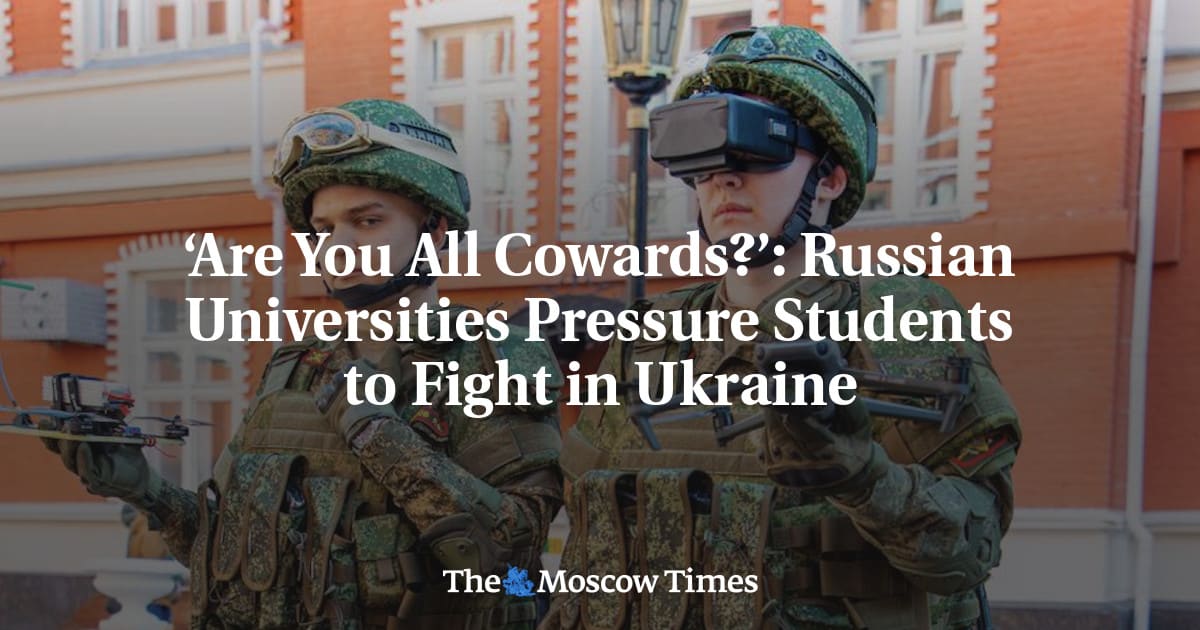
 Military recruiters have been increasingly targeting Russian universities, seeking to enlist students as drone operators and in other roles for the ongoing conflict in Ukraine. This intensified recruitment drive comes as official enlistment numbers reportedly dwindle and war casualties mount. Educational institutions, from vocational colleges to prestigious universities, are becoming a new battleground for military recruitment, with varying degrees of success and student response.
A Difficult Recruitment Pitch
At the Lunin College of Transport Technologies in Novosibirsk, Siberia, a recent recruitment event aimed at finding drone operators met with a lukewarm reception. College director Maria Kirsanova expressed her dismay, having expected students over 18 to be eager to serve their country. Her impassioned plea, captured on video, questioned students' courage and their willingness to defend their homeland, warning of the grim possibility of returning home in "zinc coffins."
This incident highlights a growing challenge for the Russian military in replenishing its ranks. While initial mass enlistment campaigns following the full-scale invasion in 2022 offered substantial financial incentives, efforts have become more targeted and assertive, particularly since January. An NGO assisting Russians in avoiding conscription, known as "Get Lost" (Idite Lesom), noted that these campaigns often coincide with academic periods.
Strategic Timing and Tactics
The timing of these recruitment efforts is often linked to the academic calendar. Military recruiters frequently leverage the winter exam season, targeting students who may be struggling academically or facing retakes. According to Ivan Chuviliaev, a spokesperson for "Get Lost," this period presents an opportune moment to approach students.
The methods employed by recruiters vary. Students are commonly invited to meetings with military representatives, where they are encouraged to sign contracts, particularly for the Unmanned Systems Forces. Some institutions request students to sign attendance sheets or formally acknowledge they have been briefed on contract terms.
"One of the arguments they use is: ‘We’ll expel you for poor performance if you don’t sign’," Chuviliaev stated, illustrating a coercive tactic sometimes used.
Beyond direct appeals, universities have also been instrumental in disseminating Defense Ministry propaganda. This includes distributing leaflets, screening patriotic films, and publishing profiles of students who have already enlisted. Student media outlet Groza estimates that recruitment campaigns have been conducted in at least 201 universities and colleges across Russia.
Recruitment Across the Academic Landscape
Advertisements promoting military service have appeared even at Moscow State University's esteemed Faculty of Journalism, situated remarkably close to the Kremlin. At Moscow Medical College No. 2, students were reportedly told in February that signing a military contract was a "ticket to life" and that new recruits would be kept away from the front lines.
Even Russia's prominent law schools are not exempt. Kutafin Moscow State Law University featured a testimonial from an anonymous student who described enlisting as an "honor" and a fulfillment of a personal calling to serve.
At Siberian Federal University in Krasnoyarsk, recruiters specifically targeted young people, suggesting they were "most suited" for drone operations due to their lifelong engagement with "cellphones and computer games."
Some universities have explicitly linked military enlistment to academic standing. The Higher School of Economics, for instance, offered students who failed their winter exams the option to sign a military contract as an "alternative to expulsion." Official notices indicated that students would be granted academic leave for the duration of the contract, with their expulsion suspended, allowing them to resume studies afterward.
Similarly, at Kazan Innovative University, director Yulia Khadiullina informed students with outstanding debts from failed exams that they were "already expelled," but that "each of you still has opportunities — the country believes in you." She framed the new army as being formed from students who could no longer be considered traditional students, implying these individuals.
Imposed Quotas and Student Skepticism
The Defense Ministry appears to be implementing recruitment quotas for universities, aiming to maximize student enlistment. Internal documents published by former rector’s adviser Marina Barinova at Far Eastern Federal University in Vladivostok indicated that the university was mandated to provide 32 students for recruitment in February alone. The independent science outlet T-invariant reported that the Russian State University for the Humanities was expected to supply 200 students for military contracts.
While a university representative later clarified to T-invariant that the institution was obligated only to "inform students about the opportunity," stating that enlistment was "entirely voluntary," the pressure to meet targets seems evident. Novosibirsk State Pedagogical University is reportedly expected to recruit 109 students by April.
However, not all university administrators are fully cooperative. A student from Yekaterinburg shared that while his university allocated class time for recruiter meetings, administrators "do not seem very willing to cooperate."
Professors generally adopt a cautious stance on political matters and are not compensated for encouraging military enlistment, according to a doctoral student who requested anonymity for her safety.
The Allure and Peril of Military Contracts
Universities and the military are enticing students with promises of a one-year service term, often in non-combat roles such as drone operators, coupled with significant financial rewards and academic benefits. St. Petersburg State University, for example, offered a one-time payment of 50,000 rubles ($596) in addition to an annual salary of up to 7 million rubles ($81,700) from the Defense Ministry, along with academic leave and flexible study arrangements. The prospect of switching to state-funded tuition upon returning from service is another incentive.
Leaked documents from the Defense Ministry to Russian universities outline instructions for offering "special terms of military service, including guarantees of being discharged from service at the end of the contract term." Kutafin Moscow State Law University advertised "guarantees of serving exclusively in Unmanned Systems Forces, as well as the option to be discharged upon the contract’s expiration if there is no desire to sign a new one."
Despite assurances of one-year contracts, rules enacted after Russia's 2022 "partial" mobilization stipulate that military contracts remain in effect until the end of the mobilization period, which has not been formally lifted. This means contracts can extend beyond the initially promised term.
"They offer a one-year contract, but don’t mention that once the term is up, the contract cannot be terminated by decree," explained Sergei Krivenko, head of the human rights group Citizen.Army.Law.
Furthermore, lawyers like Andrei Porodzinsky point out that these contracts are standard Defense Ministry agreements, and their conditions cannot legally contradict presidential decrees or federal law, raising questions about the enforceability of "special terms." There is also no absolute guarantee that a student signing a contract will not be deployed to the front lines, according to lawyer Kaloy Akhilgov.
The reality can diverge sharply from the promises. Sergei, an 18-year-old student from the Leningrad region, was initially told he would be involved in "handling security remotely and only in St. Petersburg." He considered enlisting to help his mother with tuition. However, he later reported being told to "prepare for deployment as drone operators [to the front]," a development that caused his mother to prevent him from attending college.
Ultimately, for many students, the recruitment efforts are met with a deep sense of skepticism. As the student from Yekaterinburg observed, "everyone knew that the contract offered has no real guarantees." The prevailing sentiment, he noted, is that "the overwhelming majority tend to view such recruitment efforts with either irony or skepticism."


No comments:
Post a Comment