
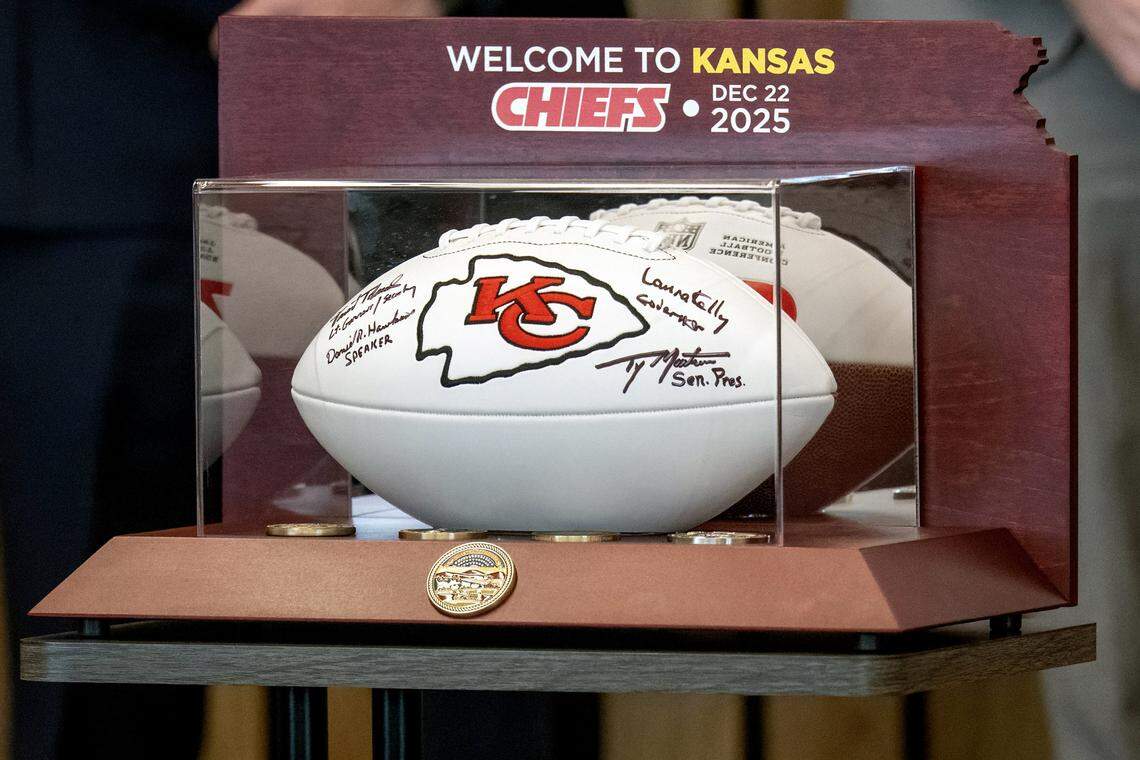
The Kansas City Chiefs’ planned $3 billion stadium in Wyandotte County cleared a major hurdle on Friday, when the Kansas Legislature passed a bill creating a sports authority and renewing the underlying incentive program that will finance the megaproject.
The legislation, which passed the Senate 30-10 and the House 78-44, now heads to Gov. Laura Kelly’s desk.
If the bill is signed into law, the 11-member quasi-governmental board it establishes will own and oversee construction of the stadium, which will not go on the property tax rolls. The vast majority of NFL stadiums are publicly owned, but the Chiefs would become the first team with a representative who gets to vote on stadium-related decisions.
“The team has one vote out of eleven. It does not control the board,” said Sen. Larry Alley, a Winfield Republican who voted for the bill.
Sen. Cindy Holscher, an Overland Park Democrat who is running for governor, said the arrangement still poses a conflict of interest.
“Allowing the team to influence bond issuing, timing, capital improvements, lease terms, operational decisions and revenue allocations - it is not something you would normally do,” said Holscher, who was one of just two Senate Democrats to vote against the bill.
The authority would be exempt from competitive bidding requirements, but the language of the bill calls on the board to “utilize competition among contractors and vendors to the extent practicable under the circumstances, at the discretion of the Authority.”
STAR bonds
The legislation also calls for extending the sales tax and revenue, or STAR bond, incentive program through 2031. The program is set to expire this summer, and failure to renew it could seriously jeopardize the stadium project.
“If the STAR bonds were the fantasy economically, Wyandotte County would be rolling in dough. They’ve got four active STAR bonds out there and the county itself is $1 billion in debt,” said Sen. Mike Thompson, a Shawnee Republican who has been critical of both the incentive program and the stadium project.
Sen. David Haley, a KCK Democrat who voted against the bill, called the stadium project “the last straw” for Wyandotte County taxpayers, expressing deep skepticism that it will stoke meaningful investment in his community.
That notion was challenged by Sen. Stephen Owens, a Hesston Republican who voted for the bill and pointed to Kansas Speedway - the state’s first STAR bond project - as a Wyandotte County success story.
“Before the Kansas Speedway and the Legends were developed, the twelve hundred acres comprising generated about $200,000 in property taxes,” Owens said. “Fast-forward to today, over $30 million in property taxes and over $1 billion in sales in that area.”
In scope, the planned stadium development dwarfs the 23 other projects Kansas has realized through its STAR bond program since 1999. Those bond issuances add up to around $1 billion, according to a 2024 Commerce report.
Kansas has pledged to issue $1.8 billion in bonds to finance stadium construction and up to $975 million in bonds to support entertainment districts in Wyandotte County and Olathe, where the Chiefs plan to build a team headquarters and practice facility.
Commerce Secretary and Lt. Gov. David Toland has until October to finalize the exact boundaries of the two-county incentive district, which will capture new sales tax revenue and divert it to pay down stadium debt over the life of the 30-year bonds.
Sen. Pat Pettey, a KCK Democrat, said her constituents have expressed mixed feelings about the project
“Yes, I have heard from lots of people, lots of my constituents and others that live in Wyandotte County about their concerns,” said Pettey, who voted for the bill. “But the other side of that coin is that I haven’t heard one person say they didn’t like the Chiefs or didn’t want the Chiefs to come to Kansas, so it’s a double-edged sword.”
How will the sports authority work?
Owens made the case that under the stadium incentive package approved by lawmakers in 2024 and the tentative STAR bond agreement negotiated by Toland on behalf of the state, rejecting the sports authority bill would only give the executive branch more control over the project.
“If we do not pass this legislation, there is a clear path for the executive branch through the Kansas Development Finance Authority . . . to make this happen,” Owens said.
Senate Minority Leader Dinah Sykes, a Lenexa Democrat who’s running for insurance commissioner, concurred with his assessment that lawmakers couldn’t kill the project.
“The Chiefs deal, that is done,” said Sykes, who voted for the bill.
Several lawmakers said they voted for the bill not because they approved of the stadium project but because they wanted to preserve some form of legislative oversight. The bill calls for the sports authority to provide annual written reports on its operations to a group of top lawmakers and the House and Senate commerce committees, and to provide in-person testimony if requested.
Besides the Chiefs representative, the board would include the commerce secretary, appointees of the governor and legislative leaders, and local representatives from KCK and Olathe.
The original sports authority bill that passed by the House earlier this month specified that the mayors of those cities would serve on the board, but the final version authorized the mayors to appoint designees if they prefer.
A proposal to mandate Senate confirmation of board appointees was scrapped by lawmakers during the conference committee stage, but all sports authority members would still have to pass a background check administered by the Kansas Bureau of Investigation.
The authority would be allowed to appoint an executive director, who would serve at the pleasure of the board and receive a salary paid out of the Chiefs’ annual rent payments.
The bill would require the authority to engage a third-party independent auditor to audit its books annually. The same auditor could not review the authority’s accounting records for more than three years in a row.
Here’s how every Johnson Couny and Wyandotte County lawmaker voted on HB 2466. A yes vote indicates support for the bill establishing a sports authority and extending the STAR bond program. A no vote indicates opposition.
Johnson County representatives
Lauren Bohi (R) Yes
Stephanie Clayton (D) No
Chris Croft (R) Yes
Charlotte Esau (R) Yes
Robyn Essex (R) Yes
Jo Ella Hoye (D) Yes
Linda Featherston (D) No
Nikki McDonald (D) Yes
Heather Meyer (D) No
Cindy Neighbor (D) Yes
Dan Osman (D) No
Jarrod Ousley (D) Yes
Mari-Lynn Poskin (D) No
Susan Ruiz (D) No
Courtney Sappington (R) No
Angela Stiens (R) Yes
Jerry Stogsdill (D) Yes
Mike Storm (R) Yes
Bill Sutton (R) Yes
Sean Tarwater (R) Yes
Adam Turk (R) Yes
Carl Turner (R) Yes
Chip VanHouden (R) Yes
Lindsay Vaughn (D) No
Laura Williams (R) No
Brandon Woodard (D) Absent and not voting
Rui Xu (D) No
Johnson County senators
Etan Corson (D) Yes
Beverly Gossage (R) Yes
Cindy Holscher (D) No
TJ Rose (R) Yes
Douglas Shane (R) No
Dinah Sykes (D) Yes
Adam Thomas (R) Yes
Mike Thompson (R) No
Kelly Warren (R) Yes
Wyandotte County representatives
Wanda Brownlee Paige (D) Yes
Carolyn Caiharr (R) No
Pam Curtis (D) Yes
Timothy Johnson (R) Yes
Lynn Melton (D) No
Melissa Oropeza (D) No
Louis Ruiz (D) Yes
Valdenia Winn (D) Yes
Wyandotte County senators
David Haley (D) No
Jeff Klemp (R) Yes
Pat Pettey (D) Yes


No comments:
Post a Comment