
ICE Funding Clash: Few Winners, Many Losers
 The political battle over immigration enforcement in the United States has intensified, with Democrats in Congress leveraging the issue to challenge President Donald Trump's administration and position themselves for electoral gains. While unlikely to secure Republican support for significant legislative changes, Democrats are strategically using the ongoing debate to send a clear message about their opposition to aggressive tactics employed by Immigration and Customs Enforcement (ICE) agents. This struggle, playing out against a backdrop of a partial government shutdown, highlights the deep partisan divide on immigration policy and its potential impact on the upcoming November elections.
The Democratic Stance on ICE Enforcement
Senate Democratic Leader Chuck Schumer has been vocal in his criticism, stating, "We’ve been clear from the ground up: Democrats will fund critical homeland security functions, but we will not give a blank check to Trump’s lawless and deadly immigration militia without reforms." This stance underscores a core Democratic objective: to impose new legal restrictions on ICE agents. These proposed reforms include requiring agents to identify themselves and cease wearing masks, halting stakeouts at sensitive locations like churches, hospitals, and schools, and mandating judicial warrants before entering private residences.
The White House and congressional Republicans, however, have framed the stepped-up enforcement as a direct fulfillment of President Trump's campaign promise to deport individuals residing in the U.S. illegally. This framing aims to rally their base and present a consistent message on immigration.
Electoral Strategies and Democratic Hopes
Democrats harbor significant expectations of gaining control of the House of Representatives in the upcoming elections. Recent special elections and polling data, which suggest a decline in President Trump's approval ratings amid rising gas prices and ongoing international conflicts, have bolstered their optimism. Furthermore, several Republican-held Senate seats have become more competitive, adding to the Democratic outlook.
Despite their strong public stance against ICE tactics, Democrats have found it challenging to achieve their desired legislative outcomes. Republicans, who hold a narrow majority in the Senate, have largely rejected the proposed reforms, arguing they would impede deportation efforts. Nevertheless, Democrats are aiming to frame the situation as a victory by highlighting their refusal to fund ICE operations and by pointing to other perceived immigration-related wins, such as the reduction of ICE agents in Minneapolis following the fatal shootings of two U.S. citizens by federal agents.
Representative Salud Carbajal, a Democrat from California, articulated this sentiment, stating that simply refusing to vote for ICE funding is "absolutely" a win for Democrats. He emphasized their commitment: "because we have made it clear that we are not willing to give another cent or dime or penny to ICE and CBP until they make all the reforms that we have been asking for." It is important to note, however, that ICE is currently fully funded through legislation passed in the previous summer, meaning this particular refusal to fund has little immediate practical effect on the agency's operations.
Republican Efforts and Messaging
Congressional Republicans have faced their own challenges, failing to push through President Trump's desired voting reform bill, the SAVE America Act, by attaching it to Department of Homeland Security funding. This proposed legislation would have mandated proof of citizenship for voter registration and potentially curtailed mail-in voting. They also did not secure full funding for ICE and Customs and Border Protection (CBP) operations through September, although both agencies possess sufficient funds to continue their work.
House Republican Conference Chair Lisa McClain acknowledged the Democrats' success in the Senate bill, admitting, "I'll be honest, they (Democrats) won in the Senate bill. We were surprised we got the bill that we got."
Despite these setbacks, Republicans are poised to campaign on a strong immigration enforcement message, a theme that resonated with a significant portion of the electorate during the 2024 presidential election. Republican U.S. Representative Bob Onder of Missouri stated, "I think Democrats have put the interests of illegal aliens, their desire to keep illegal aliens, even criminal illegal aliens in this country rather than putting the interests of the American people first."
A recent four-day Ipsos opinion poll indicated that while most Americans perceive Republicans as the stronger party on immigration, they disapprove of the Trump administration's methods for apprehending migrants, which have, in some instances, involved U.S. citizens.
Airport Delays and Public Frustration
The ongoing political standoff has also contributed to significant disruptions at the nation's airports. Nearly 500 Transportation Security Administration (TSA) agents have resigned due to insufficient pay, leading to extended wait times for travelers. Republican Senator John Cornyn highlighted the public's primary concern: "Voters 'care most about not having to wait four hours and miss their flights.' They want us to do our job. Unfortunately, it’s easier said than done.”
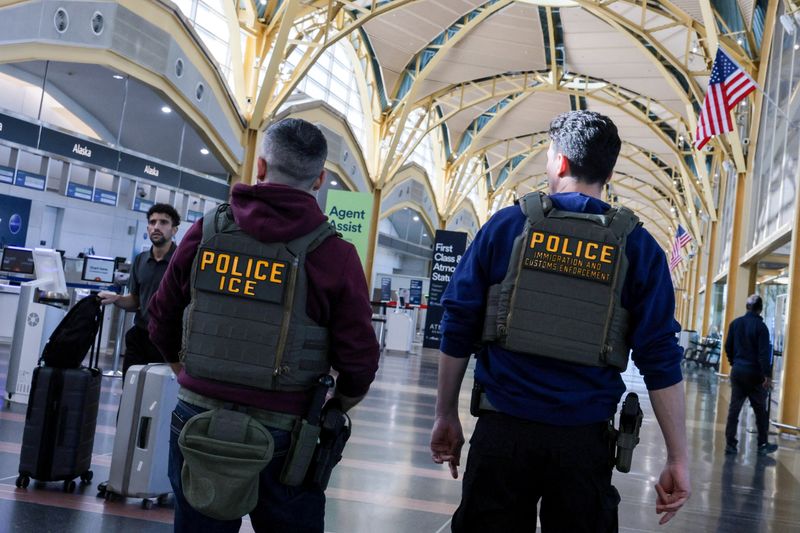
Adding to the chaos, President Trump's decision to deploy ICE agents to over a dozen U.S. airports to assist the TSA has unsettled some travelers. Diane Price, who flew from Oregon to Arizona, described the presence of ICE agents at the Phoenix airport as "intimidating" and "scary." She expressed her distress, stating, "Because of what's going on in our country, it's so hard, all of this happening. I just, I don't know what to say," as she fought back tears. She and her husband, Mike, noted their relief that the ICE agents were not masked, as has been observed in other operations.
Post a Comment for "ICE Funding Clash: Few Winners, Many Losers"