
What I learnt from being left out of my mother's will
If you want to support independent women's media, become a subscriber . Get an all-access pass to everything we make, including exclusive podcasts, articles, videos and our exercise app, MOVE.
This article is an edited version of one that originally appeared on Daisy Goodwin's Substack. Sign up here.
After my mother, Jocasta Innes died in April 2013, a month before her 79th birthday, there was a drift of phone calls, texts, emails, and letters celebrating her creativity, her energy, and the vivid attack she made upon the world.
Then the tributes dwindled, and I settled into a period of quiet mourning, that sense that a view or a joke or a dog jumping in the long grass could never quite the same because she was not there to see it with me.
I was in this phase of sepia grief when a letter came from my stepfather enclosing a copy of my mother's will.
I didn't read the will immediately; it was too vivid a reminder that the world would never be the same and that the colourful world my mother had conjured up could never be recreated.
Watch: Were you the favourite child? Post continues below.
My mother did not die a rich woman. In her life she had written bestselling books, The Pauper's Cookbook in the 1970s and PaintMagic in the 80s, but neither of these had made her financially secure. She had a quixotic attitude to money. She proved several times in her life that where the heart led, money would follow.
When in 1966, she left my father, a film producer, to live with a young novelist, she gave up a reasonably affluent existence with a cleaner and an au pair for a cold water flat in Swanage, England with no fridge or phone. But Jocasta turned her poverty into gold, spinning the offal and limpets of necessity into a cookbook full of heartfelt recipes which proved that poverty was no barrier to delicious food. The Pauper's Cookbook is still in print and has been cited as a godsend by that contemporary pauper cook, Jack Monroe.
The success of the book began my mother's career as a writer. She married her second husband and had two daughters.
They bought a terraced house in Swanage. But as my mother became more successful, her marriage faltered and once again Jocasta found herself alone and penniless, trying to recreate her life. This time she came back to London and found a derelict brewer's house just off Brick Lane. No one had lived in the house for years, and it was full of old mattresses and beer cans. There was no roof, plumbing or electricity. It was a prospect that no sane woman in her early forties with two dependent children would take on, but my mother saw through the detritus to the beautiful bones beneath.
The house had a curving staircase leading up to a galleried first floor, unique in houses of the period. The curved balustrade was echoed by two alcoves, or 'coffin corners', put there by the men who built the house in the early nineteenth century who knew that coffins could be very difficult to manoeuvre through narrow passages without damaging the masonry.
As it happened, the coffin corners were never used. My mother died downstairs in her drawing room — a place she had created in her own image. The walls were a translucent amber, the missing cornices supplied by mother's delicate laurel leaf stencil. The house was a jewel box of colour and verve. Envying the black and white marble tiles of the grander Huguenot houses in nearby Fourner Street, my mother created her own with stencils and paint. She also painted a trompe l'oeil of a £10 note on the floor to baffle her visitors. Quite often that painted note was the only money in the house.
But Jocasta's determination to live well regardless of her financial circumstances, once again paid off when she published her book Paint Magic about how to create a country house style in a shoestring, which went on to sell a million copies worldwide.
Thanks to poor agenting, she never made as much money from the book as she should have done but the money she did earn allowed her to finish doing up The Brewer's House, which she had bought from the Spitalfields Trust for £5000.
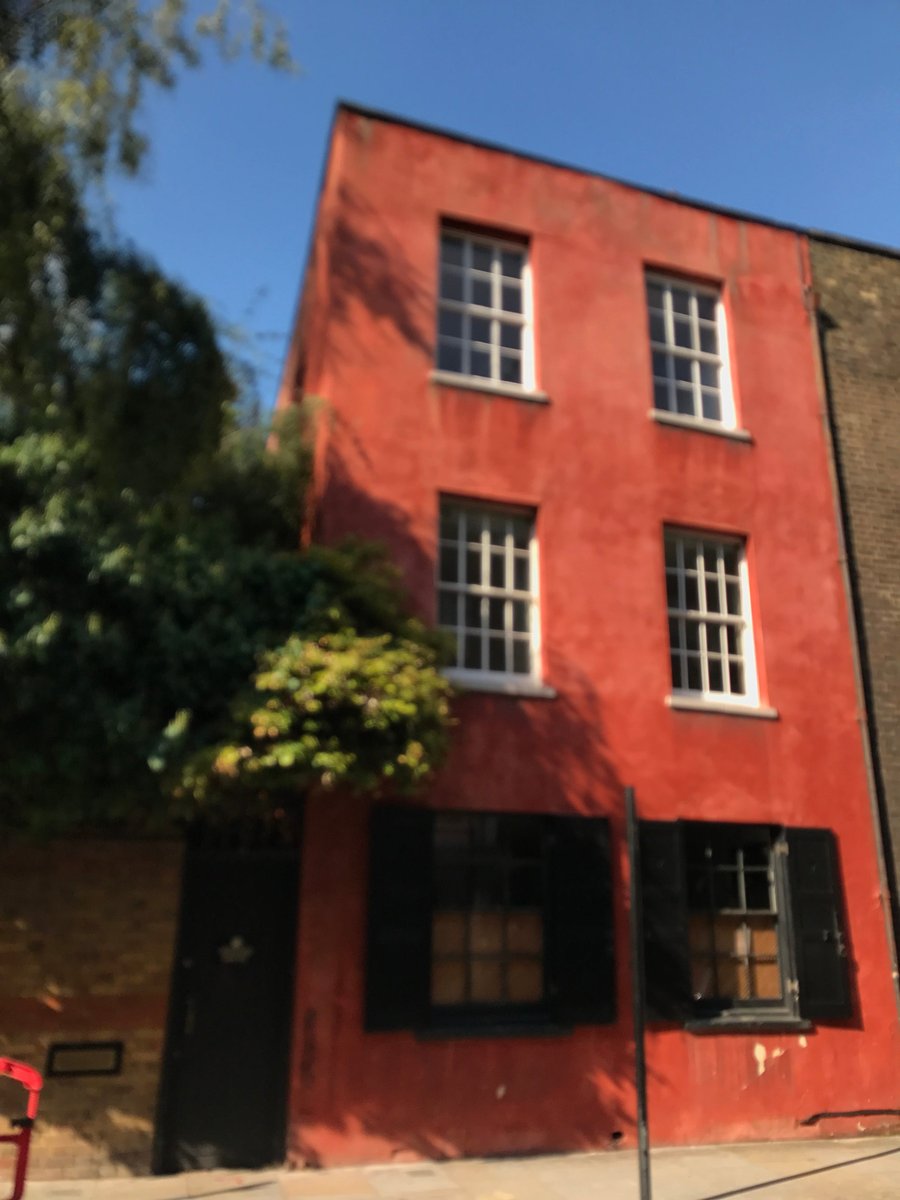 The house my mother bought for £5000 in 1983. Image: Supplied.
When she bought the house, Brick Lane was a place where shops with strip lighting sold terrifying fish flown in from the Bay of Bengal and you could buy rice by the sack and vegetables that had no English names, but there was no Dairy Milk chocolate or Mother's Pride. Now the sari shops and the shop's windows full of glistening orange sweets from the sub-continent have been replaced by vendors of handmade hats and bracelets made out of recycled rosary beads. Kulfi has been replaced by cold drip coffee. Starbucks is only five hundred yards away. And the derelict house that my mother broke into in 1981 is now worth nearly three million pounds.
I wonder if my mother knew when she made her will how substantial her assets were. Although she had believed passionately that Spitalfields was an astonishing place — full of potential, she probably didn't quite believe that it was now a place where film stars who cared about their credibility, like Keira Knightley, would choose to live.
My mother had four children, my brother and I by her first marriage and my two sisters by her second.
In her will, she left me a small cash sum and a number of personal items, but she left the remainder of her estate, including the house, to my other siblings, with the biggest share going to my youngest sister. In the will, it says that, "I leave my daughter Daisy out of the estate not because I love her any less, but because I think she has less need of it."
In many respects, it was a perfectly reasonable thing for my mother to do. I was her oldest and, materially, at least, most prosperous child. I had a successful career in television and was without obvious financial worries.
By contrast, my youngest sister was living in a housing association property in Dorset working at a job she loved but which pays only just over the minimum wage. My brother and my other sister are better off, but there can be no doubt that they need the money more that I do.
But, and here's the rub, although I know in my head that my mother's will is fair, in my heart I feel left out.
I love my siblings dearly, and I don't begrudge them the money. I can understand that they need it more than I do, but all the same, I feel rejected. I am pretty sure that this was not my mother's intention. She was trying to do the right thing as she saw it, but the result left me, a decade later, still trying to fight the feeling that she left me out of her will because she loved me less.
It wasn't that I ever expected to inherit money, my expectations have never been great. My contemporaries who inherited money young have mostly found it to be more of a curse than a blessing; as my mother found in her life, financial necessity is often the impetus to invention and success.
But when a parent makes a will, they should be aware that although their children may be reasonable adults in every other respect, when it comes to inheritance, maturity dissolves into a puddle of childish resentments. Because when a beloved parent dies, what is being parcelled out may look like goods and chattels, but it feels a lot like love. A parent's will is not just a legal document, it is the last expression of their thoughts and feelings towards their children. It is a testament of love.
Writers, and my mother was a wonderful writer, have always understood the significance of the last will and testament.
Geroge Eliot adds the final twist to the awful desiccated character of the arid scholar Casaubon in her great masterpiece Middlemarch by having him make a will that bequeaths everything to his young widow Dorothea on the condition that she never marries Casaubon's cousin Will Ladislaw. The irony is that until the will is read there has been no illicit relationship with Dorothea and Will. Casaubon, in his impotent jealousy, has completely misjudged his wife; but the result of the will is exactly the reverse of the intention. Dorothea does not want the tainted money and, of course, marries Will Ladislaw. Casaubon's testamentary spite does not prevail.
Some writers have made their will their last literary work. The modernist writer Ivy Compton Burnett left a will as mannered and oblique as any of her novels, bequeathing a mirror to the twelve writers who made up her literary salon, so that "they could better see themselves."
Scholars are still arguing as to the real meaning of Shakespeare's famous legacy of the 'second best bed' to his wife Anne Hathaway, but it seems unlikely that such a master of language would not thought about the residue that his final words might leave.
The probate lawyers, the people who make their living drafting and executing people's wills, are not paid to advise their clients on the potential emotional aftermath of their legacies.
On the record, one leading solicitor told me that it is his job to translate his clients' wishes into a legally binding document. Off the record, and for this reason he did not want to be named, he says that, "it's a common mistake made by successful people who think that it is their job to redress the balance between their children through their wills. They may have hugely successful in business, and they see their will rather like a business plan — a rational document with foreseeable results . What they don't understand is that when it comes to a will , money equals love and the child who is left nothing , however successful, will feel rejected. If a client asks me for my advice, I always tell them to split things equally between their children. To divide things unequally may make perfect sense to them at the time but it won't when the will is read."
 Image: Canva.
This is a particularly Anglo-Saxon problem.
In most parts of Europe, whose laws derive from the Napoleonic code, it is virtually impossible to disinherit a legitimate child. The law lays down that apart from a discretionary amount equal to up to a third, the property should be divided equally between the children. Anyone who has tried to buy property in France and Italy will know that it can be a nightmare even the most derelict farmhouse as it will be the property of all the descendants of its original owner.
It is an issue that will become more common as the rise in property prices means that many people will, like my mother, leave estates of unexpected value.
I expect that there will be many people in my situation who feel hurt by being passed over in a will, but of course, there will be some people who will seek legal redress. There is no more bitter legal dispute than between siblings fighting over an estate. They aren't just fighting over the money, it is always about who is loved the most.
Of course, and it pains me to write this, but the possibility has to be acknowledged. My mother was sending me a message in her will. Perhaps she was saying that she didn't love as much as her other children, and part of the reason for that was that I didn't appear to need her as much. As her eldest child, I had learnt from an early age to cope without her. When she left my father for her, the man who would become my first stepfather, she left her two children behind. I was five and my brother was three. We went to live with my father's mother for a couple of years until my father remarried two years later and brought us to London to live with him.
Who knows why my mother left her children?
She said later that she never meant to lose custody of us, unfortunately the courts in those days took a dim view of a woman who deserted the marital home. But I can't help feeling that two small children did not really have a place in the folie a deux she had with Joe.
That was not an entirely selfish decision. She knew that my brother and I would have a more regulated and secure existence in my father's house. And Joe, her lover, was six years younger than her, and he was not ready to be a father. It must have been agony for her to come and visit us when we were living with my grandmother.
Jocasta couldn't drive, and it was a long journey by public transport to the New Forest where we were living. My grandmother wouldn't let her spend the night, so Jocasta's time with us was necessarily short. I remember her having to prise my brother's arms from around her legs as he tried to stop her leaving. I was always more aloof.
One Christmas she gave me some turquoise earrings which must have been expensive and, given her difficult financial situation, involved some sacrifice on her part. For reasons, I can't quite remember but must have involved a subconscious desire to punish her, I gave the earrings to a friend. When my mother saw what I had done, she cried. She never cried.
During my teenage years, my resentment of my mother eased. She represented freedom from the restraints and rules of my father's house. At her home in Swanage there were no strictly enforced bedtimes and I could drink as much homemade parsnip wine as I wanted. She had very useful opinions on life. When I asked her if people really put their tongues inside each other's mouths when they kissed, she laughed and said that on a cold day it was a lot warmer than holding hands. As a chubby, self-important fourteen-year old, I was desperate to be more like my lithe mother who wore boy's jeans and did cartwheels on the beach.
But fifteen years later, in 1991, when I had my first child, I suddenly found myself in the grip of two very different emotions: one was an overpowering love for my infant daughter, the other was a feeling of rage that my mother could have left me. It wasn't anger I could express to her, it felt too late and too primal.
How could I expect my mother to understand the churning of my soul that giving birth had produced in me?
Not that the world would have known about my inner turmoil. I worked hard and, through a combination of talent and luck, made a successful career as a TV producer. Then, in 2007, I published a book called Silver River, an account of my childhood, and an attempt to understand why my mother had left her children by looking at the family she had come from.
It was a book that tried to understand as much as blame — I realised from looking into my mother's family that she had never been properly mothered. And I can see now that it is hard to believe that you matter to your children, if your own mother had never made you feel valued.. As Larkin said, "these patterns repeat themselves, they' deepen like a coastal shelf."
But my mother was furious with me. She saw the book as a betrayal. Perhaps it was, I know I would be devastated if one of my daughters wrote a similar book about me. We didn't speak to each other for about a year. It was a horrible time and there were many occasions when I regretted writing the book. But when at last we did, gradually, scratchily reconcile, I felt some relief, I had said what I felt and my mother and I had come through.
When my mother got swiftly and fatally ill, I was there with my siblings at her side. I spoke at her funeral, I honoured her memory.
But after all that, we were not quite done. Whether it was my mother's intention or not, the will left me feeling that she had not forgiven me, or not entirely.
She made the will about eighteen months before she died, so long after we had reconciled. I think it might have been easier if she had told me what she was going to do, but in the same that I found it easier to write a book than to tell my mother how I really felt, I think it was easier for her to put this in her will than to face me directly. Jocasta always found it difficult to look me in the eye.
Perhaps I am overthinking this — my brother and sisters insist that my mother was simply doing what she thought was fair.
Listen: The 'quiet grief' that arises when life looks different from the one you once planned. Post continues below.
I am grateful to them for their insistence, but my own sense of guilt tells me otherwise. Anyway now I will never know. The only think I do know is that in my will I am leaving all that I possess to be divided equally between my two daughters –—even if one of them invents the next Facebook and the other is living in a tent. I want my legacy to them to be unconditional love.
And if after I am gone one of them wants to help the other , then I think I will have been successful as a mother.
The other thing I learnt was that the only way to get over the upset the will caused me was to let it go. Of course, the money would have been nice, but I would so much rather be close to my siblings. I wasn't going to let my mother's will reach into my present.
It has been the most grown-up decision of my life, and in the end it has made me richer.
This article is an edited version of one that originally appeared on Daisy Goodwin's Substack. Sign up here.
Feature Image: Canva.
Post a Comment for "What I learnt from being left out of my mother's will"