
A Stuffed Fish and £6K in a Plastic Bag: TFL's Wacky Lost Property Hub
A Glimpse into the Lost Property Office of Transport For London
At a warehouse in east London, a gentle-looking woman in her 50s named Ann is going through – and emptying – a stranger’s handbag. There’s a single, unopened contact lens; an eyebrow pencil with its lid off; receipts; coins; a baby’s dummy. Ann takes all of these out, one by one, and sets them down on a desk. ‘You do [imagine who the owner is] in your head,’ she says. ‘You think, if your bag looks like this, what does your house look like?’
We are inside the Lost Property Office of Transport For London (TFL) – a 50,000-square-foot site near West Ham station. Barring Tokyo, it’s the largest centre for lost property on earth; there are, currently, around 80,000 items within it. TFL receives 6,000 new lost things a week and keeps them for three months. After that, if something has not been reclaimed, it either goes to charity (toys are sent to local schools, clothes to homeless shelters etc) or, if it’s valuable, to auction, after which any money made is put back into the service. Last financial year, the LPO, as it’s called, made £142,578 selling unclaimed items at auction, and the year before it made £199,136.
Still, says the organisation’s performance manager, Diana Quaye, ‘we run at a loss’. She has had the job for almost four years and says that not enough of the public knows about – or has confidence in – this service: for every 6,000 weekly items handed in, TFL gets just 500 requests from people who are trying to find their things. ‘And we have a high success rate of matching items with people, too!’
The LPO began life in 1933 and for 90 years, until 2023, was located in a rickety town house near Baker Street. The system functions as follows: lost items are either handed in by honest strangers or collected by Tube staff, like cleaners and drivers. They then get marked with where and when they were found, plonked into crates, picked up from stations at the end of each day, and driven to the West Ham depot.
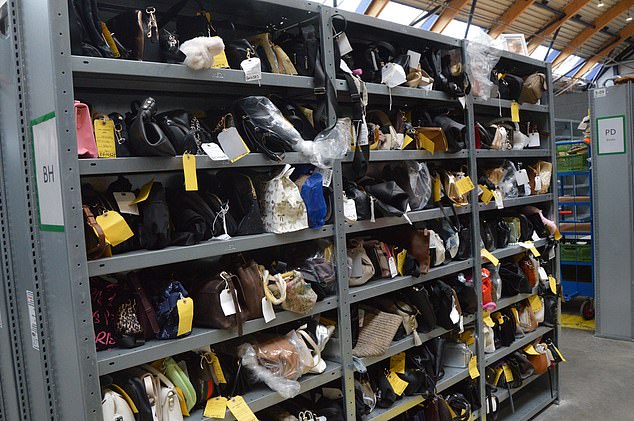
In the sorting room, staff like Ann log every lost item and, in the case of handbags and purses, the contents within them. (Locked things, like briefcases, are X-rayed.) Then, they sort them into categories: technology, clothing, handbags, books, umbrellas, and so on. If something is clearly broken or perishable, they recycle it (or give it to a local foodbank), but, other than that, TFL keeps everything. Even, I ask Diana, a single Tupperware? ‘Yep.’ You don’t know what ‘could be precious [to someone]’. She once saw a man come back for a crate of unopened Lucozade.
If there are IDs, the team will try to contact the owner. Otherwise, to stop chancers ringing in and claiming they lost an iPad, people must provide thorough details of their missing item: what day and time they misplaced it, plus what Tube line they were on. If it’s something expensive – like a laptop – TFL might ask for the original receipt. Then, you have to book an appointment to collect your item at the warehouse and, on arrival, there’s a pick-up fee: £26.50 for anything tech-y, £16 for big items such as bikes or pushchairs, £6.50 for everything else.
I ask Ann how much cash she has found today. ‘Not very much,’ she says, still poking through the purse. ‘People don’t really carry it.’ Although, she adds, quite casually, years ago they found a blue plastic bag, ‘with about £6,000 [inside]’. Unsurprisingly, its owner came back for it – ‘Somebody was phoning, constantly, for it.’ (Without wanting to suggest that a plastic bag with six grand inside sounds dodgy, if the sorting team ever find drugs, they put them into a safe and the police are contacted, who then dispose of them.)
So, less cash, but still plenty of ‘interesting things’, says Ann. ‘Divorce documents, love letters,’ adds Diana. ‘Prison release forms,’ mumbles Ann.
I ask what the weirdest item they’ve found is. ‘Oh,’ says Ann, ‘naughty toys.’ It doesn’t happen ‘that often’, but people come back for them.
‘And we used to do this thing that, when you came to collect a bag, a staff member would go through every item and say, “You have a blah, a blah, a blah…”’ says Diana. Now, they spare people’s blushes – although some punters don’t mind. Three years ago, lost property received a metal chastity belt – ‘and somebody came and picked it up!’
At the sorting room today, there are lots of clothes. An abandoned shirt and jacket, found at High Barnet; several children’s jumpers; a stray left shoe; a stray right shoe. In 2017, the old lost property boss, Paul Cowan, told The Guardian that he thought people were more likely to track down a single shoe than they were a pair. (‘If you lose two shoes, well, it’s slightly out of sight, out of mind.’) Diana confirms that the LPO often gets – and reunites people with – single shoes. I ask if people misplace more left shoes or right, and she says, sadly, they don’t have the data.
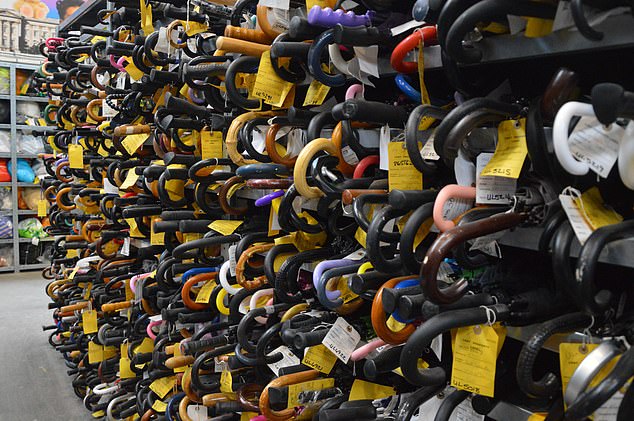
Here’s the data they do have: last year TFL users lost 26,437 mobile phones, 14,782 pairs of glasses, 13,634 keys, 192 crutches, 88 wigs, 26 sex toys, and 44,003 bags. The latter are the most-common lost item (when Claudia Winkleman was reunited with her bag after leaving it on the Tube she was so chuffed with the LPO, she spoke about it on The Graham Norton Show). And the least-claimed item is umbrellas, of which 6,286 were lost and only 2.4 per cent returned. Also, people lose things more on buses (171,328 items found) than they do on Tubes (106,149).
Once things have been categorised, they are put into the main, enormous, warehouse. Here Diana and I walk through the rows of lost property, ogling the oddities. There’s a wheelchair (‘miracles happen on TFL’); a clarinet (‘we’ve had a double bass’); and several, giant, children’s toys – the amount of these apparently spikes ‘during the Christmas season [with funfairs like] Winter Wonderland. I think the parents don’t want to take them home.’
Upstairs there’s a special mezzanine level containing unclaimed items that are so weird, the team have kept them: a prosthetic leg; a box full of false teeth; a taxidermied puffer fish. ‘Once, an urn came in,’ says Diana. ‘We were able to track down the owner. Someone had stolen their handbag, not realising there were ashes inside.’
There is also lots of luxury. In the rows of carrier bags, between the plastic offerings from Sainsbury’s and Tesco, I see a large Hermès shopping bag, with fresh ribbons poking out of its top. A few shelves down, there is an even larger receptacle from Brunello Cucinelli – the ultra-luxe Italian designer store where a plain white T-shirt costs £690. It is full of clothes and was found at Blackfriars.
There are plenty of designer handbags, too: more than one quilted Chanel purse, a Louis Vuitton bucket bag, a Gucci clutch. If these don’t get claimed, an expert has to verify them before they go to auction. However, the most expensive thing Diana can remember finding was not a bag but a pearl necklace – left in the back of a black cab in 2017. The team had it valued and were told it was worth £125,000. Luckily, they tracked down its owner, a presumably stressed-out bride who had been lent the jewellery by her mum for her wedding. (As an incentive to hand things in, taxi drivers are allowed to keep any lost property they find if it is not claimed within three months.)
Back on the mezzanine level, standing between a wedding dress and a stuffed stoat, I ask Diana what she has learnt about society since working for the LPO. She answers quickly. ‘There are a lot of honest people. And, on that note, there are a lot of people who don’t trust people – because if you did, you’d automatically think, “Could someone have handed [my lost item] in?” But we don’t think like that. So that’s the biggest thing that I’ve learnt, because most of the stuff that comes here has been handed in! It gives you faith in human nature.’
*Some names have been changed
Post a Comment for "A Stuffed Fish and £6K in a Plastic Bag: TFL's Wacky Lost Property Hub"