
The culture-rich capital of great food, leafy neighbourhoods and jazz nights
After four months of lugging an 80-litre backpack around chunks of Mexico, Guatemala, and Belize, I was exhilarated to live and work from Mexico City for at least a few weeks.
I ended up staying for seven. From the off, I found CDMX (Ciudad de México) to be everything I dreamed of and more: sunny, but with cooler temperatures compared with a stifling Oaxaca, a colourful, cosmopolitan and bike-friendly capital with enough to keep a big city fan entertained, and sizzling and epic street food on nearly every corner. Mexico City felt alive, with many places open until the early morning.
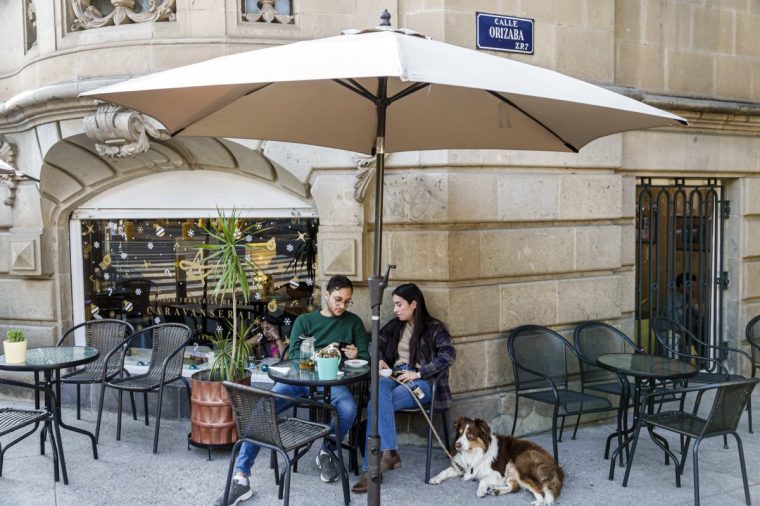
The popular neighbourhoods
The first step was finding somewhere to stay. I try to avoid renting non-owner occupied properties on platforms such as Airbnb, as they can have a negative effect on communities. This summer, Mexico City saw anti-gentrification protests, including against unregulated holiday lettings.
Instead, I seek out houseshares, sublets or petsitting opportunities when I’m away from home (note that some countries consider petsitting to be work, even if it is only in exchange for board, so be careful not to flout the rules of your stay or visa).
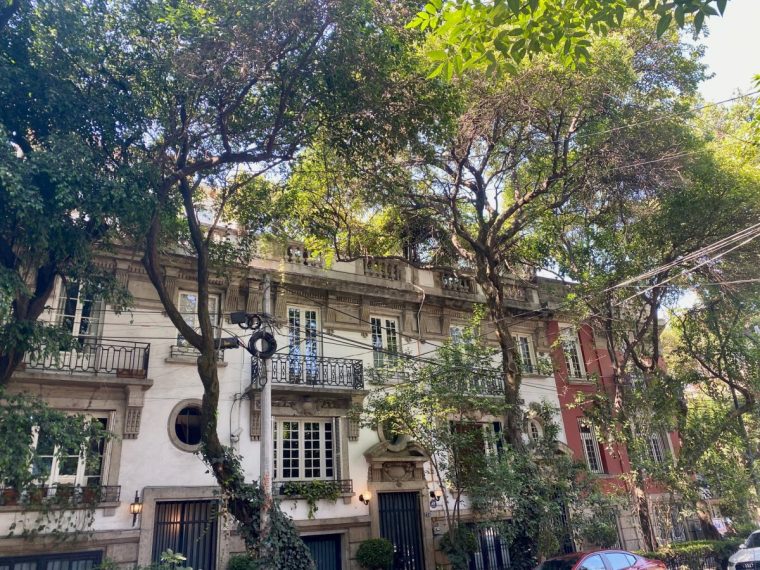
I started my research in Mexico-related Facebook groups, where I posted that I was seeking a sublet. Following a video call, I chose a two-bedroom, two-bathroom top floor apartment with a balcony in Roma Norte, the northern area of the city’s attractive Roma neighbourhood. It cost me US $950 (£700) a month.
Roma and Condesa are two adjoining tree-lined boroughs with a mix of Art Nouveau and Neoclassical architecture.
I only received accommodation offers from people living in Roma, Condesa and Polanco, but there are more neighbourhoods to choose from.
A comfortable climate
Mexico City is among Mexico’s most expensive cities for its cost of living, and a popular place to live among international travellers, with estimates suggesting that up to 12 per cent of its residents are foreign-born. Even so, rent prices are around 60 per cent less than London, and grocery shopping about 28 per cent cheaper, according to price comparison website Numbeo.
Mexico is in the spotlight for 2026 as it’s one of the Fifa World Cup hosts, with some matches taking place in the capital. It was the world’s seventh most-visited country in 2024, according to the annual World Tourism Barometer from UN Tourism. Meanwhile, the country’s tourism minister Josefina Rodríguez announced last week that international visitor arrivals to Mexico were up by 13.6 per cent in the first 10 months of 2025 compared to the same period in 2024.
The capital offered everything I wanted for an extended city stay: a comfortable climate with highs of 28°C, historic buildings like Chapultepec Castle, which offers views across the city, an abundance of culture with mariachi bands popping up on street corners or outside of restaurants, and leafy neighbourhoods where storied townhouses nudge up against buzzy bars and taco stands with plastic awnings.
An eclectic food scene
Food prices vary widely with tacos at street food stalls from Mex$20 (about 80p) to Michelin-starred restaurants such as Pujol with a tasting menu of Mex$3,496 (£145).
One of my favourite places to eat in Roma Norte was Por Siempre Vegana Taqueria, a simple restaurant. Here, chilaquiles – tortillas served in green or red sauce – set me back about $50 (£2). For a treat, I would head to El Mundo – also in my neighbourhood – an Art Nouveau building with artfully sparse decor where main courses start at Mex$245 (£10.15) for hibiscus birria taquitos.
Cocktails at places such Licorería Limantour, a two-storey open-air, art-deco inspired crowded bar in Roma, start at about Mex$250 (£10). Over at pulquerías (taverns) such as La Nuclear you can try pulque (from $45/£1.86), an ancient Aztec drink that is made from the fermented sap of the maguey (agave) plant. Let’s just say it’s an acquired taste thanks to its sour yoghurt flavour.
While Mexican food with bold flavours was just steps away from my apartment, I craved cooking in my own space. My first supermarket food shop (a couple of bags) came to about £80. Fortunately, a Mexican friend suggested another supermarket, which was about a third cheaper, and I also filled my bags with fresh produce at Mercado de Medellín.
The cultural highlights
But one thing worth doing for free – and one of my highlights – was cycling down Paseo de la Reforma, which is closed to traffic from 8am–2pm every Sunday. You can hire a bike for free for three hours – you just need to hand in your ID, which is returned when you come back with the bike. I also joined a gym, which set me back about £30 per month.
To make the most of my time in the city, I tried cooking classes (starting from Mex$2,381, about £99) at Aura Cocina Mexicana in Coyoacán and Roma Norte, where I learnt how to make mole, salsas and vegan tacos al pastor, and watched Ballet Folklórico de México, a Mexican folkloric ensemble that performs at the Palacio de Bellas Artes.
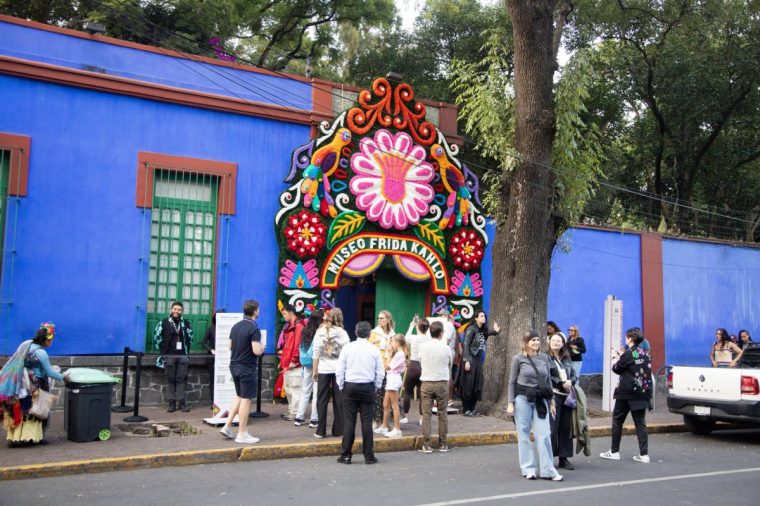
Cultural stops included the Frida Kahlo Museum, known as the Blue House, in Coyoacán, which set me back Mex$320 (£13.27) for a general admission ticket. For fewer crowds, the Leon Trotsky House and Museum, where entry is Mex$70 (£2.90) is a fascinating account of the life of the revolutionary leader who fled to Mexico City in 1936.
I also wandered the gallery-lined Avenida Amsterdam, visited the Museo Nacional de Antropologia and explored the waterways of World Heritage Site of Xochimilco.
I visited jazz clubs such as Jazzatlan Capital, a tightly-packed two-storey space where acts perform in an intimate setting (tickets starting from Mex $385/£16). I also watched the loud and colourful spectacle that is Lucha Libre (wrestling) at Arena Mexico, which costs from $122 (£5).
Before visiting Mexico City, I felt that it had a reputation as being unsafe. Of course, there’s crime in Mexico. Like everywhere, you need to be careful, but I felt confident enough to walk around and between neighbourhoods on foot as well as by bus and subway (journeys cost from 20p).
It’s worth taking Spanish classes before you go so you can integrate more. I was fortunate to be able to take Spanish lessons in Guatemala, but had spent time travelling around Spain and South America in the past.
Be mindful about how you discuss Mexico City when it comes to affordability. Life is a struggle for many, with a daily minimum wage of $279 (£11.57), and many residents I met had to work more than one job, six days a week.
By the end of my stay, I had become attuned to life in the city – it felt like home. I was dizzingly feliz (happy) to get a little bit under the skin of the sprawling, dynamic and culture-rich megalopolis. It’s a place I know I’ll return to again one day.
Suzanne Bearne was a guest of Lucha Libre, Aura Cooking, Jazzatlan Capital, and Ballet Folklórico de México.
Post a Comment for "The culture-rich capital of great food, leafy neighbourhoods and jazz nights"