
How Danbury High’s new career academies put students on job-ready paths: "That is the goal"

DANBURY — Erica Pauta sat strapped in a stretcher in a large boxlike structure, modeled after a real-life ambulance, in her classroom. Pauta’s classmate Jessie Jaurez crouched next to her. She asked Pauta a set of questions, as they ran through a practice scenario similar to a real-life health emergency.
Both of them are juniors at Danbury High School learning about emergency medical services, as part of the Allied Health Services career pathway in the larger Scientific Innovation & Medicine Academy. Their classroom is part of the new west campus, which opened in August.
The academy is one of eight in the Academies of Danbury High School. Seven academies offer 21 career pathways and the eighth helps freshmen pick their future academies and pathways.
Three of the academies are at the new west campus. Five are at the main campus on Clapboard Ridge Road.
Educators call the reconfigured high school, a project that took several years to develop, a “wall-to-wall” career academy. The setup is now technically in its third year, meaning all high school students except this year’s seniors have an academy or are choosing their career pathways for next year.
Next yearthe program will be completely rolled out.
Recent visits to both the west and main campuses showed two of the pathways in action: Allied Health and Culinary Arts, and Hospitality Management.
Training for careers
One morning in the Hatters Cafe, the hub of Danbury’s culinary arts program, juniors had just received their new chef coats. They were serving breakfast that day. Some students were at the stove, scrambling eggs and making omelets, while others were down the line, mixing up fruit and yogurt into creamy parfaits.
Students who complete the three-year culinary arts pathway and take a food safety certification exam will be eligible to graduate with a ServSafe Food Protection Manager certification. This will allow them to go into the restaurant service industry at an entry leadership role.
Students also learn how to use commercial cooking equipment and perform customer service, using cash registers and doing credit card transactions.
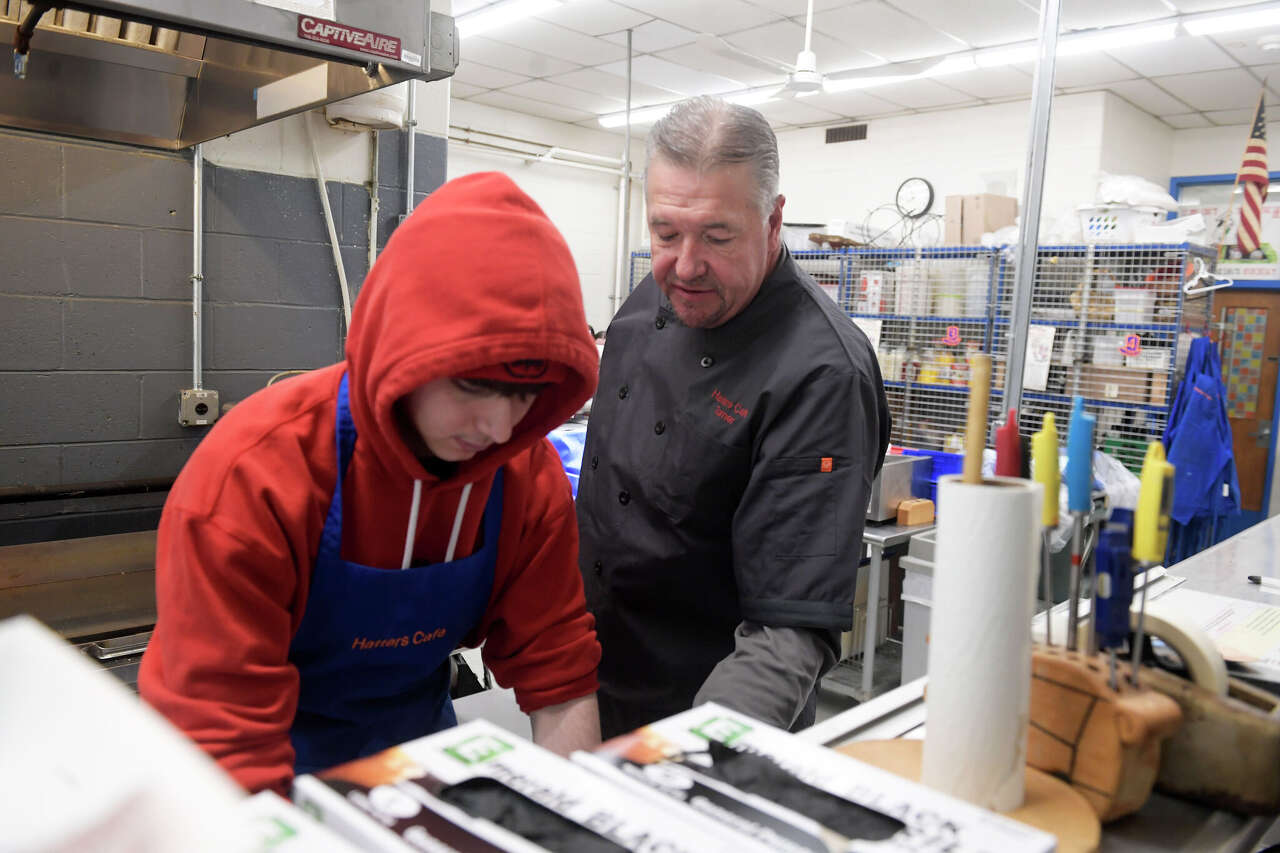
Brian Turner, a longtime culinary arts instructor, said he believes students will leave the program prepared to enter the restaurant and hospitality industries. They’ll have done a lot of the jobs already.
“So they can go into any establishment and basically get the shift supervisor or assistant manager position,” Turner said.
Similarly, students studying emergency medical services in the Allied Health pathway will have the opportunity to graduate as certified emergency medical technicians. They will have accrued the medical knowledge and clinical experience from actual ambulance ridealongs during their senior year to pass those exams and immediately go to work with an ambulance company.
While Pauta and Jaurez practiced what it’s like to work in an ambulance with patients, their classmates ran through similar exercises.
Hadeel Alkasaji pretended to be a patient experiencing abdominal pain. Denise Jerez peppered Alkasaji with questions about her symptoms.
The academy model
According to Danbury schools superintendent Kara Casimiro, the conversation about establishing the career academy initially started out as a quest for more space. The high school building was bulging with students well beyond its capacity.
The conversation broadened to improving the high school experience and creating more opportunities, Casimiro said. The COVID-19 pandemic didn't slow those conversations.
“We had a very small team that met on a regular basis throughout the pandemic, right after we shut down, and we never stopped meeting and planning to get this started,” Casimiro said.
The academy model they sought couldn't be found in Connecticut, nor across the Northeast.
They found it in other areas, like Nashville. Danbury's model would be informed by visits to such districts, said Meghan Martins, associate principal of the high school.
“That has been very instructive,” she said.
Understanding grows
At the beginning, as educators tried to introduce the concept to families, there was a lot of misunderstanding, Martins said.
But over time, through continued messaging at back-to-school meetings and at meetings in the city’s middle schools on what to expect in high school, leaders like Martins say they believe they got the message across.
“One of the best things the district did was to develop this exploration seminar class kids take freshman year, because it requires them to learn about how to be a high school student, to do career aptitudes and strengths inventories and it gives them the opportunity to explore the academies and pathways,” she said.
Leaders hope the academy model not only improves students' learning and engagement, but also makes the high school buildings more manageable.
“It’s hard to make connections with a population of 3,600 kids. And now that we’re broken into these academies, it makes it possible to have closer relationships,” Martins said.
Students are not just sharing their career pathway classes, but many of their core academic classes, like English and social studies, Martins said.
The mix is different if students are enrolled in Advanced Placement or honors classes. Otherwise, the goal is to have 80% of students from the same academies in shared classes.
“We're not probably there yet. We're at not the full model, but that is the goal,” Martins said.
Post a Comment for "How Danbury High’s new career academies put students on job-ready paths: "That is the goal""