
The year before Ray Floyd planned to retire from his teaching job in London, his daughter rang him from Bath, where she and her husband had moved. She asked him: “When you retire, why don’t you move down to Bath, because it’s a really nice part of the country, and I’m planning to have lots of children.”
Ray liked this idea. “I know some children don’t necessarily want their parents living nearby, but she obviously did. So I thought, “Well, that sounds good.’” He decided to retire that year instead, at 64, and sold the north London terraced house he and his late wife Heather had brought their three – now adult – children up in.
While Ray, now 74, liked many things about London, when on family holidays to other parts of the country, he’d often wondered whether it might be nice to try living somewhere different one day. His wife had died in 2011. “I only had myself to think of, with this move,” says Ray, “so what was the worst that could happen?”
Not everyone thought it was a good idea. “Friends my sort of age would say to me, ‘Oh, you’re leaving all your social group behind,’ but I told them that when I moved down to Somerset, I was planning to find a church where I’d feel comfortable, and if I did join the church, then I’d have met a ready-made group of people who would make me feel welcome. I also planned to do activities, and join a choir. I knew I wouldn’t be sitting in a little house by myself feeling lonely.”
Ray’s daughter, who is a doctor, gave birth to her first child in 2017, two years after Ray moved to be nearby, and he looked after the baby every Tuesday from the age of 18 months old. Two more children were born, and now there are three under nine years old.
For a few years, when he first moved to Somerset, Ray lived more rurally, half an hour’s drive from Bath, but now he lives in a house just three minutes’ walk from his grandchildren. He picks up the eldest two children from school once a week and is called upon to do occasional full days with the youngest, who otherwise goes to a childminder. Every other Thursday, he picks up all three children, and takes the older two swimming. “And because I live so close,” he says, “they can just pop in if they want to on the way somewhere, or they’ll say, ‘Can we have a sleepover at granddad’s?’”
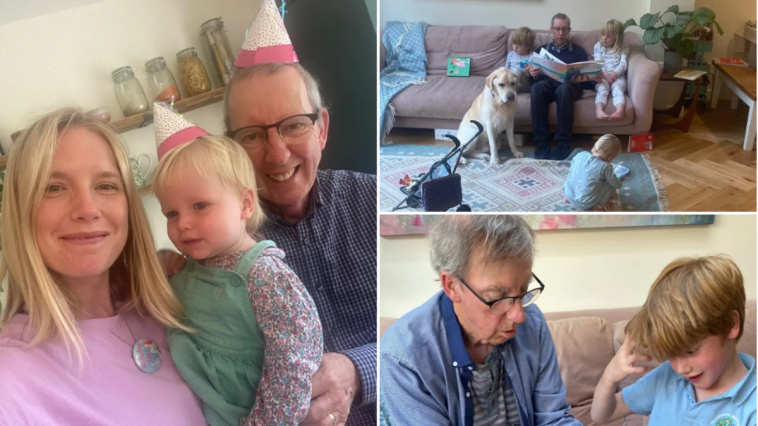
There are a few things that Ray was clear about when he made the move. “Right from the beginning, when the children came along,” he says, “I tried to be as much part of their family as I could be, but I was also sure to be conscious that I’m not going to be living my life through their family, that I’ve got to do my own things as well. I’m there to help when I’m needed, but I’m not expecting to be involved in every aspect of every part of their life, necessarily.
“I know that Heather would really have enjoyed being a grandma, and she never got a chance to do that. My daughter also hasn’t had her mum around while she’s had children, so I’ve sort of tried to compensate for that as much as I can.”
Ray advises other grandparents considering the move, to talk to their children and their partners about their expectations. “I think if I had to look after the children every day, I probably would find it too much, but I don’t feel like that at all. These precious moments that you get when you live so close by, are so worthwhile.” Ray has really enjoyed living somewhere new too; he likes the area, and the people.
Studies by social historians show that at least since the Industrial Revolution, grandparents have always looked after their grandchildren, and research from the English Longitudinal Study of Ageing (ELSA) finds that doing so tends to enhance grandparents’ quality of life, while looking after a partner is associated with a poorer quality of life.
The Kinship charity found that in the past two generations, the number of children in the UK being looked after by their grandparents has increased substantially from 33 per cent to 82 per cent. A 2023 survey from Sunlife insurance suggested that more than half of UK grandparents now provide some sort of childcare during the working week, doing more than four hours a day on average.
David Sinclair, the chief executive of International Longevity Centre (ILC), has for the last 20 years been working in policy and research on ageing. He says that this “grandparent army” – the vast, unpaid cohort being relied upon for childcare – has risen due to the high cost and inaccesability of formal childcare, higher cost of living, and more mothers working before their child is of school age.
Yet he has found that those grandparents moving to be near grandchildren are also likely to be doing it with their own futures in mind. “Grandparents might also want to be near family for their own care needs, and we know loneliness is a huge issue among the ageing population.
“People in retirement might move to the seaside or a rural area for a more peaceful life, and to downsize, or free up some equity in their home. But they sometimes move away from their social ties, and they can end up far from important services – such a stroke clinic, for example – and spend their time watching the TV. One way to mitigate that, is to move nearer family. Having a relative close by who they can rely on is going to also be great for a sense of purpose.”
According to McCarthy Stone’s 2023 survey of 2,000 grandparents nationwide, one in four grandparents are moving closer to family to offer support, and 26 per cent of grandparents moved house in the last five years to help their time-poor kids with their offspring.
“Grandparents have always played a part in supporting families and grandchildren, and multigenerational living whether in the same house or nearby,” says Sinclair, “and so in that sense, things haven’t really changed.” In essence, although the social context has changed, we’ve come full circle.
Of course, not every grandparent can, or wants to be, involved in childcare – whether in a formal sense or ad hoc. And whether a grandparent makes a big move to be nearer to their grandchildren depends on their financial situation, whether they’re able to retire, and what sort of relation they have with their grown children in the first place.
Sarah and Phil Anderson had always planned to leave London when they retired from their jobs as a bursar and a headteacher. “We wanted a better quality of life,” says Sarah. In 2021, when their first grandchild was 18 months old, they decided to sell their house and move to be near their daughter, son-in-law and the baby. They knew the area already from sporting events they’d been to over the years, and felt it was somewhere they’d enjoy living, regardless of proximity to grandchildren. “If our daughter chose to move somewhere else at a later date, that wasn’t a problem for us. We were clear that this did not tie us to each other.”
There was also another consideration – Sarah and Phil couldn’t move hundred of miles away from London, because they both had their own mothers to look after.
For the first three-and-a-half years, they rented a house in the same Cambridgeshire village as their daughter. “Renting was a lower level of commitment, in case we didn’t end up liking the area,” says Sarah. “Conveniently, we were located towards the back of the village so we weren’t living in each other’s pockets and bumping into each other permanently.”
Phil also wanted to ensure his son-in-law – although easy-going – didn’t feel his in-laws were “omnipresent, turning up anytime of night or day.” Any visiting by either party is prefaced with a WhatsApp message.

Recently, Sarah and Phil found a house they wanted to buy in the next village along, a 10-minute drive, or a short cycle. Somewhere suitable for them as they get older – no huge garden to maintain, and walkable to a village shop, so that they’re not reliant on driving. Their daughter has said she will also be able to look after them one day, given how close they live. “We have a more active social life here than we did in north London,” say the couple, “despite living there for decades.”
They have relished being closer to their grandchildren – “We started to have him for regular sleepovers from quite a young age, and he always felt comfortable with us” – and they helped out and provided support when a new baby came along in 2023. “Over the summer holidays this year,” says Sarah, “we had the boys one day a week to help our daughter during the long summer period.”
One of the main reasons they believe it works for all parties is that they are not relied upon for formal, regular childcare. “Whilst we have always been happy to look after the children and step in during an emergency, we all agreed fairly early on that we wouldn’t be part of their regular childcare arrangements. Both children have gone to a childminder for a couple of days a week and pre-school and the older child has now started Reception in our village which means we are able to help with after school pick-ups.
“One of the boundaries that we agreed on is that largely if the children are with us, our rules apply. This does not mean we give them endless amounts of chocolate and spoil them but it gives us the freedom to ‘parent’ them with some variation. Our elder grandchild [who recently started school] has got savvy to this and sometimes says it is ‘granny’s rules’ with a big smile on his face when he wants to do something – but that is the nature of grandparenting.” They are also both able to still care for their parents, because they can get back to London in under an hour.
The move has worked out brilliantly for them, but for Jackie*, 72, uprooting her life was harder than she thought it would be. When her husband Tom* was diagnosed with Parkinson’s in 2022, Jackie persuaded him that living in their four-bed detached house in rural Wales wasn’t a great plan for the future. “I felt it was better to downsize and move somewhere better connected while we’re still in good shape,” she says.
Their son lives in Bristol with his wife, and when they had their second child, Jackie and Tom moved 145 miles from the home they’d lived in for 40 years, to a bungalow in a village just outside the city. They found somewhere within walking distance of shops and a pub, and a 20-minute drive or half hour bus from Bristol. “I found it so tough,” says Jackie. “I had evenings standing in our new kitchen thinking, ‘”Why did we do this?”
A year-and-a-half on since the move, though, things are much better. “We needed time to settle in – it was a very big and tricky change, but it has been an immense joy to be so involved in family life.”
Ray feels this way, too. He had cancer three years ago – once he’d already moved to be near his daughter and her family – and after a long and arduous recovery, he was more sure than ever that what matters is not money or the kind of house you live in, but the relationships he was forming with his grandchildren. “I hope that I’m helping even a little bit to shape them,” he says. “They are also so interesting, and honest, and they keep you young.
“The other day, just as he was putting on his shoes, one of my grandchildren said, “When you think you’re going to die, granddad?” I said to him, ‘Well, no one knows when they’re going to die, so you don’t have to worry about it, just enjoy being alive.’ I’m so privileged to be able to have them so close by as they grow up.”
*Names have been changed
The grandparent army – in numbers
There are an estimated 14 million grandparents in the UK and 75 per cent of adults are likely to become grandparents.
Half of parents with children under the age of 13 live less than five miles from their nearest grandparent, according to a 2024 study by Zoopla, with seven in 10 being a 30-minute journey away.
In the past two generations, the number of children being cared for by their grandparents has soared from 33 per cent to 82 per cent.
Two fifths of the nation’s grandparents over the age of 50 – five million – have provided regular childcare for their grandchildren, according to a new YouGov poll forAge UK.
Grandparents providing childcare for their grandchildren save working parents approximately £6.8bn nationally in childcare costs.
A total of 28 per cent of grandparents with grandchildren under 16 are in the “sandwich generation”, with their own parents still alive.
Young grandmothers aged under 50 are more likely than older grandmothers to provide childcare, but overall most childcare is provided by grandmothers and grandfathers aged 55 to 64.


No comments:
Post a Comment