
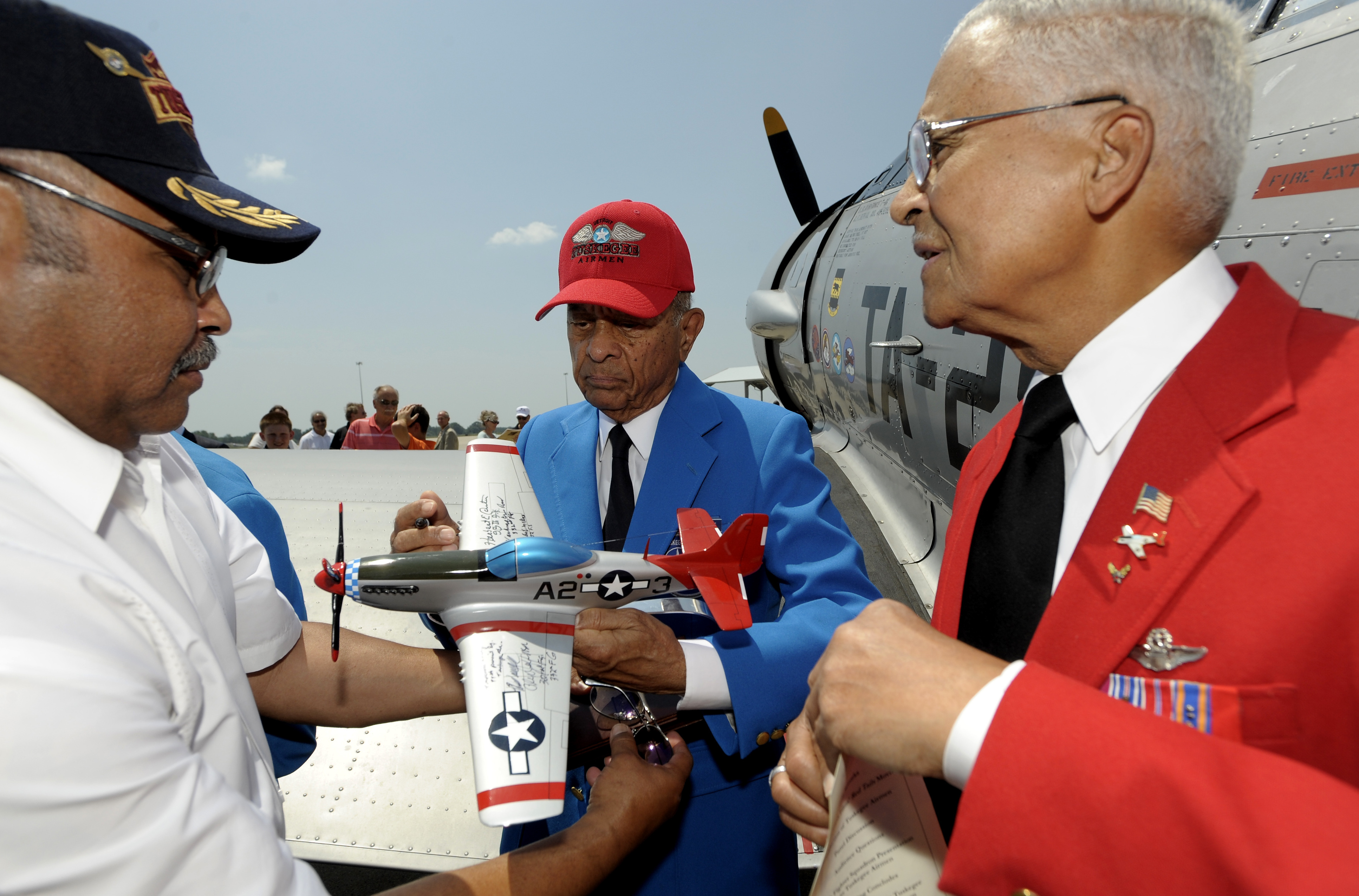
 During World War II, a groundbreaking initiative saw a group of Black Americans embark on aviation training at Tuskegee, Alabama. This endeavor, initially conceived as a "racial experiment," would ultimately see these pilots, known as the Tuskegee Airmen, defy expectations and prove their exceptional skill and bravery in the skies over North Africa and central Europe. Serving as escort fighter pilots in the Fifteenth Air Force, they etched their names into history with numerous distinguished exploits.
Among these celebrated achievements, the actions of Joseph D. Elsberry, Clarence D. Lester, Lee A. Archer Jr., and Harry Stewart were particularly noteworthy. In a single, daring mission, these four pilots were credited with downing three German aircraft. One of these remarkable aviators, Harry Stewart, went on to participate in and win the United States Air Force's inaugural "Top Gun" competition, a testament to his superior flying abilities.
The Early Life and Ambitions of Harry Thaddeus Stewart Jr.
Harry Thaddeus Stewart Jr. was born on July 4, 1924, in Newport News, Virginia. His family relocated to Queens, New York, when he was just two years old. It was in Queens, observing the constant activity at North Beach Airport – which would later become LaGuardia Airport – that Stewart's fascination with aviation ignited. The sight of planes taking off and landing fueled a deep-seated desire to enter the world of flight. When the United States officially entered World War II, and the opportunity to train as a pilot at Tuskegee presented itself, an 18-year-old Stewart eagerly enlisted.
Service with the 332nd Fighter Group
Following his successful completion of flight training, Stewart earned his commission as a second lieutenant on June 27, 1944. He was subsequently assigned to the 302nd Squadron of the renowned 332nd Fighter Group, stationed at Ramitelli, Italy. However, due to operational challenges and personnel shortages within the group, which was structured to maintain four squadrons, the 302nd was deactivated on March 6, 1945. The pilots from the 302nd were then reassigned to the remaining three squadrons of the 332nd: the 99th, the 100th, and, in Stewart's case, the 301st Fighter Squadron.
A Defining Mission: April 1, 1945
By April 1945, Nazi Germany was facing an undeniable defeat. Despite facing significant shortages in aircraft, fuel, and experienced pilots, the Luftwaffe continued to launch massed formations against Allied forces with disconcerting regularity.
One such engagement occurred on April 1st. Forty-five of the 332nd Fighter Group's distinctive red-tailed North American P-51 Mustangs rendezvoused with Consolidated B-24 Liberators of the 47th Bombardment Wing (Heavy). Their mission was to provide escort for a strike targeting the marshalling yards at St. Pölten.
The vanguard of the escort mission comprised eight P-51s from the 301st Squadron, led by First Lieutenant Richard S. Harder. This flight conducted a sweep from Wels to Linz, where they encountered a formation of four Focke-Wulf Fw 190A fighter aircraft near Wels airfield.
This initial encounter, however, proved to be a carefully orchestrated trap. Soon after, ten more Fw 190s and several Messerschmitt Me 109Gs joined the fray, escalating the situation into a complex aerial melee. The Tuskegee pilots, however, were prepared for the ensuing dogfight, which involved a series of head-on passes, Lufbery circles, and skillful deflection shots.
During this intense battle, Second Lieutenant Charles L. White was credited with downing two Me 109s. Single victories were also awarded to Second Lieutenants Carl E. Carey, John E. Edwards, Walter P. Manning, Harold M. Morris, and James H. Fischer.
Stewart's Triple Victory and the Cost of Combat
The standout performance of the day belonged to First Lieutenant Harry Stewart. He claimed three German aircraft shot down, though official records initially confirmed two of these victories. Stewart later recounted the thrilling and perilous circumstances of his third kill: "I sneaked up on the two guys and I hit them both. It was just at that time I looked round and my God, there was this 190 on my tail."
Stewart immediately dived, employing every evasive maneuver he knew in a desperate attempt to shake the persistent German fighter. Near the ground, he executed a sharp, tight turn and pulled out of the dive. The pursuing Fw 190, unable to match Stewart's maneuver at such low altitude, spiraled uncontrollably into the ground, a crash that was subsequently counted as Stewart's third confirmed victory of the mission. For this exceptional feat, he was awarded the Distinguished Flying Cross.
Despite the significant aerial successes, the 332nd Fighter Group did not emerge from the engagement unscathed. After successfully downing his opponent, Flight Officer James H. Fischer's Mustang was hit by ground fire. He was forced to bail out over Yugoslavia, fortunately landing among pro-Allied partisans who aided his survival. Tragically, Flight Officer William Armstrong was shot down and killed during the mission.
Perhaps the most deeply traumatic memory for Stewart was the fate of Second Lieutenant Walter P. Manning. After scoring his sole victory in the engagement, Manning was shot down and taken prisoner. In a horrific act of brutality, he was subsequently dragged from jail by members of the "Werewolves," a paramilitary unit composed of German and Austrian Nazis, incited by local SS units, and brutally lynched from a lamppost.
In 2017, Stewart revisited Linz-Hörsching, Austria, to accept a formal apology from the local populace for the murder of his friend. A monument was also dedicated in Manning's honor, serving as a somber reminder of the sacrifices made.
The First "Top Gun" Competition and Later Life
In May 1949, Stewart was among a select group of remaining personnel from the 332nd Fighter Group who participated in the newly reorganized U.S. Air Force's first-ever "Top Gun Competition." Alongside Captain Alvan Temple and First Lieutenant Halber Alexander, and now flying the formidable Republic F-47N Thunderbolt, their impressive displays of aerial proficiency, marksmanship, and bombing accuracy earned them the competition's silver trophy. The Air Force, however, kept the trophy in storage until 1995, when it was finally brought out of obscurity.
Stewart departed the regular U.S. Air Force in 1951 but continued his service in the Reserves, eventually retiring with the rank of lieutenant colonel.
Recognition and Legacy
As one of the distinguished Tuskegee Airmen, Harry Stewart Jr. was honored with the Congressional Gold Medal in 2006, recognizing his extraordinary service and contributions. His wife, Delphine Alice Friend, passed away in 2015. Stewart spent his later years with his daughter, Lori Collette Stewart.
In 2019, Stewart, in collaboration with Philip Handleman, co-authored a memoir titled "Soaring to Glory: A Tuskegee Airman's Firsthand Account of World War II," sharing his remarkable experiences with a wider audience.
Harry Thaddeus Stewart Jr. passed away in Bloomfield Hills, Michigan, on February 2, 2025, at the age of 100, leaving behind a profound legacy as a pioneering aviator and a true American hero.


No comments:
Post a Comment