
 Palladium, a precious metal, plays a critical role in numerous industries and everyday technologies. From the intricate components of smartphones and the complex processes of semiconductor manufacturing to the burgeoning field of hydrogen fuel cells, palladium's catalytic properties are indispensable. Even in minuscule amounts, it effectively reduces pollutants and significantly boosts energy efficiency. However, the global supply of palladium is inherently unstable, largely due to its concentrated production in only a few countries. South Korea, in particular, generates substantial quantities of spent catalysts and electronic waste each year. Historically, a lack of efficient and environmentally sound recovery technologies has resulted in much of this valuable metal being discarded.
A Breakthrough in Palladium Recovery
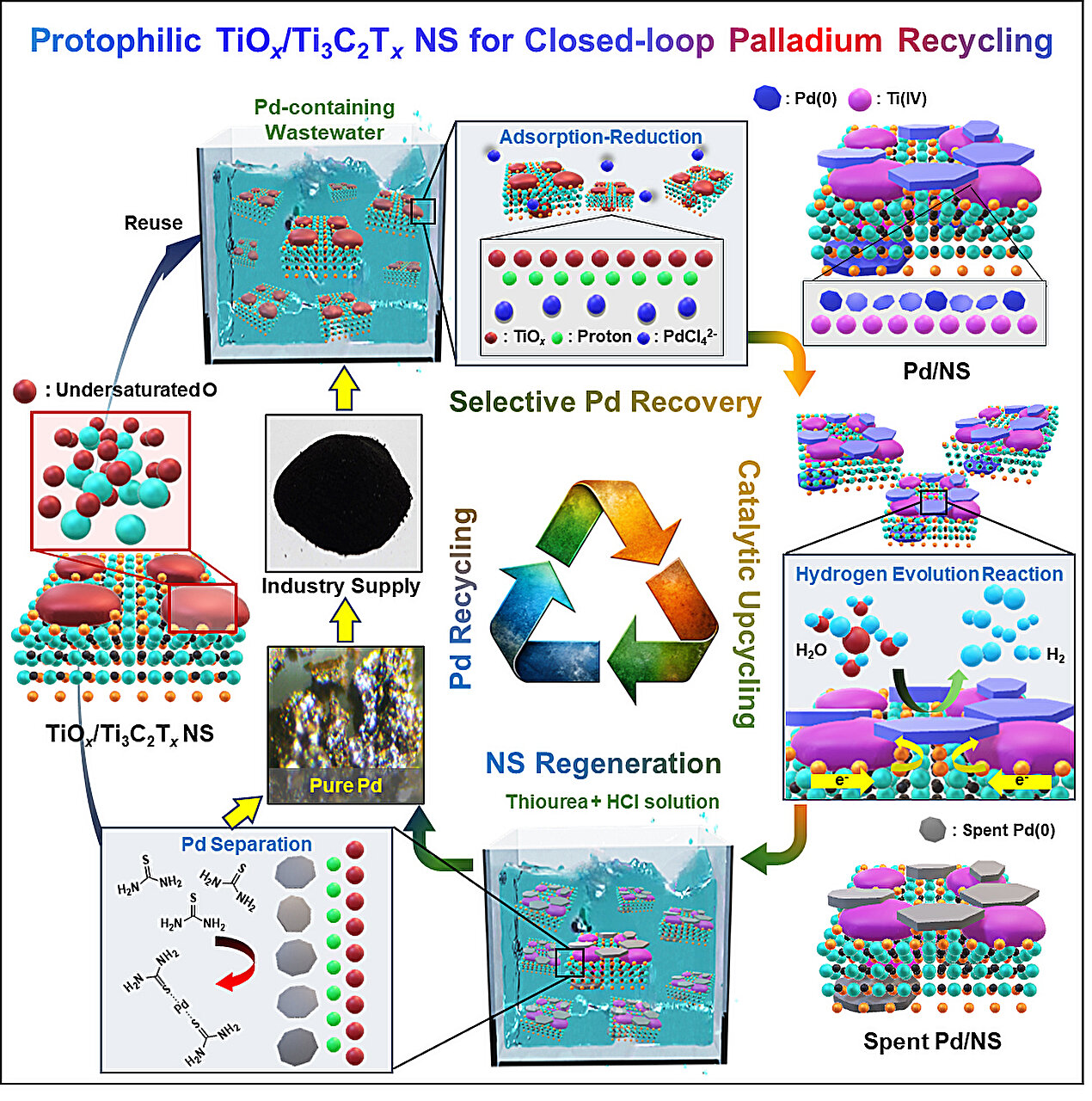
A dedicated research team, spearheaded by Dr. Jae-Woo Choi from the Water Resources Recycling Research Group and Dr. Jin Young Kim from the Center for Hydrogen and Fuel Cells at the Korea Institute of Science and Technology (KIST), has unveiled a groundbreaking, eco-friendly technology for palladium recovery. This innovative method centers on titanium-based maxene material, specifically TiOₓ/Ti₃C₂Tₓ nanosheets. The findings detailing this advancement have been published in the prestigious journal Advanced Functional Materials.
Overcoming Limitations of Existing Technologies
Previous palladium recovery methods developed internationally often necessitated strongly acidic environments. This requirement severely limited their practical application, especially in industrial settings where weakly acidic wastewater is far more common. The KIST team's novel technology directly addresses this limitation.
Key Features of the New Technology
The developed material boasts a unique characteristic: a high-density arrangement of TiOₓ nanoclusters with unsaturated oxygen on its surface. This structural feature is the key to its exceptional performance.
- Exceptional Purity and Speed: The technology can recover palladium with 99.9% purity in as little as 30 minutes. Crucially, this high level of efficiency is achieved even in weakly acidic conditions where traditional methods struggle.
- Environmentally Friendly Process: A significant advantage is the elimination of toxic chemicals and the need for an external power supply. The recovered palladium naturally reduces to its metallic state, allowing for straightforward separation via simple filtration.
- Reduced Energy and Carbon Footprint: Compared to existing processes that rely on strong acids, this new method promises substantial reductions in energy consumption and carbon emissions.
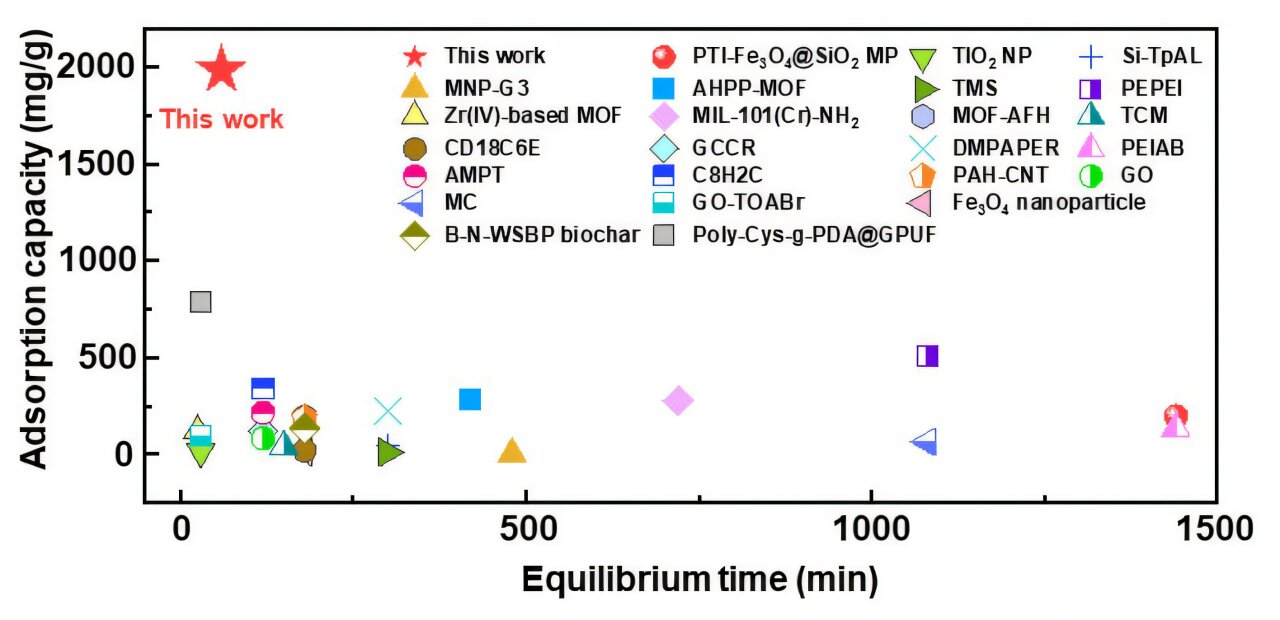
- Superior Adsorption Capacity: The material demonstrates a world-leading adsorption performance, capable of capturing an impressive 1,983 mg/g of palladium.
- Durability and Reusability: The technology exhibits remarkable stability and reusability. It maintains approximately 90% of its efficiency even after more than 10 cycles of reuse, underscoring its long-term viability.
A Circular Economy for Precious Metals
The recovered palladium, in the form of a palladium-nanosheet composite, can be directly recycled for use as a hydrogen evolution catalyst. This opens the door to a truly closed-loop precious metal recycling system, transforming waste into valuable resources.
- Room Temperature Operation: The process operates at room temperature, eliminating the need for high-temperature processing or harsh acidic chemicals. This contributes significantly to its reduced carbon footprint, with potential reductions of up to 80% or more compared to conventional methods.
- Cost-Effectiveness: The absence of electricity usage and the high reusability of the material translate into lower cost burdens for industrial applications.
- Versatile Applications: The technology's broad applicability is another major advantage. It is suitable for a wide range of industries, including refining, petrochemicals, automotive, and hydrogen fuel cells. Furthermore, it can be employed to recover palladium from electronic waste, such as discarded smartphones and circuit boards.
Future Outlook and Commercialization
The KIST researchers are optimistic about the future of this technology. They plan to further refine it to enable real-time treatment of palladium-containing wastewater generated in industrial settings. Their ultimate goal is to establish a circular resource ecosystem where recovered palladium is seamlessly reintroduced into the production cycle as both a catalyst and an electronic material.
Through technology transfer and commercialization efforts, the team aims to bolster South Korea's self-sufficiency in precious metal recovery. Future expansion plans are already in motion, with the development of recovery technologies for other precious metals like platinum, gold, and silver.
Dr. Jae-Woo Choi highlighted the transformative potential of this research, stating, "This research represents a technological turning point that can contribute to the self-sufficiency of Korea's resource circulation system and reduce dependence on precious metal imports by enabling the easy recovery of precious metals previously discarded in spent catalysts or electronic waste. We plan to enhance commercialization potential by developing a modular recovery system in the future."
Collaborator Dr. Jin Young Kim added, "We confirmed that the recovered palladium can be applied not merely as recycled material, but as an electrochemical electrode catalyst material for producing high-efficiency hydrogen. We verified the potential for it to be utilized not as a 'discarded metal,' but as a circular resource supporting clean energy production."


No comments:
Post a Comment