
Cosmic Collision Reveals Trio of Actively Feeding Supermassive Black Holes
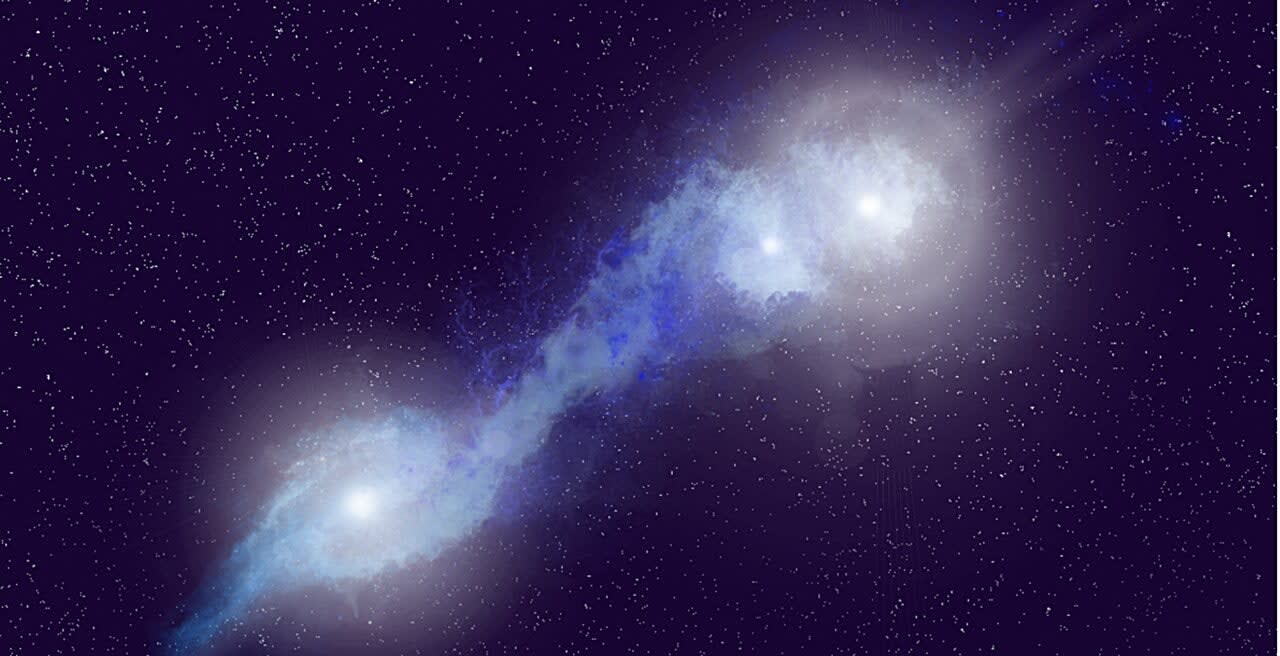
In a celestial ballet occurring approximately 1.2 billion light-years away, astronomers have identified an exceptionally rare cosmic phenomenon: three galaxies locked in a gravitational embrace, each with a supermassive black hole at its core actively devouring matter and emitting powerful radio waves. This remarkable system, designated J1218/J1219+1035, offers scientists an unprecedented opportunity to observe the intricate processes by which galactic collisions ignite and fuel the growth of central black holes.
The groundbreaking research, spearheaded by Dr. Emma Schwartzman of the U.S. Naval Research Laboratory, utilized high-resolution radio telescopes to pinpoint compact radio "cores" within each of the three galaxies. These cores are definitive indicators of active galactic nuclei (AGN), regions powered by supermassive black holes actively accreting surrounding gas and dust.
This discovery marks J1218/J1219+1035 as the first confirmed "triple radio AGN," a system where three active black holes within a single interacting group are all detectable through radio observations. Furthermore, it represents only the third confirmed triple AGN system identified in the relatively nearby universe.
A Gravitationally Bound Ensemble
The three galaxies are situated close enough to be gravitationally bound. Two of the galactic nuclei are separated by roughly 22.6 kiloparsecs, while the third is located approximately 97 kiloparsecs from this close pair. The galaxies exhibit distinct tidal features—long streams of stars and gas—that are clear visual evidence of their mutual gravitational pull and an ongoing merger.
Unveiling the System: A Journey Through Infrared and Optical Observations
The initial clues to this extraordinary system emerged from data gathered by NASA's Wide-field Infrared Survey Explorer (WISE). Mid-infrared wavelengths are particularly adept at detecting dusty, obscured AGN that might otherwise remain hidden in visible light. Dr. Schwartzman explained that her team assembled a primary sample of 133 candidate dual-AGN pairs from the AllWISE Bright Source Catalog. This selection process involved a specific "color cut" designed to identify potential AGN, requiring a W1 minus W2 magnitude difference of at least 0.8, along with a brightness cut in W2 and stringent signal-to-noise and photometry requirements.
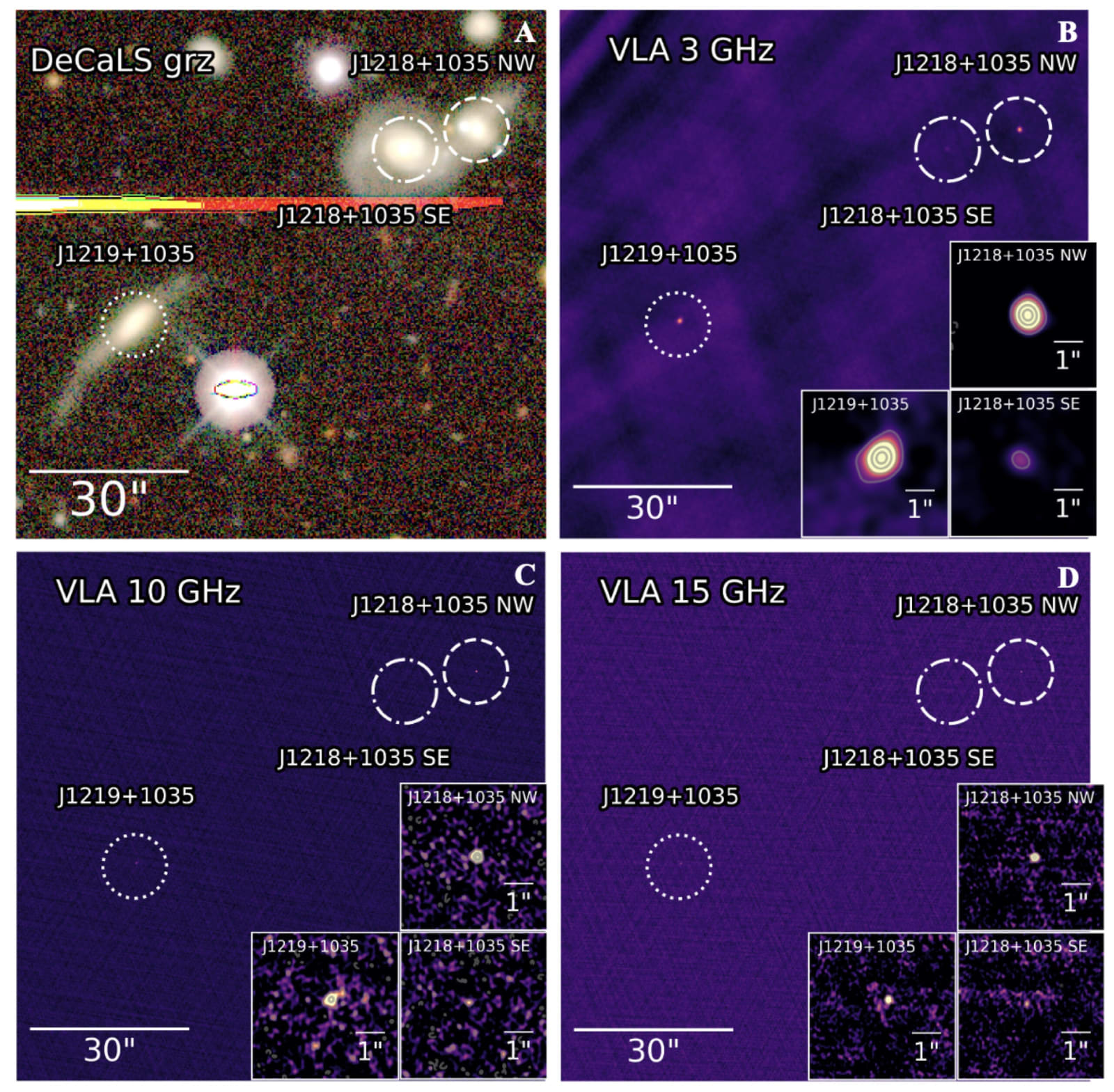
This meticulous infrared survey flagged a promising pair within J1218/J1219+1035. Two galaxies, identified as J1218+1035 NW and J1218+1035 SE, met the WISE color criteria. Their spectroscopic redshifts were in close agreement, and optical images revealed distorted shapes characteristic of interacting galaxies.
A third galaxy, J1219+1035, was observed at a greater distance. It also shared a similar redshift with the close pair and appeared gravitationally linked to the system, evidenced by a prominent tidal tail. However, unlike the tightly bound pair, J1219+1035 did not exhibit mid-infrared colors that unequivocally signaled an AGN. This raised a critical question: was the third galaxy's luminosity driven by an active black hole, or were other astrophysical processes at play?
The Limitations of Visible Light and the Need for Sharper Tools
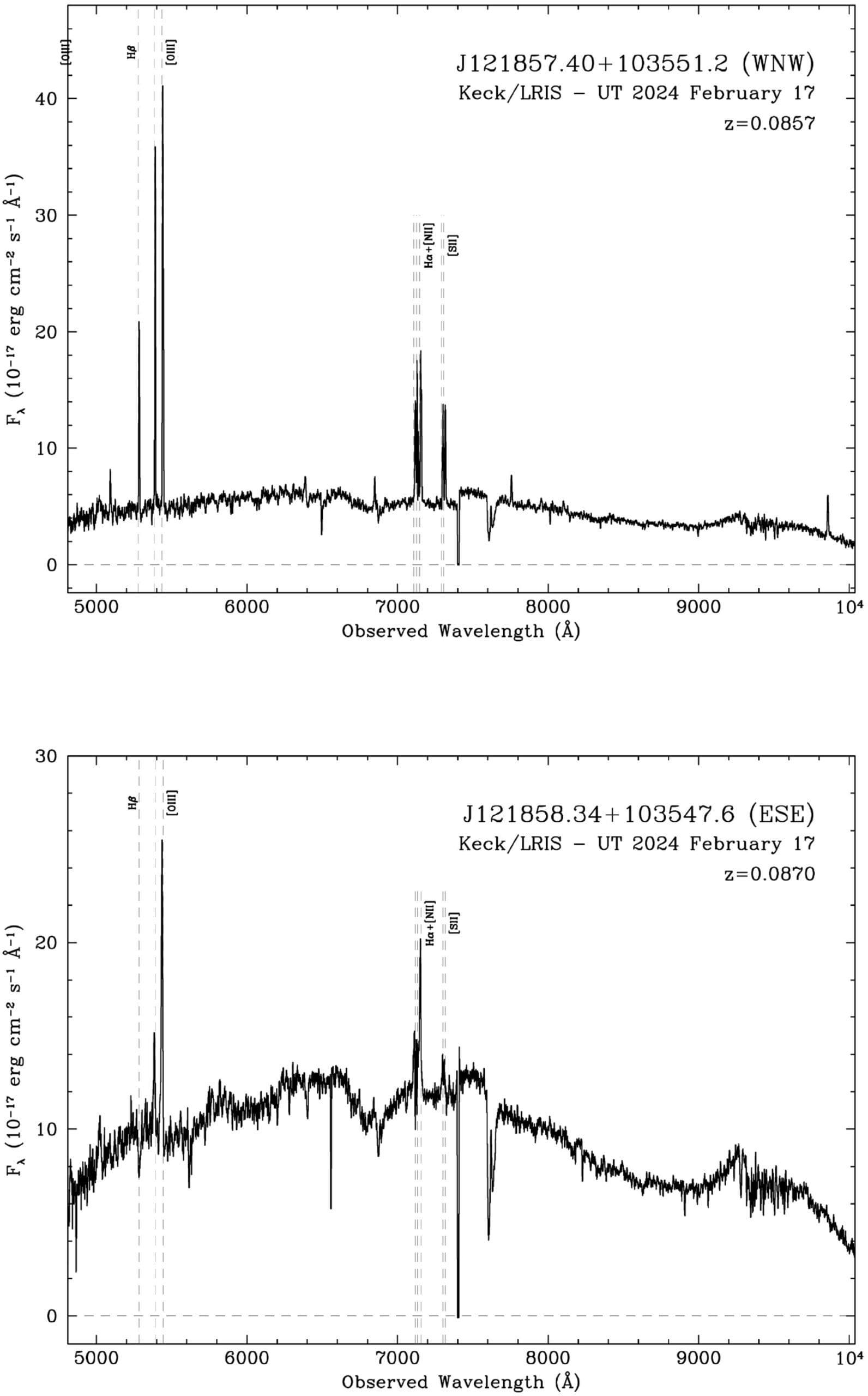
Initial optical spectral analyses had already hinted at activity within parts of the system. J1218+1035 SE had previously been classified as a narrow-line Seyfert II galaxy, a strong indicator of an AGN. J1219+1035 displayed a "composite" spectral signature, suggesting its emissions could originate from both star formation and an AGN.
However, composite line ratios can be ambiguous, as they can arise from multiple sources. Star formation, shock heating, or even older stellar populations can produce signals that mimic those of AGN. To further investigate, the team obtained follow-up optical spectra of the close pair using the Keck Observatory's Low-Resolution Imaging Spectrometer. These observations confirmed a shared redshift for the pair, but the NW nucleus still lacked a definitive optical classification.
The quest for conclusive evidence of three active black holes necessitated a more powerful observational tool.
Radio Imaging Provides Unambiguous Proof
That tool proved to be high-resolution radio imaging conducted with the U.S. National Science Foundation's Karl G. Jansky Very Large Array (VLA). Operating in its highest-resolution A configuration, the VLA captured detailed radio maps of the system at frequencies of 3, 10, and 15 GHz. At each frequency, the team detected compact, unresolved radio sources precisely aligned with the centers of each galaxy. This precise alignment is crucial, as it strongly suggests nuclear activity rather than emissions from more diffuse star-forming regions.
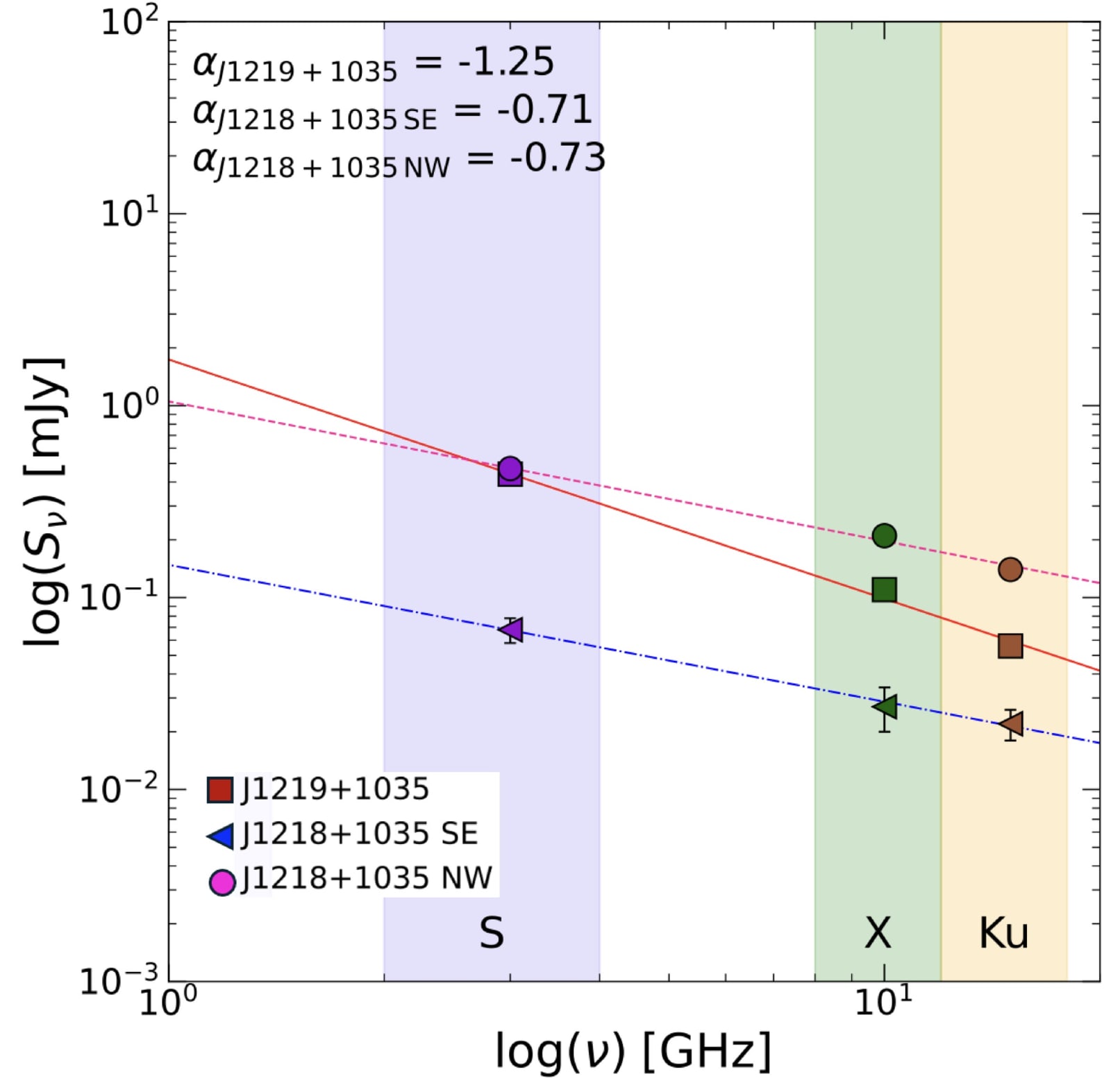
The observed radio signals exhibited characteristics consistent with AGN emission. Two of the detected cores displayed typical "steep" radio spectra, while the third showed an even steeper spectrum. This means their radio brightness diminished with increasing frequency in a manner expected for synchrotron radiation—the type of emission generated by high-energy particles accelerated in magnetic fields near black holes and their associated jets.
To further constrain the compactness of one of the radio cores, the team employed the U.S. National Science Foundation's Very Long Baseline Array (VLBA), which offers even finer resolution. While the VLBA did not directly detect J1218+1035 SE, its non-detection provided a crucial upper limit. This limit implied a brightness temperature exceeding what star formation alone could typically produce, thereby bolstering the AGN interpretation.
Collectively, the evidence from both the VLA and VLBA observations unequivocally confirmed that all three galaxies host active nuclei and that these nuclei are compact and radio-bright. The researchers noted that none of the individual sources met the standard criteria for "radio loud" galaxies. Nevertheless, their radio cores and spectral properties align perfectly with the expected behavior of AGN.
"Triple active galaxies like this are incredibly rare, and catching one in the middle of a merger gives us a front-row seat to how massive galaxies and their black holes grow together," Dr. Schwartzman stated. "By observing that all three black holes in this system are radio-bright and actively launching jets, we’ve moved triple radio AGN from theory into reality and opened a new window into the life cycle of supermassive black holes."
The Significance of Triple Systems in Understanding Cosmic Evolution
Current astronomical models predict that galaxies grow through a continuous process of mergers. In this scenario, larger galaxies are formed by the accretion of smaller ones. During these galactic mergers, the central supermassive black holes do not immediately coalesce. Over vast timescales, gravitational forces and internal friction within the merging galaxy gradually draw these black holes closer together.
While most confirmed systems involve two active black holes, triple systems are far more uncommon, particularly in the local universe. These rare configurations provide invaluable opportunities to test theoretical models regarding the frequency with which multiple black holes become active during merger events. They also enable researchers to study the complex dynamics of gas inflow during chaotic galactic interactions.
Prior to this discovery, only two triple AGN systems were confirmed in the local universe undergoing ongoing mergers: HCG 16 and J0849+1114. Both of these systems required evidence gathered across multiple wavelengths for their confirmation, and even then, radio data for J0849+1114 did not clearly indicate activity in all three nuclei. The comprehensive radio evidence for all three active nuclei in J1218/J1219+1035 sets it apart and makes it a particularly significant find.
The detailed findings of this research are published in The Astrophysical Journal Letters.


No comments:
Post a Comment