
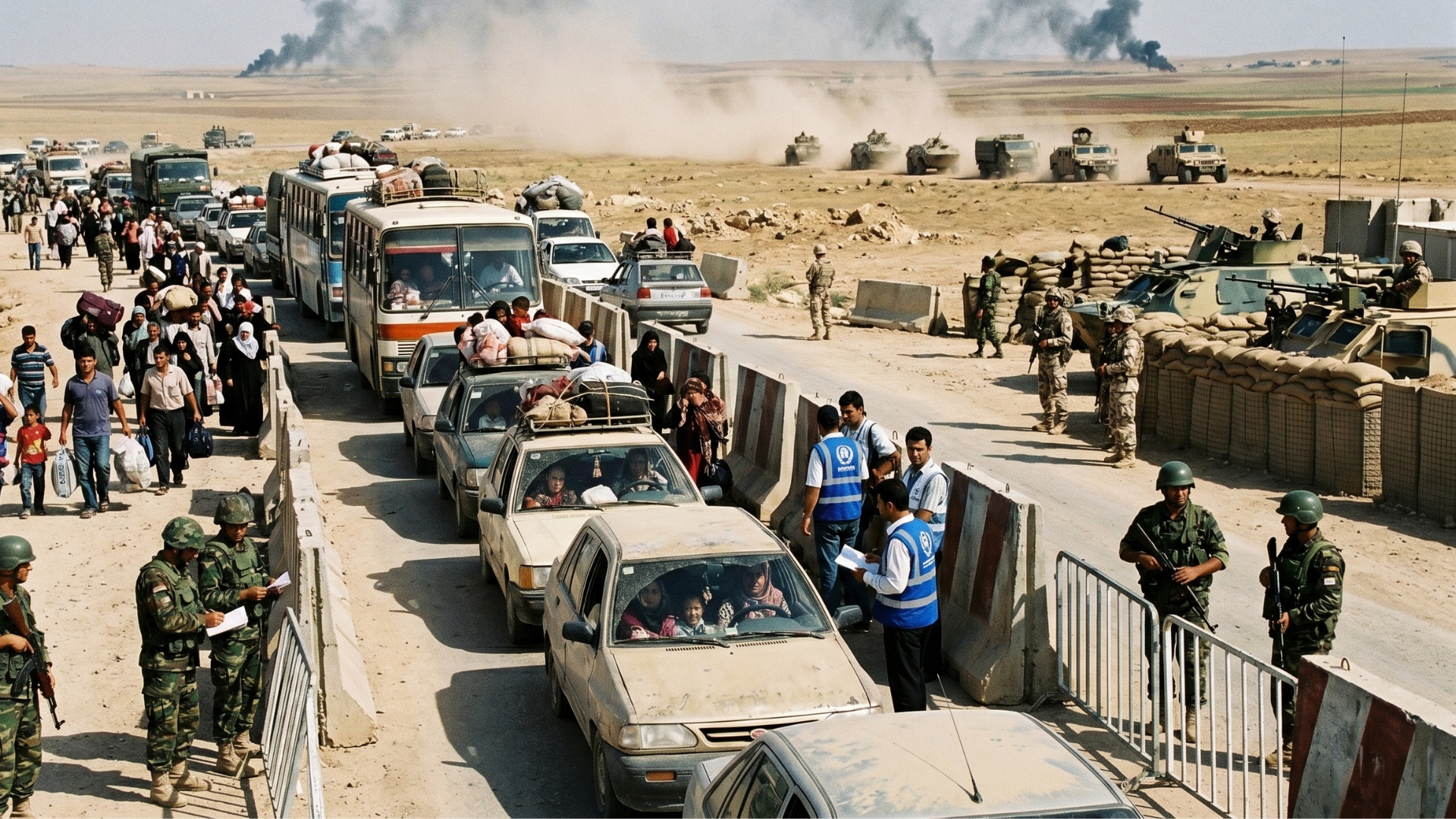
Local conflicts become regional wars when the fighting starts to affect the interests, territory, or internal stability of nearby states. Once cross-border attacks, proxy involvement, refugee pressure, trade disruption, or ideological alliances widen the number of actors involved, the war stops being only about one country’s internal struggle and starts to reshape an entire region’s security map.
For civilians, regional escalation usually means the war becomes harder to escape and harder to contain. Families flee across borders, host communities come under strain, aid systems are overwhelmed, and countries already coping with poverty or political fragility can be destabilized by sudden inflows of displaced people and the spread of armed violence. UNHCR says major recent crises have shown how conflict spillover and mass displacement can unsettle neighboring states as well as the country at war.
Borders Rarely Stop Armed Violence
One of the simplest reasons local wars spread is that borders are often politically important but operationally weak. Armed groups can move across frontiers, use neighboring territory for refuge, smuggling, recruitment, or logistics, and draw other states into military or law-enforcement responses. The ICRC has noted that conflict in fragile states often produces cross-border spillover effects that increase the number of players involved and add an international dimension to the violence.
This matters because once violence begins crossing borders, neighboring governments no longer see the war as someone else’s internal problem. It becomes a direct security concern, which raises the chance of troop deployments, airstrikes, covert action, and military partnerships that widen the battlefield.
Proxy Warfare Turns Nearby States Into Participants
Regional wars often emerge when outside powers decide they can advance their own interests through a local conflict. Instead of sending full conventional armies at first, they may fund, arm, train, or politically back local allies. That lowers the threshold for intervention while steadily internationalizing the war. SIPRI’s work on arms transfers and conflict trends reflects how external military support can deepen and prolong conflict dynamics.
Once several outside actors back different local factions, the original conflict can stop being primarily local in any meaningful sense. It becomes a proxy struggle layered onto the original grievances, with each sponsor fearing that withdrawal would hand victory to a rival. That is one reason regional escalation can continue even when the local population is exhausted by war.
Refugee Flows and State Fragility Can Spread Instability
Another path to regional war is humanitarian spillover. Large-scale displacement can strain fragile neighboring states, especially where public services, jobs, housing, and political institutions are already under pressure. Refugee inflows do not automatically cause conflict, but in volatile settings they can intensify ethnic tension, economic competition, and security fears, especially if armed actors move among civilian populations or if host governments feel abandoned by the international system.
This is part of why regional escalation is not only a military story. It is also about governance. A nearby state does not need to be invaded to be destabilized. Sometimes the combination of displacement, border insecurity, illicit trade, and political polarization is enough to draw it into the conflict directly or indirectly.
Trade Routes, Sea Lanes, and Strategic Corridors Raise the Stakes
Conflicts spread faster when they threaten something bigger than the territory being fought over. A local war near a major shipping lane, pipeline corridor, border crossing, or energy hub can quickly become a regional crisis because surrounding states and outside powers depend on those routes. What begins as a local clash then acquires broader economic and strategic significance. The IMF warned this month that war in the Middle East can generate wider regional and even global spillovers through energy and trade disruption, while UNDP said escalating conflict can drive poverty effects far beyond the directly affected states.
That broader exposure changes decision-making. States that might otherwise stay out may intervene to protect trade, deter adversaries, reassure allies, or keep a local war from threatening a chokepoint they consider vital. Regionalization becomes more likely when leaders believe non-intervention is costlier than intervention.
Alliances, Identity, and Retaliation Create Chain Reactions
Not every escalation is driven purely by cold strategic calculation. Some wars spread because governments feel bound by alliances, sectarian ties, ideological solidarity, or domestic political pressure to respond. A strike on one ally, militia, or border force can trigger retaliation by another, turning separate fronts into a connected conflict system. The ICRC recently warned that major military escalation in the Middle East was creating a dangerous chain reaction across the region, which is exactly how regional wars often take shape in practice.
These chain reactions are dangerous because they compress diplomacy. Leaders may feel they must respond quickly to avoid looking weak, even if they do not want a wider war. In that atmosphere, miscalculation matters as much as intent. A local confrontation can become regional not because every actor planned it that way, but because each response triggers another.
What Makes Regional Escalation So Hard to Reverse
Once a conflict regionalizes, peacemaking becomes much harder because there are now several wars inside one war. Local actors still fight over power, territory, and survival. Neighboring states fight over borders and influence. Outside powers pursue deterrence, access, prestige, or alliance management. Humanitarian crises deepen, and every actor fears that compromise will benefit someone else. Crisis Group’s conflict tracking repeatedly highlights how quickly situations can drift toward wider violence when these layers accumulate.
That is why early containment matters so much. Preventing cross-border escalation usually requires more than a ceasefire inside the original conflict zone. It often means border monitoring, pressure on outside sponsors, humanitarian support for neighboring states, protection of trade routes, and diplomacy that addresses regional fears rather than only local grievances.
What Comes Next
The main lesson is that local conflicts do not become regional wars by accident alone. They widen through identifiable pathways: border spillover, proxy intervention, displacement, economic disruption, alliances, and cycles of retaliation. Once enough of those pathways activate at the same time, the conflict stops being containable within one state. By then, the challenge is no longer just ending a local war. It is preventing a whole region from reorganizing itself around permanent insecurity.


No comments:
Post a Comment