
2026 Yamaha R7 first ride review: The everyday sportbike?
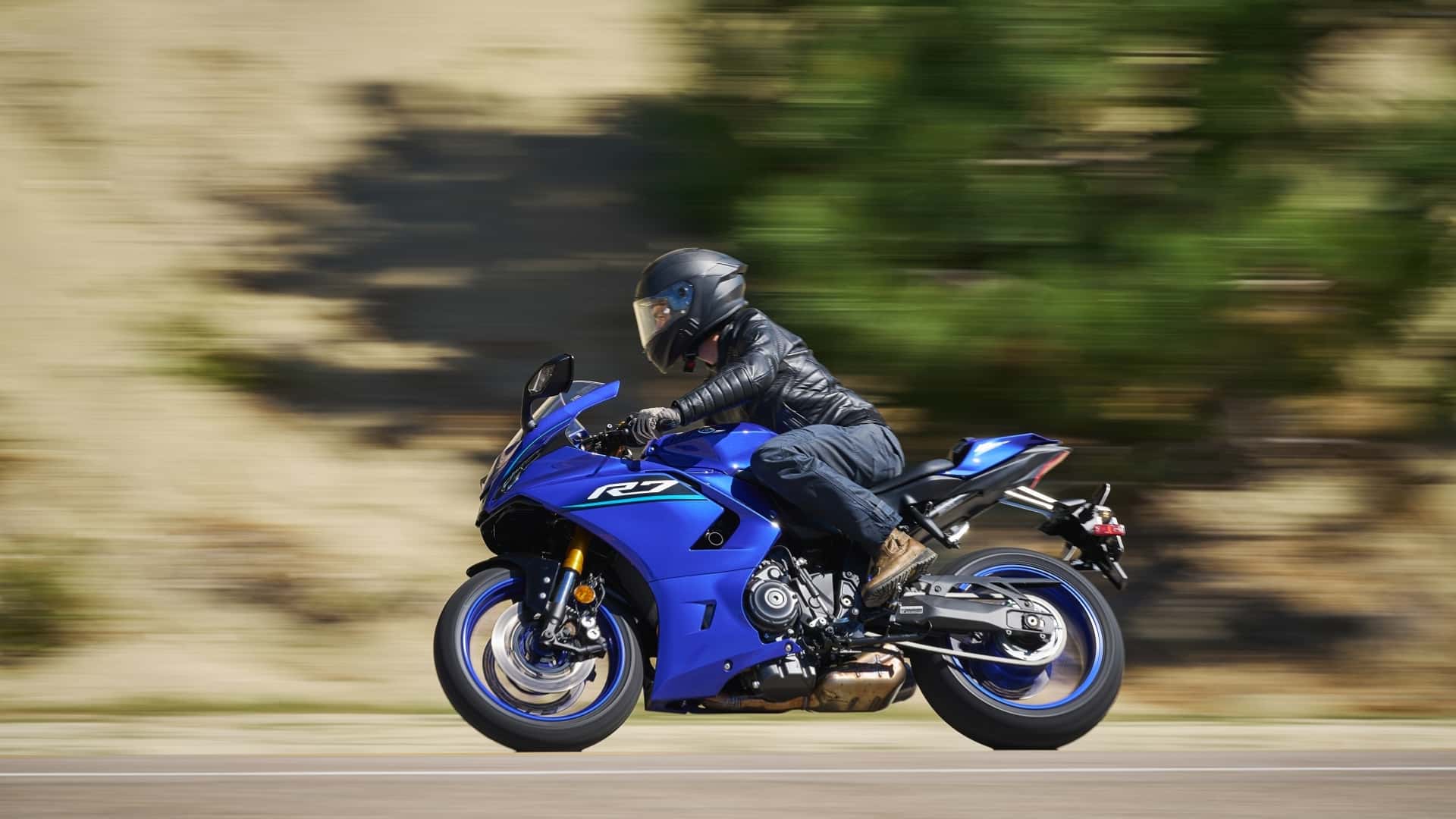
Yamaha kept the best parts and changed the rest with a major update to the R7 for 2026. Here's what we have to say after our first hands-on ride with the motorcycle.
I had a photo of a blue-and-white Yamaha R6 taped to a plastic cup in my bedroom as a teen. "Justin's Motorcycle Fund" was scribbled above the image of the bike. I'd pile dollar bills into the cup whenever I could, hoping to one day collect enough coin to fulfill my dream of joining Laurence Fishburne and the rest of the Biker Boyz.
It was a long shot. I hadn't ridden anything greater than 70cc up until that point and wouldn't until I was 25 years old. But that R6 seemed attainable, and the Team Yamaha blue-and-white livery did something for me. So, I daydreamed.
The first-generation R6 won the World Supersport Championship the year it debuted, and the two years following—1999, 2000, and 2001, respectively. It was a force to be reckoned with, producing 120 horsepower and tipping the scales at just 365 lbs. It was a track-focused weapon sold to the masses, offering riders a lighter and slightly slower alternative to the mighty R1. But it wasn't an entry-level motorcycle by any means.
As much as I wanted it to be my first, I quickly realized that a 600cc, four-cylinder Supersport probably wasn't the best choice. So, I swiped right on an old Kawasaki KZ440, and joined the Cretins M.C. as they rode from bar to bar on old Japanese machines fashioned in the Ton-Up aesthetic that was all too popular at that time.
But the image of that 2001 Yamaha R6 has lingered in my mind for years. Decades. And I'll admit, I was a little crushed when I heard that the Tuning Fork company killed the R6 platform in 2020, replacing the middle-weight, high-strung four-cylinder Supersport with a lumpy twin-cylinder machine badged as the R7.
Since my introduction to riding motorcycles on the road, I've had the good fortune of throwing a leg over just about everything. From massive adventure machines to Superbikes that make more horsepower than my V8-powered van. I've ridden chrome-laden American touring monsters across the continent nearly a dozen times and have danced with the Devil on Italian sport-touring missiles, riding twisting scribbles of concrete around islands off the coast of Africa.
All that hasn't made me fast, though. Maybe the fastest of the slow guys, or the slowest of the fast guys, I guess, but I wouldn't call myself quick by most measures. I can keep up, though, and I enjoy the chase, following my fast journalist friends up infamous California canyons whenever the opportunity presents itself.
And present itself it did, with the introduction of the much-updated, almost all-new 2026 Yamaha R7 being held in north county San Diego, with a ride up Palomar Mountain planned, and a stop for pie part of the program.
According to Yamaha, the R7 is the best-selling bike in the Japanese brand’s lineup. Not the best-selling sport bike or street motorcycle. No, the best-selling bike they make. Period. They sell more R7s than PW50s, and more than any off-road model they make, for that matter. Which came as kind of a surprise, honestly. Sure, it’s priced under $10,000 and features sportbike stylings without the high strung powerplant you’d traditionally find in a bike at that size and price (see: R6), but it is still a sportbike, however you shake it. And I kind of thought people stopped buying those?
Apparently, I’m not the only one daydreaming about bright blue sportbikes…
Yamaha did their homework with this one, namely via focus groups who asked that some rather substantial changes be made to the model. But they still wanted a sub-$10k Supersport styled motorcycle, so, the 2026 R7 is more than an update to an existing platform, it’s a re-think.
According to their engineers, the only thing that remains from the outgoing model is the motor, a 689cc CP2 parallel-twin powerplant that you’ll find in both the MT-07 and Ténéré 700. And while the motor remains the same, Yamaha threw their Yamaha Chip Controlled Throttle (YCC-T) tech onto the R7 for 2026 (more commonly referred to as throttle-by-wire) along with other electronic updates taken from the top-shelf YZF-R1 machine. There’s a 6-axis IMU which provides all the appropriate rider aids (traction control, wheelie control, engine brake management, launch control, et al) as well as the Yamaha Ride Control (YRC) system which lets you tailor power delivery.
You’ll also find a new 5-inch TFT display that features smartphone connectivity and navigation, and an updated quick-shifter that works both ways (the previous generation’s quick-shifter only shifted up). You can even enable a MotoGP shift pattern if you’d rather click down to shift up.
That’s YZF-R1 level technology in a $9,399 (MSRP) package.
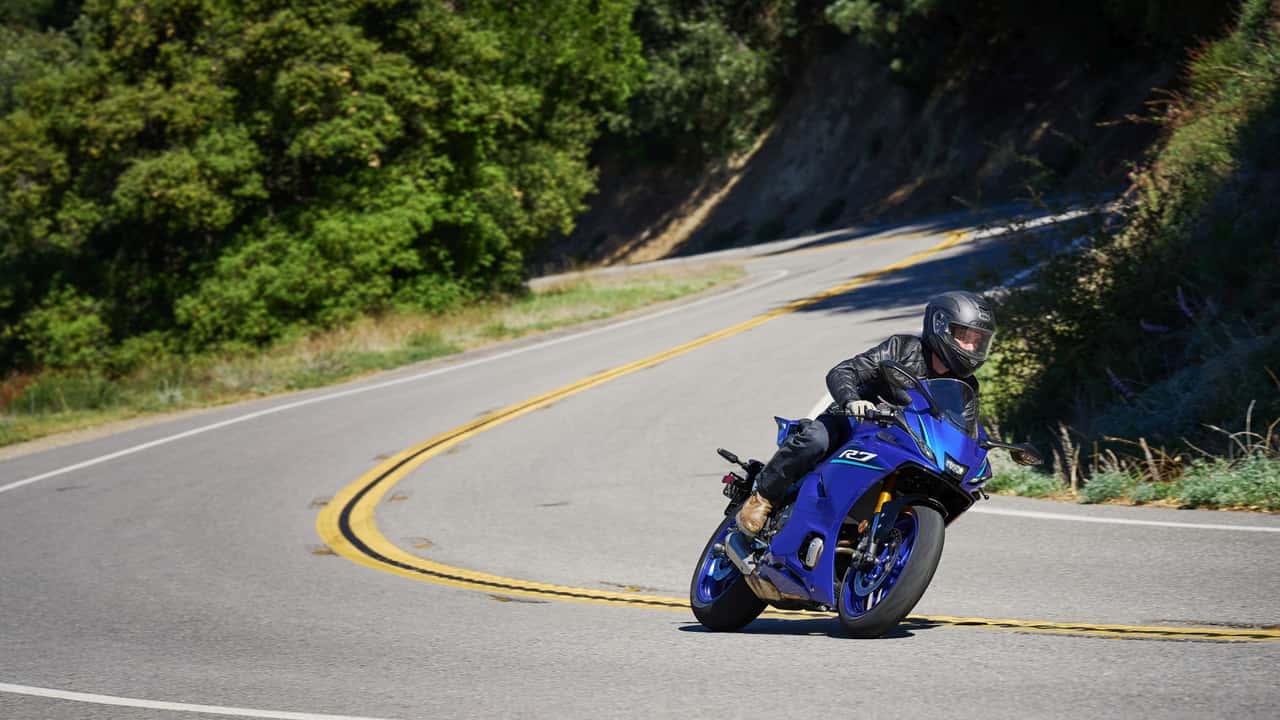
The 2026 R7 offers four different ride modes—Sport, Street, Rain and Custom—along with four different track modes that provide you with the opportunity to turn off the rear ABS. The CP2 parallel-twin engine produces a claimed to 73-horsepower at 8,750 rpm and makes 50 lb-ft of torque at 6,500 rpm . Now, that’s not YZF-R1 territory, but after my weekday rip up Palomar Mountain Road, I can attest that those numbers are enough.
Plenty, in fact.
The R7 is equipped with a new 41mm KYB inverted front fork which allows for full compression, rebound, and preload adjustments. They’ve also outfitted the new R7 with “SpinForged” wheels, a proprietary Yamaha design, which reduces weight (apparently 4% over the outgoing model) and inertial movement. The wheels are wrapped in Bridgestone Battlax Hypersport S23 tires and slowed by dual four-piston calipers grabbing 298mm discs. The R7 carries 3.7 gallons of fuel, has a 32.7-inch seat height and tips the scales at 417-lbs soaking wet.
Our ride was brisk—roughly 130 miles in total—and abbreviated only by breaks to shoot photos and eat apple pie. We made our way out of town, splitting lanes along the slow-going Interstates of Southern California. The R7 runs up to freeway speeds quickly, the torquey twin-cylinder motor providing an initial thrust and a throaty sound. But it runs out of power towards the top end of the RPM spectrum, as expected.
The rev limiter comes alive around 10,500 rpm, and a noticeable chop of throttle tells you that you’ve reached the end of the RPM road. But the low-end torque, all 50 lb-ft of it, is at your disposable in the lower revolutions, meaning the R7 comes off the line quickly, and the power is usable, especially on crowded streets or when passing a lazy semi-truck. The cruise control, a newly added feature, and one that owners of the outgoing generation had asked for, came in handy for the 45-minute-long highway ride we had to endure.
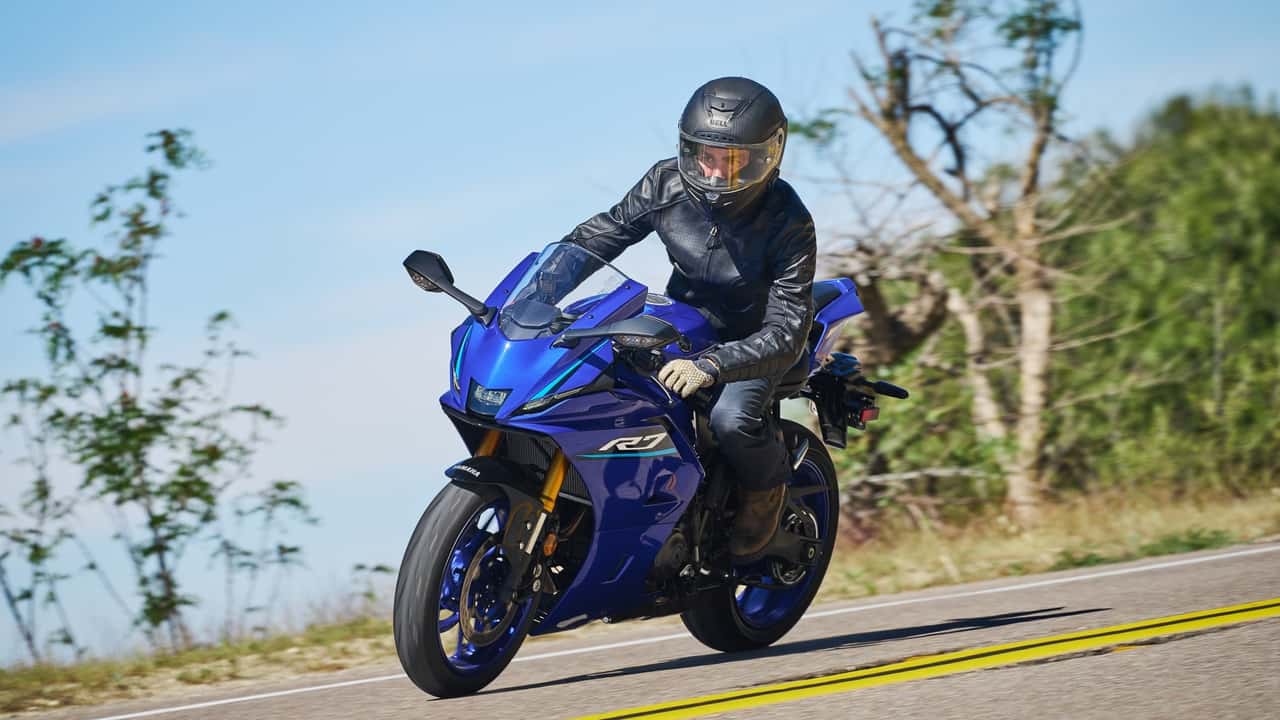
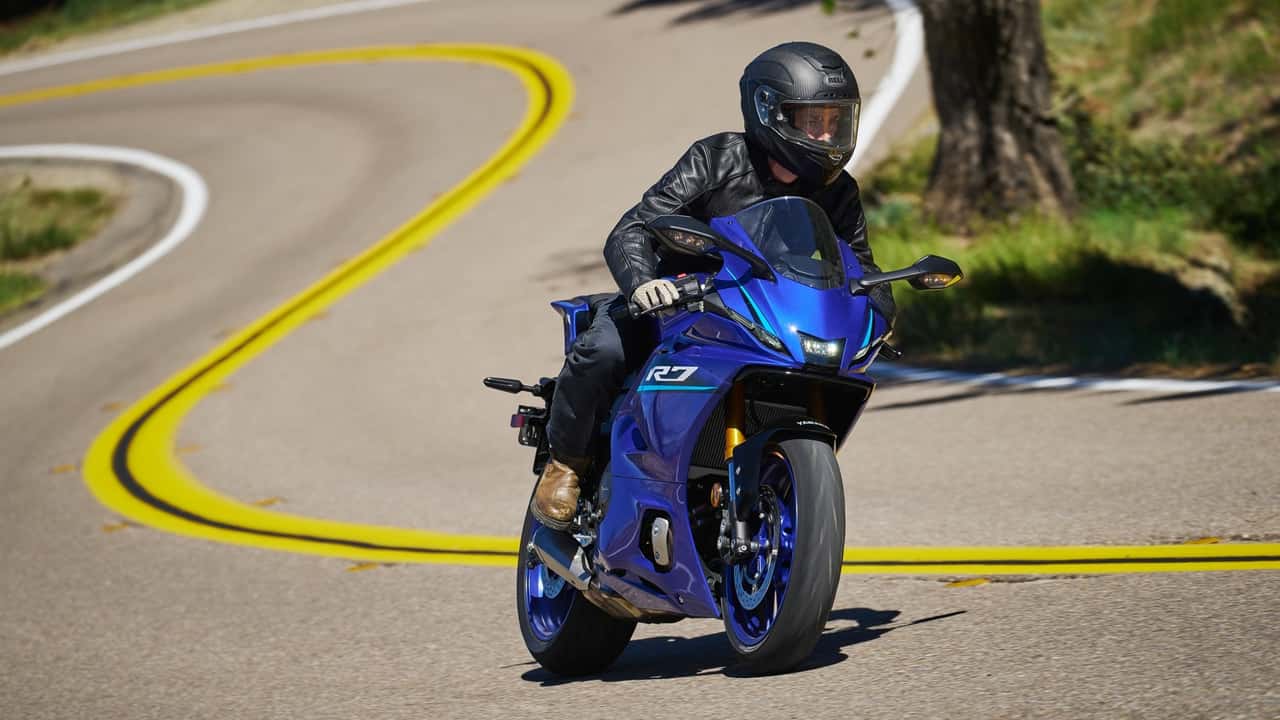
The Interstate gave way to twisting two-lane blacktop as we climbed in elevation along Highway 76. Yamaha updated the ergonomics of the R7, namely raising the position of the clip-on handlebars and flattening the seat, which had previously been pointed down toward the fuel tank, causing undue discomfort in the between-the-legs department. The new ergos make the R7 more comfortable for day-to-day riding, but don’t take much, if anything, away from its ability to be ridden like a proper Supersport. As the curvature of the road increased, the R7 came out of its proverbial shell.
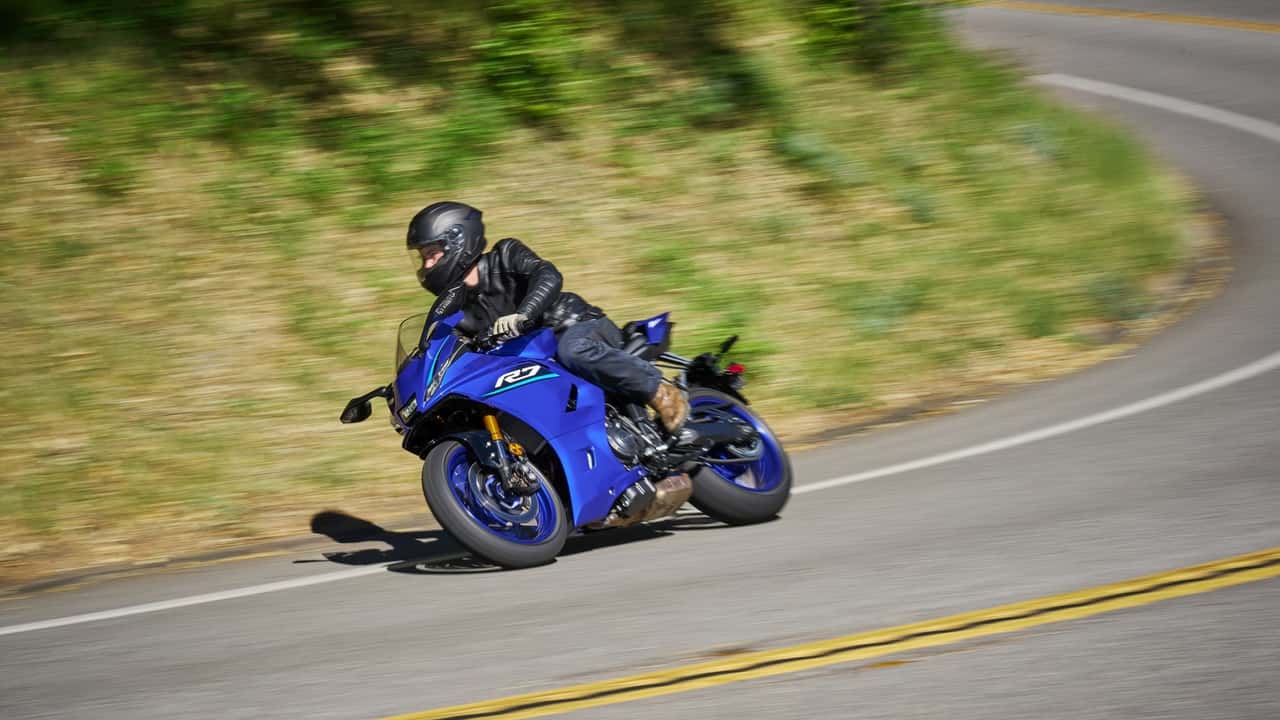
If you’ve never ridden Palomar Mountain Road, just imagine a MotoGP track in the middle of the woods with a painted yellow line down the middle. At least that’s what it felt like the first time. Sweeping corners lead into tight, off-camber, uphill turns. Fast, flowy stretches of pavement are laid out in front of you, linked together by quick shifts in bodyweight and riding position, then you’re hard on the brakes, looking for an apex as you lean into a right-hander that’s edged by a steep drop off on one side, and a mix of earth and stone and trees on the other.
The R7 didn’t mind.
In fact, it was here that the updated ergonomics and top-shelf technology truly shined. The motor carries momentum, using its abundance of torque to carry you into the next corner without rolling on the throttle much. The chassis, suspension, brakes and gearbox get along like a barbershop quartet. The quickshifter is just that, quick, and although the riding position has been made more user-friendly, it still felt like a sportbike, especially tipped into a corner at speed.
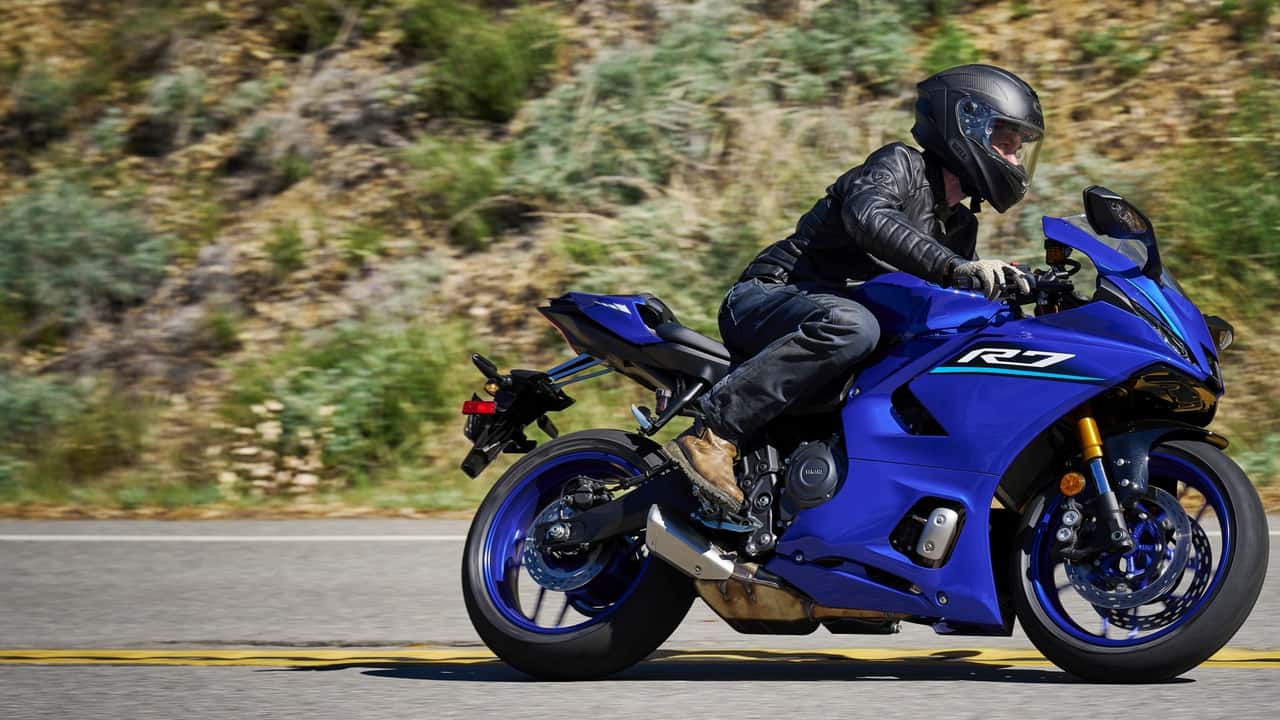
Friendly, that’s the best way I can describe the CP2 motor. It doesn’t put a lump in your throat, though. Not like a high-strung four-cylinder spun to 14,000 rpm does. It’s great on the city streets, or for logging miles on the Interstate, and didn’t mind being pushed hard up Palomar Mountain. But it’s not exciting. It’s not scary. Perhaps that’s the point, though. The 2026 R7 feels like an everyday sport bike, if there’s even such a thing. And while it’s hard to argue that a sport bike is appropriate for everyday riding, it seems as though that is, ultimately, what this motorcycle does most.
Is this the same bright blue sport bike I wished for as a teenager? No, not really. The 2026 R7 is a concession to the current motorcycle market. A multi-tool for the Millennial motorcyclist who doesn’t have the space or funds for a fleet of bikes. Can you take it to the track and grin like an idiot as you dance through corners? Yep. Will it make the ride to work more fun? No doubt. Does it lend itself to longer riders, with the cruise control clicked on just above the posted speed limit? Sure, why not. If the R7 is one thing, it’s a deal. A bike that will do more than you’re likely to ask of it, is packed with high-end technology, an approachable powerplant, better ergonomics and yet still maintains the sport bike aesthetic that teenage Justin daydreamed about.
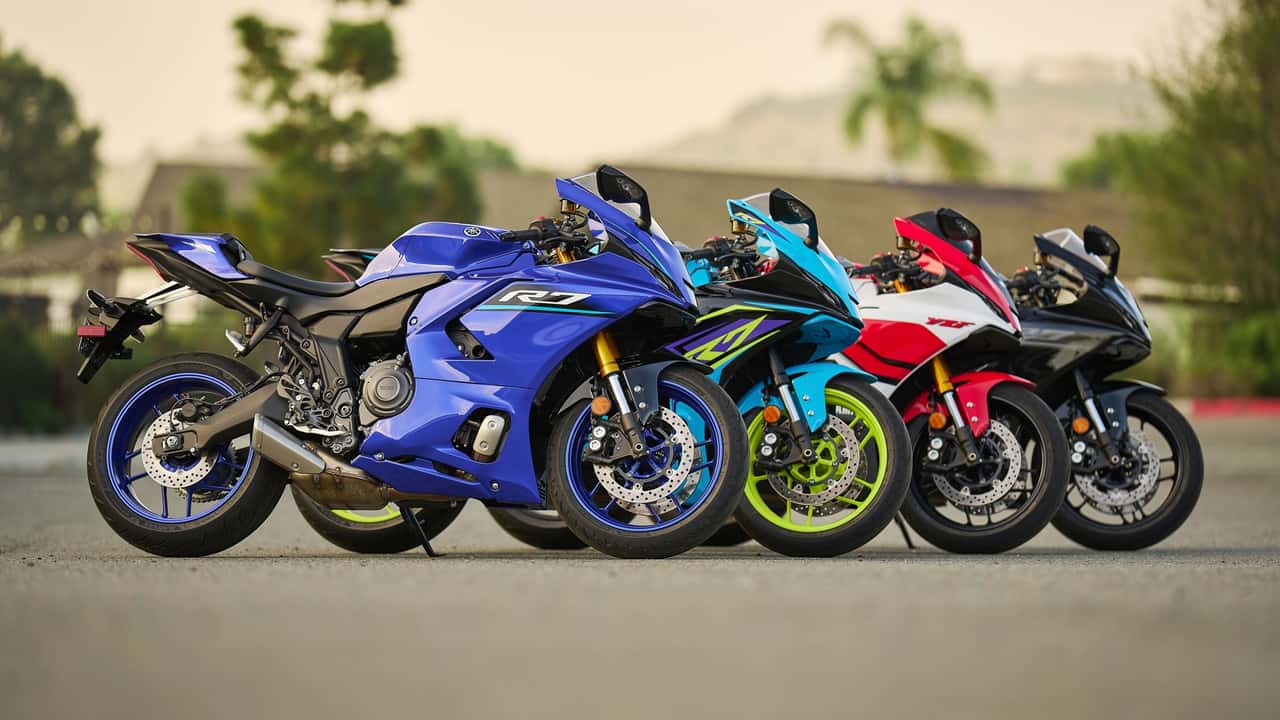
The 2026 Yamaha YZF-R7 will be available in four colors in the U.S. market: Team Yamaha Blue, Breaker Cyan and Raven will set you back $9,399 (MSRP), while the 70th Anniversary Edition with red and white speedblock livery will cost you an additional $300, at $9,699 (MSRP).
More Bikes, Sport Bikes
- Yamaha Made A Racing Series That Regular Humans Can Actually Enter
- The 2026 Kawasaki Ninja ZX-10 Just Reminded Us Why It’s The Ultimate Ninja
Post a Comment for "2026 Yamaha R7 first ride review: The everyday sportbike?"