
Iran's Strained Missile Might
Iran's Ballistic Missile Program Faces Significant Setbacks Amid U.S.-Israeli Offensive
The ongoing U.S.-Israeli offensive has inflicted substantial damage on Iran's critical ballistic missile infrastructure, impacting at least four key manufacturing sites and an estimated 29 launch locations within the first four weeks of hostilities. This extensive campaign, involving thousands of strikes across a broad spectrum of military targets, has significantly disrupted Iran's core military strategy, according to a comprehensive review of satellite imagery and expert analysis.
The strikes have targeted aboveground launching facilities, obstructed access to underground missile storage, and temporarily halted Iran's capacity for immediate new missile production. While these actions have undeniably degraded Iran's missile capabilities, experts caution that the program has not been entirely eradicated.
"They're still shooting. That's a key indicator," remarked Tom Karako, director of the Missile Defense Project at the Center for Strategic and International Studies, highlighting Iran's continued missile launches as a sign of its persistent capabilities.
Some analysts express skepticism about the possibility of completely destroying Iran's missile program. They point to the regime's history of rebuilding after previous attacks and its access to foreign supply chains that can replace damaged manufacturing equipment. Furthermore, the use of mobile missile launchers, whose exact numbers are unknown, presents an additional challenge to a complete dismantling of the program.
"I don’t see Iran making a fundamental change to their missile strategy if the regime survives," stated Nicole Grajewski, a nonresident scholar at the Carnegie Endowment. "Missiles are still going to be the ultimate deterrent against attackers and the foundational military strategy."
The destruction of Iran's missile program has been a stated primary objective of the Trump administration's strategy. Defense Secretary Pete Hegseth noted on March 19 that U.S. attacks had successfully targeted "the factories, the production lines that feed their missile and drone programs." Simultaneously, Israeli Prime Minister Benjamin Netanyahu asserted that Iran's missile and drone arsenals had been "massively degraded," with attacks destroying components essential for missile production.
While specific targets have not been exhaustively disclosed by the U.S. and Israel, official briefings have indicated a significant reduction in Iranian retaliatory missile attacks against neighboring countries. Defense Secretary Hegseth reported a 90% decrease in such attacks since the conflict's commencement on February 28. However, Chairman of the Joint Chiefs of Staff, Gen. Dan Caine, acknowledged that Iran retains substantial missile capabilities.
On March 21, Israel reported a notable escalation, claiming Iran fired intermediate-range ballistic missiles at the joint U.K.-U.S. Diego Garcia military base in the Indian Ocean, a distance of nearly 2,000 miles.
Production Sites Hit
The manufacturing, development, and testing of Iran's ballistic missiles are managed through a network of facilities overseen by the Islamic Revolutionary Guard Corps (IRGC) and Iran's Ministry of Defense. Four of the most crucial sites, responsible for producing missile fuel, have sustained severe damage from U.S. and Israeli strikes. This damage is reported to be more extensive than that inflicted during previous conflicts, including the 12-day war with Israel last June and attacks in October 2024.
These key production sites—Khojir, Parchin, Hakimiyeh, and Shahroud military complexes—are integral to the creation of critical missile propellants and the assembly of weaponry.
"If you don’t have propulsion, the missile’s aren’t going anywhere," explained Jim Lamson, a senior research associate at the James Martin Center for Nonproliferation Studies. Four experts who reviewed satellite imagery of these locations at the request of The Post concluded that the damage has likely halted Iran's production of short-range and medium-range ballistic missiles until these facilities can be rebuilt.
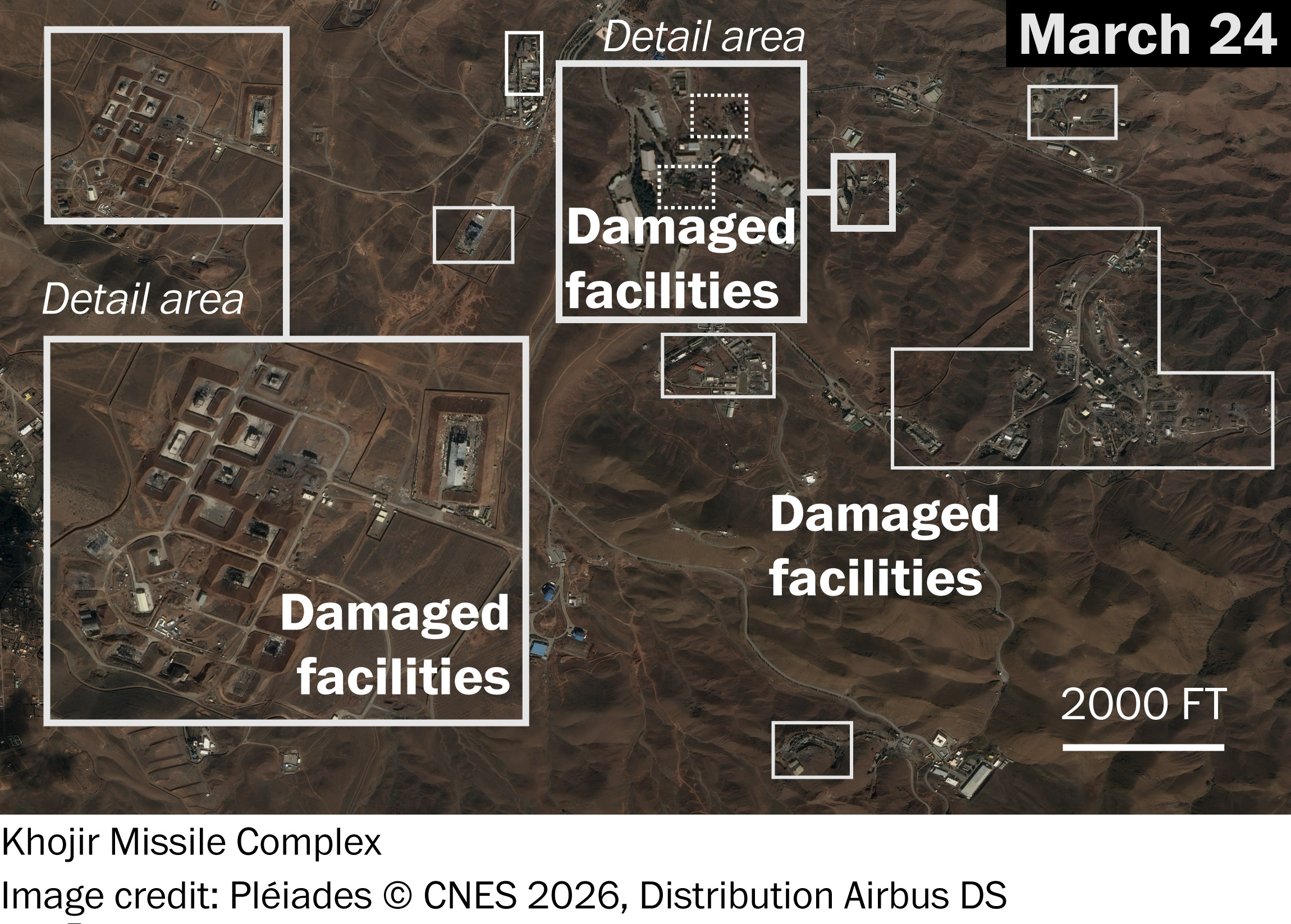
Satellite imagery analysis of the Khojir missile complex, situated east of Tehran, reveals that four main areas were targeted. These strikes focused on complex production systems responsible for manufacturing both solid and liquid fuels necessary for ballistic missiles, according to Sam Lair, a research associate at the James Martin Center for Nonproliferation Studies.
Ballistic missiles are designed to travel vast distances before descending at high velocities. Iran's arsenal utilizes missiles fueled by either solid or liquid propellants. Solid fuel is more commonly employed for shorter-range munitions and is generally more efficient during combat operations. Liquid propellants, typically used for longer-range missiles, require more time-consuming fueling processes, making them more susceptible to attack.
Detailed satellite imagery from March 24 indicates that at least 88 structures were destroyed at the Khojir site.
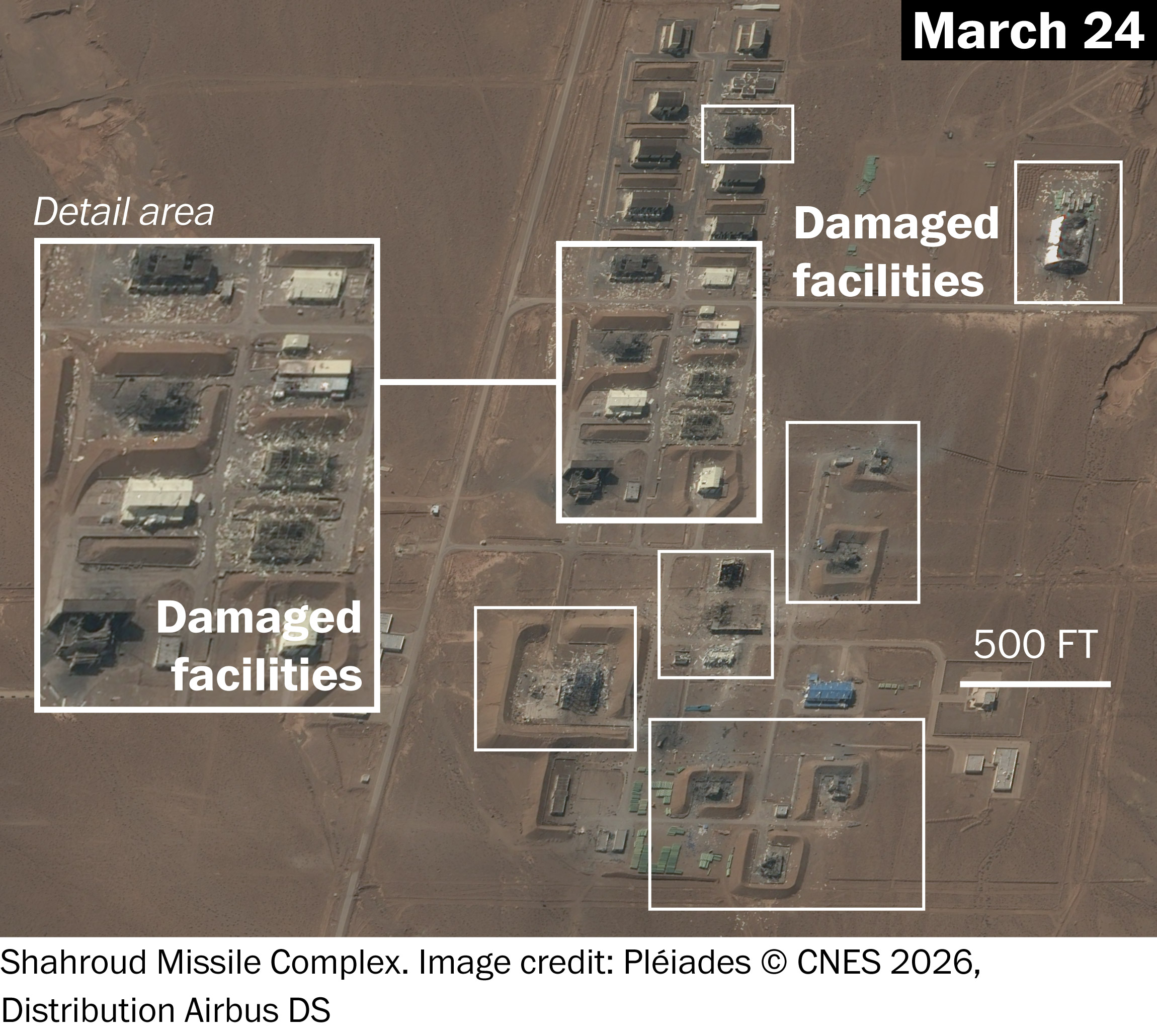
The IRGC's Shahroud production complex in northeastern Iran, a hub for the research, development, and mass production of solid fuel, was heavily attacked. Satellite imagery shows at least 28 structures at this complex were damaged or destroyed.
At the Parchin military complex, located east of Tehran and responsible for solid propellant production, 12 structures were impacted, according to imagery dated March 12. On the outskirts of the capital, the Hakimiyeh military complex sustained damage to 19 structures, including facilities involved in liquid propellant production and launcher assembly, as evidenced by imagery from March 14.
Sean O’Connor, an imagery analyst at the security intelligence firm Janes, communicated via email that if Iran is unable to reconstitute its missile forces, it will significantly diminish its primary defensive strategy in the Middle East.
Launch Bases Under Attack
Analysis of satellite imagery indicates that at least 29 missile launch bases have been targeted by airstrikes, severely undermining Iran's ability to deploy ballistic missiles. Experts estimate that Iran possesses approximately 30 ballistic missile launch sites, many of which feature underground storage facilities accessed via mountain tunnels. U.S. and Israeli strikes have demonstrably hit many of these tunnel entrances, effectively blocking access to stored weaponry, according to satellite imagery.
"These strikes will significantly hamper operations," Lair commented, adding that the destruction of base infrastructure means "it now takes longer to set up launchers, which gives the U.S. and Israel more time to identify and destroy them."
Missile bases located in central and western Iran are strategically positioned for medium-range strikes against Israel. Conversely, bases along the Persian Gulf are utilized for launching short-range missiles at Gulf states, as noted by Lamson.
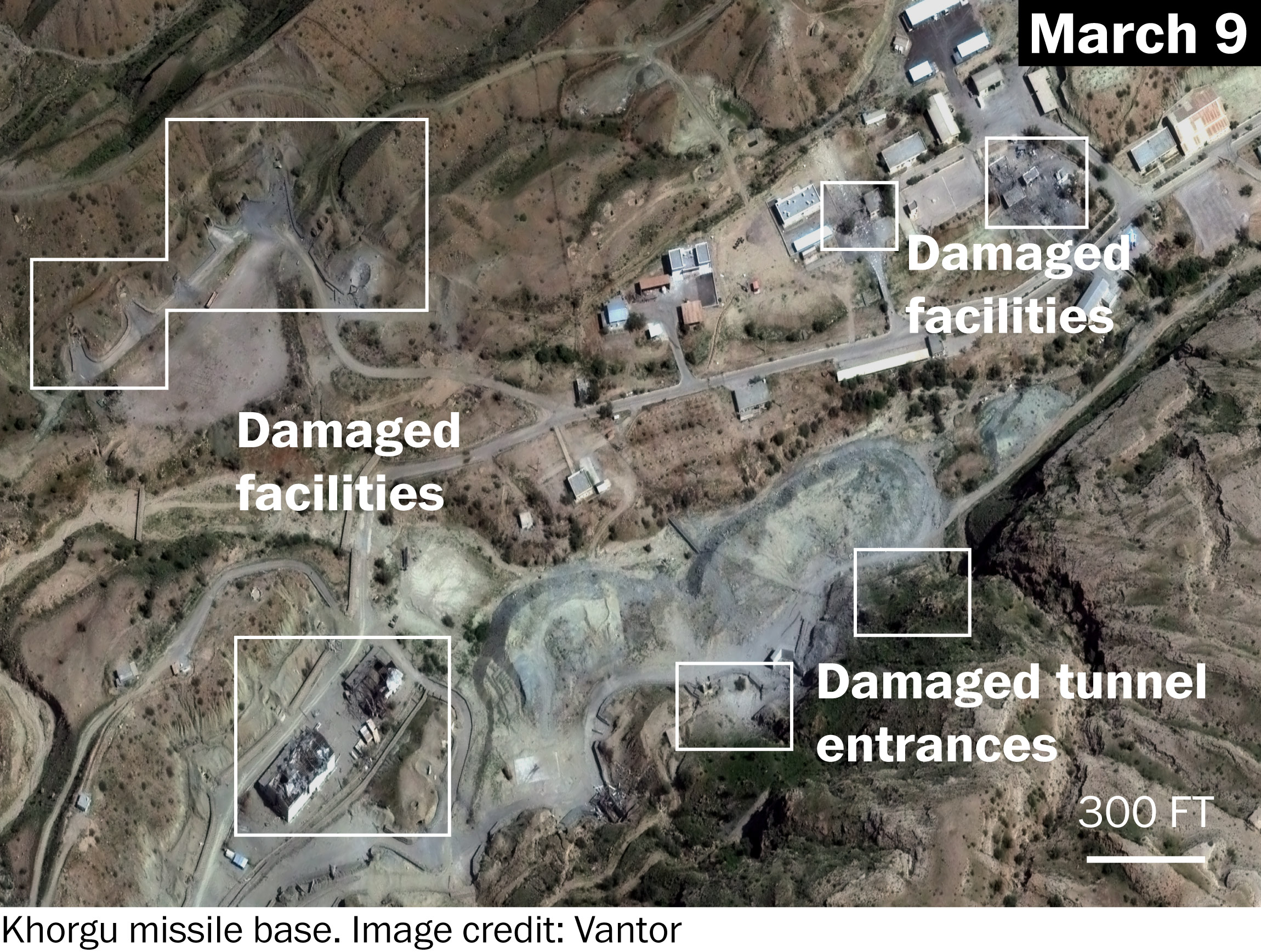
The Khorgu missile base, situated along the Gulf, has been struck at least twice by either Israel or the U.S. Satellite imagery shows that at least 15 facilities at this base were destroyed, and two tunnel entrances were targeted.
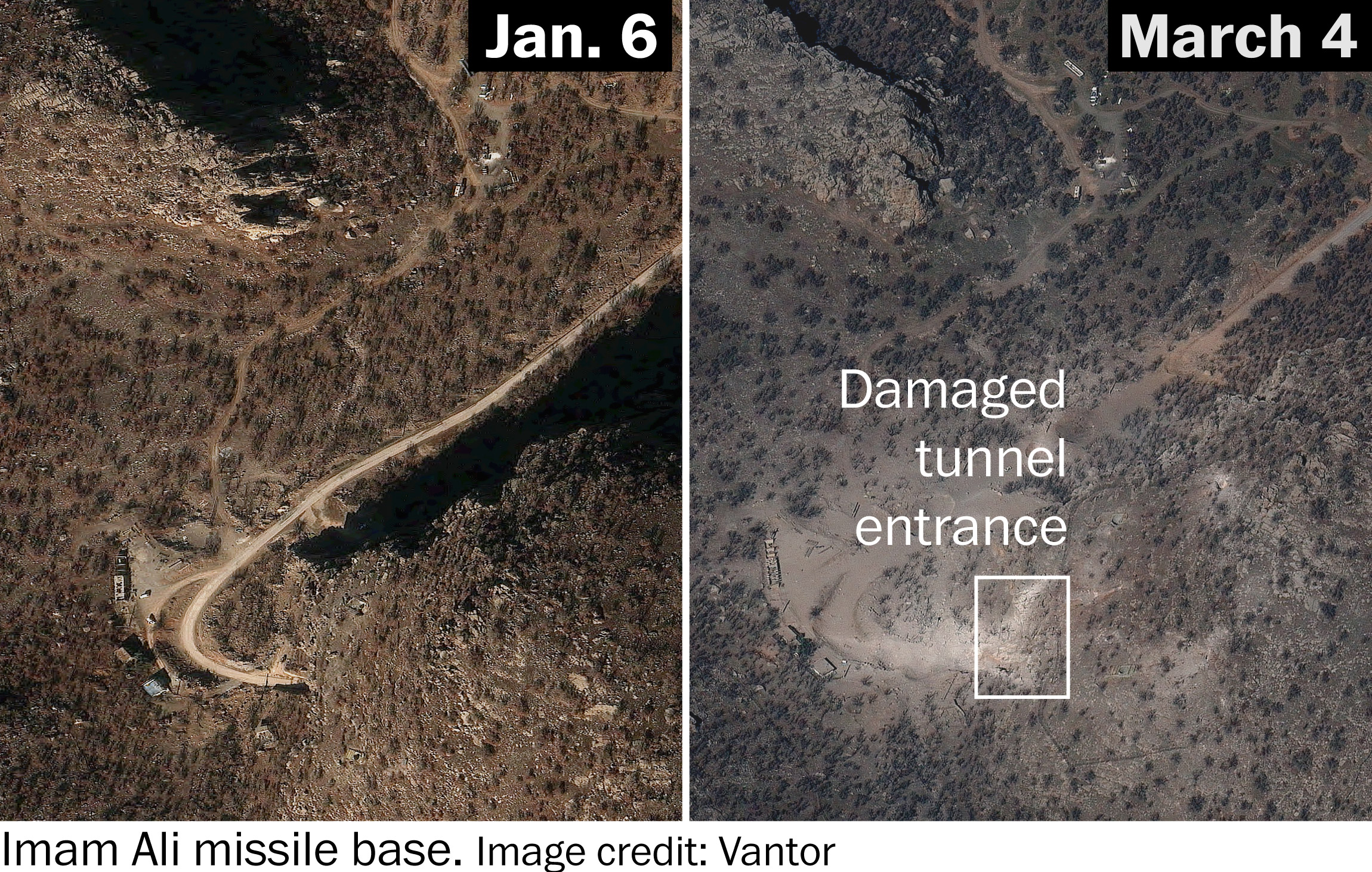
Imagery of the Imam Ali missile base in western Iran depicts damage to nine aboveground structures and at least two tunnel entrances, impeding access to underground weapon caches, according to O’Connor of Janes.
Despite the significant damage, many experts believe the impact may be temporary. "It seems hard to permanently knock those bases out," commented Jeremy Binnie, another analyst at Janes. "You can neutralize them in theory but Iran will just keep digging them out and repairing."
Post a Comment for "Iran's Strained Missile Might"