
Where the most strategic military zones in the Middle East are, and why they matter
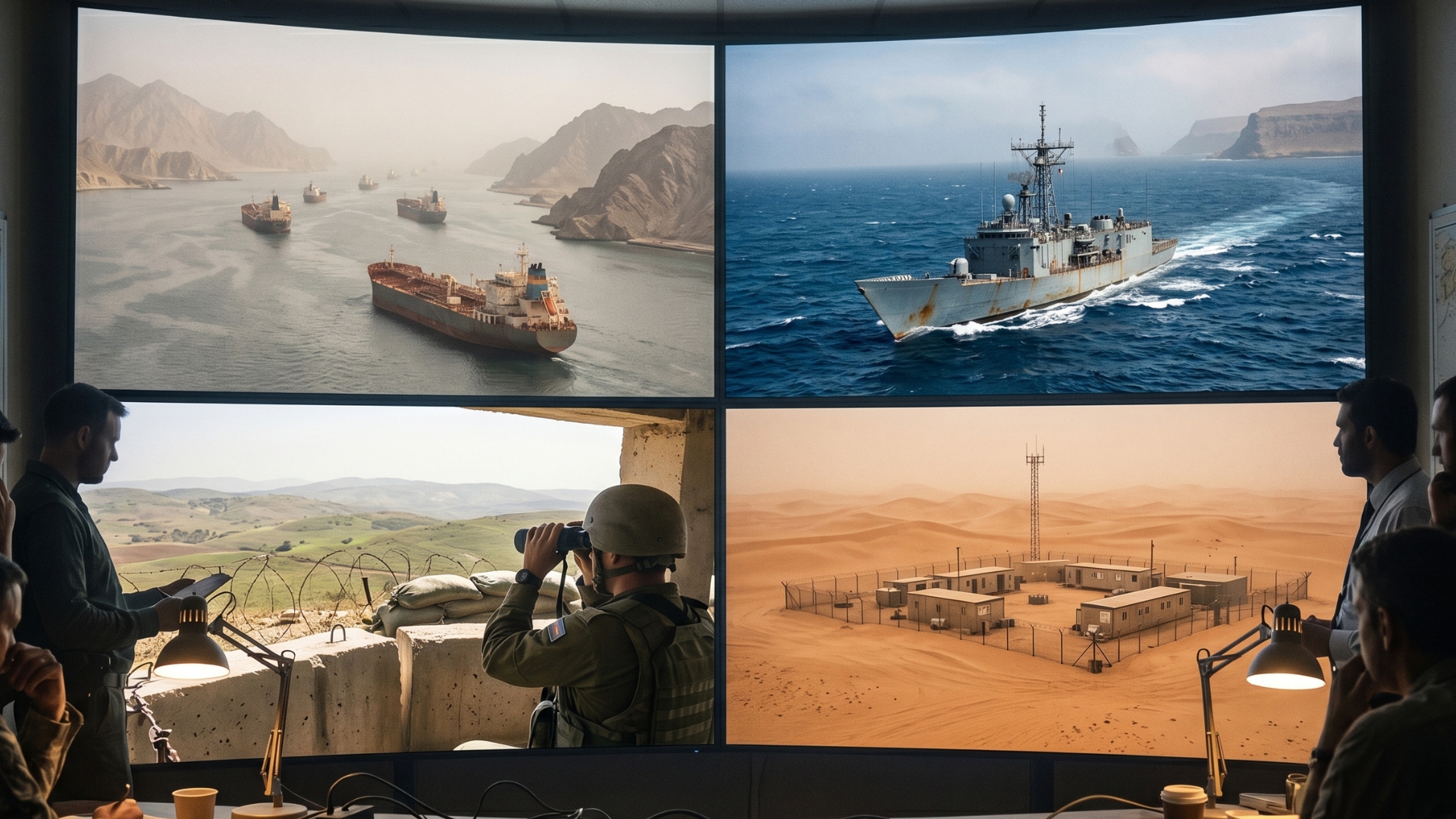
The most strategic military zones in the Middle East are not simply where the biggest armies sit. They are the choke points and frontier spaces where control over a narrow corridor, a ridge line, or a shipping lane can affect oil flows, air defense, proxy supply routes, border security, and regional escalation all at once. That is why the same locations keep surfacing whenever a local confrontation threatens to become something much larger.
For civilians, these zones matter because they are never just military abstractions. When a chokepoint is threatened, shipping costs rise and energy markets react. When a border plateau or tri-border corridor heats up, nearby towns face displacement, militarization, and the risk of spillover. Strategic geography shapes daily life because the places militaries value most are often also the places where trade, water, transport, and basic security are most fragile.
The Strait of Hormuz Sits at the Top of the List
If one zone stands above the rest, it is the Strait of Hormuz. The U.S. Energy Information Administration says it remains one of the world’s most important oil transit chokepoints, and current reporting from CFR describes it as a flash point through which nearly one-fifth of global oil and gas supply can be affected. That gives the waterway enormous military significance even before a single shot is fired.
Its importance comes from both traffic volume and geography. The strait is narrow, transit routes are constrained, and Iran’s coastline, islands, missiles, mines, and naval tactics give Tehran leverage that is disproportionate to the width of the passage itself. In practical terms, Hormuz is not just a shipping route. It is a pressure valve for Gulf security, U.S.-Iran confrontation, and global energy pricing.
Bab el-Mandeb Is the Red Sea’s Military and Economic Gate
Bab el-Mandeb is the other maritime zone that consistently ranks near the top. EIA describes it as the strategic route connecting the Red Sea with the Gulf of Aden and Arabian Sea, linking Persian Gulf exports to the Suez Canal and the SUMED pipeline. U.S. maritime guidance has also warned recently that vessels transiting the Bab el-Mandeb and adjacent waters face elevated risks from Houthi attacks.
What makes Bab el-Mandeb so important is that it ties military threat directly to commercial consequence. A force that can menace traffic there can raise insurance costs, reroute container flows, strain naval deployments, and complicate Saudi, Egyptian, Gulf, European, and U.S. security calculations all at once. It is one of the clearest examples in the region of how a relatively narrow zone can create effects far beyond the battlefield.
The Golan Heights Remain a Strategic High-Ground Frontier
On land, the Golan Heights remain one of the most strategically important frontier zones in the Levant. Britannica notes the area’s commanding elevation over the upper Jordan River valley, while U.N. reporting shows that the 1974 disengagement framework remains under pressure, with continuing military violations and reinforced positions in and around the area of separation.
The military value of the Golan lies in surveillance, artillery advantage, early warning, and the ability to shape approaches between Israel and Syria. It also matters because it sits close to the wider Lebanon-Syria-Israel conflict system. In a region where escalation can move quickly across fronts, high ground with direct observation and defensive depth remains strategically priceless.
The Syria-Iraq-Jordan Tri-Border, Especially Al-Tanf, Punches Above Its Size
Another zone with outsized importance is the Syria-Iraq-Jordan tri-border area, especially around al-Tanf. Carnegie’s analysis says the garrison’s value far exceeds its size because it allows monitoring of Iranian logistics, helps shield Jordan from instability spilling out of Syria, and offers surveillance and rapid-reaction reach across the triborder desert.
This zone matters because it sits on the logic of corridor warfare. Whoever influences that space can complicate overland movement between Iraq and Syria, affect militia supply lines, and shape how outside powers watch eastern Syria. It is less visually dramatic than Hormuz or the Golan, but strategically it is one of the region’s most consequential junctions because it touches counter-ISIS operations, Iran-linked networks, Jordanian security, and U.S. regional posture at once.
The Eastern Mediterranean Has Become a Wider Strategic Basin
The Eastern Mediterranean is not one single point, but it has become one of the most strategic military zones in regional planning. IISS describes it as a basin shaped by active maritime-border disputes, energy dynamics, and major military capabilities spanning Israel, Lebanon, Syria, Egypt, Cyprus, Türkiye, and Greece. That makes it strategically different from a chokepoint, but no less important.
Its value comes from overlap. Naval power, gas infrastructure, undersea routes, air-defense coverage, offshore claims, and alliance politics all intersect there. When conflict rises in Gaza, Lebanon, or Syria, the Eastern Mediterranean becomes a zone for naval signaling, missile defense, logistics, and deterrence, which is why outside powers and NATO-linked actors watch it so closely.
Suez and the Red Sea Corridor Still Anchor Regional Strategy
Any serious map of strategic military zones should also include the Suez-Red Sea corridor. EIA’s latest chokepoint analysis groups the Suez Canal, SUMED pipeline, and Bab el-Mandeb together because they form a linked energy and trade chain between the Gulf, Europe, and the Atlantic basin. In practice, that means the northern and southern entrances to the Red Sea are strategically connected, even when the immediate military pressure is concentrated farther south.
This corridor matters because it blends classic military strategy with commercial vulnerability. A disruption at one end can force changes in naval deployment, tanker routing, insurance pricing, and state behavior across the whole chain. In Middle East conflicts, that makes the Red Sea corridor more than a shipping story. It is a military-economic system.
What These Zones Have in Common
What unites these zones is not culture or alliance, but leverage. The most strategic military zones in the Middle East are the places where geography magnifies force. A narrow sea lane can affect energy security. A ridge line can shape intelligence and defense. A desert junction can interrupt proxy mobility. A maritime basin can pull in multiple states and outside powers at once.
That is why the answer is not a simple list of capitals or major bases. The most strategic zones are the corridors and edges where military control changes the regional balance faster than the map size would suggest. In today’s Middle East, that means Hormuz first, Bab el-Mandeb close behind, the Golan and southern Syrian frontier on land, the al-Tanf triborder corridor for overland strategy, and the Eastern Mediterranean-Red Sea network as the wider arena tying them together.
What Comes Next
These zones will remain central because the region’s main security contests still run through them: Iran versus the U.S. and its partners, Israel’s northern and northeastern frontier concerns, Red Sea instability, and the militarization of regional trade and energy routes. As long as regional conflicts stay interconnected, the most strategic military zones will continue to be the places where geography turns local pressure into regional consequence.
Post a Comment for "Where the most strategic military zones in the Middle East are, and why they matter"