
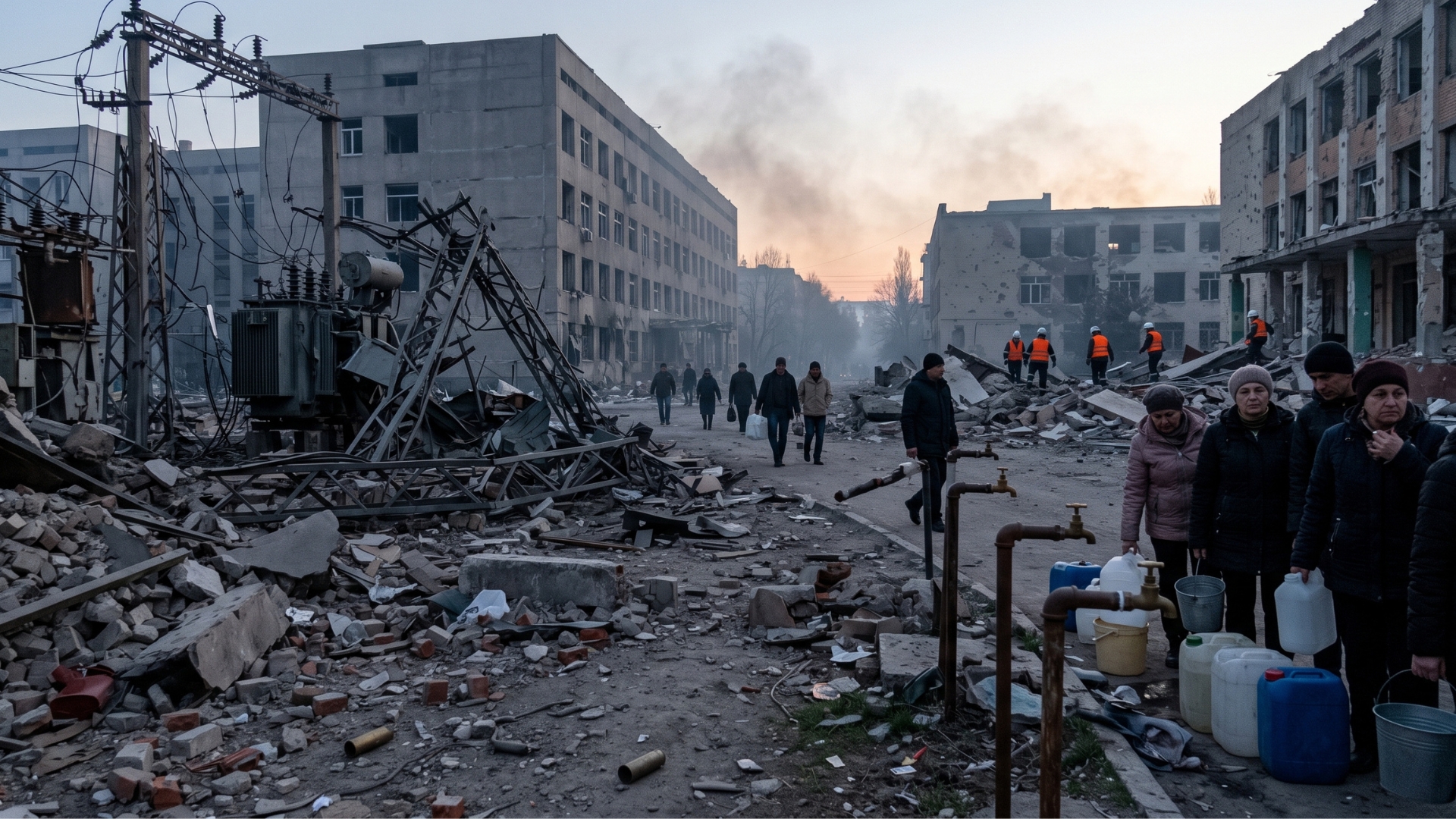
Civilian infrastructure becomes a target in war because modern conflict is not only about defeating enemy troops. It is also about breaking the systems that allow a society to function, move, communicate, heal, govern, and endure. When those systems are hit, the damage spreads far beyond the strike itself, turning electricity, water, transport, and medical care into pressure points that can shape the course of a conflict.
For civilians, the destruction of infrastructure is often what makes war unlivable. When water systems are damaged, disease spreads and hospitals cannot function properly. When schools are hit, children lose both education and shelter. When power grids fail, food spoils, sewage systems break down, and basic survival becomes harder long after the bombing stops. UNICEF says attacks on water, sanitation, schools, hospitals, and other essential systems can cascade through every part of civilian life.
Civilian Infrastructure Is Often Seen as a Source of Leverage
One reason infrastructure is attacked is that it offers strategic leverage. A military may believe that knocking out bridges, fuel depots, rail lines, ports, electrical networks, or communications nodes will slow troop movements, weaken command and control, or reduce an enemy’s capacity to sustain combat operations. In some cases, dual-use systems blur the line further, because infrastructure that serves civilians may also support military logistics or state operations. Article 52 of Additional Protocol I says civilian objects are protected unless and for such time as they become military objectives, and in case of doubt they are presumed civilian.
That legal standard matters because it shows the basic tension. Civilian infrastructure does not lose protection just because it is important. But in war, precisely because it is important, belligerents often argue that certain facilities contribute effectively to military action and can therefore be attacked. Those claims may be valid in some cases, exaggerated in others, and deeply contested in many of the wars the world sees today.
War Is Often Fought Against Systems, Not Just Soldiers
Modern war increasingly targets networks rather than isolated positions. An army does not necessarily need to destroy every opposing unit if it can paralyze electricity, transport, internet access, fuel distribution, or water pumping. That makes infrastructure attractive because it can produce outsized effects. Disabling one substation, pipeline, road junction, or telecom hub can disrupt whole cities and regions.
This logic can also become coercive. Parties to a conflict may hope that enough civilian hardship will pressure political leaders, undermine public morale, or force displacement from strategically important areas. That is one reason humanitarian agencies repeatedly warn that attacks on essential services are not only immediate strikes but part of a broader pattern of social collapse. OHCHR and UNICEF have both stressed that damage to housing and essential infrastructure can have grave and compounding effects on civilians.
The Law Draws Limits, but Those Limits Are Often Contested
International humanitarian law is built around distinction, proportionality, and precautions in attack. Parties must distinguish between civilians and combatants, and between civilian objects and military objectives. Even when a legitimate military objective is present, an attack is prohibited if the expected civilian harm would be excessive in relation to the concrete and direct military advantage anticipated. Those rules are reflected in treaty law and customary international humanitarian law.
In practice, however, the dispute usually shifts from the rule to the facts. Was a power station really serving a military function? Was a school being used by fighters? Were adequate precautions taken? Was the likely civilian harm excessive? Because these judgments are often made by the attacking force in real time, and because independent verification can be delayed or blocked, civilian infrastructure often ends up damaged before those questions are fully tested.
Some Infrastructure Is Hit Intentionally, and Some Through Recklessness
Not every strike on infrastructure reflects the same intent. Some attacks appear deliberately designed to deprive civilians of essential services. UNICEF notes that water can be used as a weapon through direct attacks on pipelines, wells, and sanitation infrastructure, or through denial of access. Other damage happens through heavy bombardment, imprecise weapons, urban warfare, or reckless operations that make little effort to spare critical civilian systems.
That distinction matters legally and morally, but for civilians the outcome can look similar. Whether a hospital loses electricity because it was directly hit, because nearby power infrastructure was destroyed, or because fuel routes were cut off, the result is still failing care. This is why the protection of civilian infrastructure cannot be understood only in terms of isolated strike points. It also involves the wider system of dependencies that keep people alive.
The Human Cost Is Broader Than the Blast Radius
Infrastructure attacks often kill fewer people immediately than direct strikes on crowded shelters or homes, but they can produce deeper long-term harm. Damage to water and sanitation systems raises the risk of disease. Damage to schools affects education, shelter, child safety, and community stability. Damage to hospitals weakens emergency response and chronic care at the same time. These effects multiply because infrastructure works as an interlocking web rather than a series of separate buildings.
That is why humanitarian organizations frame infrastructure damage as a protection crisis, not just an engineering problem. When essential services fail, displacement rises, poverty deepens, and recovery becomes far harder even if front lines later stabilize. In many wars, the destruction of infrastructure is what turns a military confrontation into a prolonged civilian emergency.
What This Reveals About Modern War
The repeated targeting of civilian infrastructure reveals that contemporary warfare is often about shaping civilian reality as much as achieving battlefield gains. Infrastructure offers military utility, political leverage, and psychological pressure, which is exactly why the law tries to protect it. But when enforcement is weak, facts are contested, and belligerents believe civilian suffering can serve strategic aims, those protections can erode quickly.
The result is a grim pattern seen across multiple conflicts: the more war moves into cities and depends on networked systems, the more civilian infrastructure becomes entangled with military strategy. That does not make such attacks lawful by default. It means the legal and moral battle over who or what may be targeted has become one of the most consequential questions in modern armed conflict.
What Comes Next
The central question is not whether civilian infrastructure matters in war. It plainly does. The real question is whether armed forces, political leaders, and international institutions are willing and able to enforce the limits that humanitarian law sets. As long as electricity, water, hospitals, schools, and transport systems remain tempting tools of pressure, civilians will continue to pay for wars in ways that extend far beyond the front line.


No comments:
Post a Comment