
NTSB releases preliminary report into plane crash that killed 7, including Greg Biffle
NTSB Preliminary Report Details Cessna Crash That Claimed NASCAR Driver Greg Biffle and Family
A preliminary report from the National Transportation Safety Board (NTSB) has shed light on the tragic December 18, 2025, plane crash that resulted in the deaths of NASCAR driver Greg Biffle, his wife Cristina Biffle, their children Emma and Ryder Biffle, and pilot Dennis Dutton, his son Jack Dutton, and Craig Wadsworth. The investigation is ongoing, but the initial findings point to a complex series of events involving potential electrical and instrument anomalies during the aircraft's takeoff and initial flight.
The aircraft, a Cessna 550, was piloted by Dennis Dutton, who occupied the left seat. His son, Jack Dutton, was in the right passenger seat. Notably, the report indicates that a rear-seat passenger, who held a private pilot certificate with ratings for multi-engine land, instrument airplane, and rotorcraft-helicopter, was positioned in the cabin area near the cockpit. Greg Biffle was identified as one of three passengers on board possessing a pilot's license.
Takeoff Anomalies and Communication Challenges
According to the NTSB report, issues began to arise during the taxi phase near runway 10. The pilot and two pilot-rated passengers discussed an inoperative thrust reverser indicator light for one of the engines. Despite the faulty indicator, the thrust reverser itself was functioning correctly. Dennis Dutton proceeded with the takeoff, with a planned destination of Sarasota/Bradenton International Airport in Sarasota, Florida.
During the takeoff roll, Greg Biffle reportedly commented on a discrepancy between the left and right engines, noting that the left engine seemed to be producing more power than the right. He suggested the possibility of a faulty gauge, but the aircraft continued its ascent. Simultaneously, Jack Dutton attempted to contact air traffic control (ATC) and activate the flight's instrument flight rules (IFR) flight plan on three separate occasions. However, these attempts were unsuccessful due to the controllers' high workload and the resulting radio communication congestion.
Mid-Flight Complications and Instrument Failures
As the Cessna 550 climbed, the report details a critical period around 10:09 a.m. There was a discussion between the pilot and the rear passenger regarding climbing to a higher altitude, even though the aircraft was technically required to remain under Visual Flight Rules (VFR). The aircraft had descended to approximately 1,580 feet mean sea level (MSL) and was established on a heading of about 250 degrees with an indicated airspeed of 164 knots.
As Dennis Dutton initiated a climb, the rear passenger observed a difference in the interstage turbine temperature indications between the left and right engines. By 10:10 a.m., audio recordings captured remarks from Dennis indicating that his altitude indicator was malfunctioning, along with other left-side flight instruments experiencing similar issues. The report does not record any transfer of aircraft control during this critical phase. Communications between Dennis and Jack were consistent with the pilot resuming control of the aircraft.
Landing Gear and Power Issues Emerge
At 10:13:03, the pilot requested the flaps be extended. Shortly thereafter, at 10:13:22, he requested the landing gear be extended. Subsequent discussions indicated the landing gear was being configured; however, the gear indicator lights failed to illuminate, suggesting a potential problem with the landing gear system or its reporting mechanisms.
In a puzzling exchange, the rear passenger inquired about the alternator's power. The Cessna 550 is not equipped with an alternator, which may indicate a misunderstanding or a misidentification of aircraft systems by the passenger. The pilot, when asked about the situation, stated there was a "problem" but did not elaborate on its nature or potential solutions.
Final Approach and Crash
As the pilot reached an altitude of 1,240 feet, traveling at 114 knots, audio recordings captured Jack visually acquiring the runway and providing directions to Dennis. Around 10:15 a.m., the pilot made comments indicating he had also visually acquired the runway. During the final approach, the indicated airspeed fluctuated, decreasing from 107 knots to 93 knots within a five-second data interval.
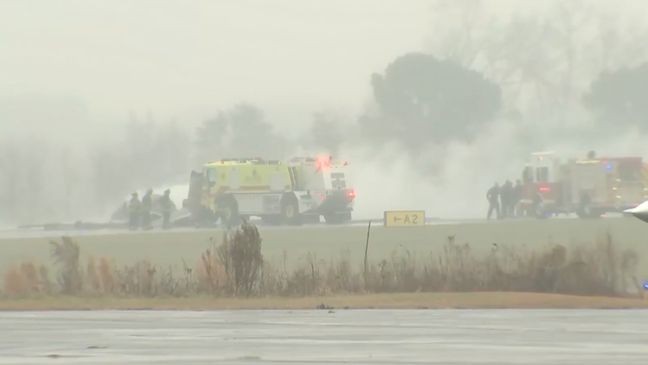
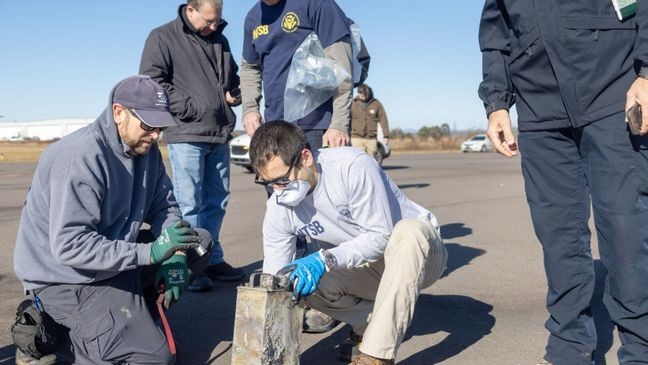
Tragically, the jet impacted the light station of runway 28, located 1,380 feet from the runway threshold. Following the impact, the aircraft was engulfed in flames. The NTSB's investigation is ongoing, and further details will be released as they become available.
Post a Comment for "NTSB releases preliminary report into plane crash that killed 7, including Greg Biffle"