
BrahMos simulated firing part of Balikatan exercise
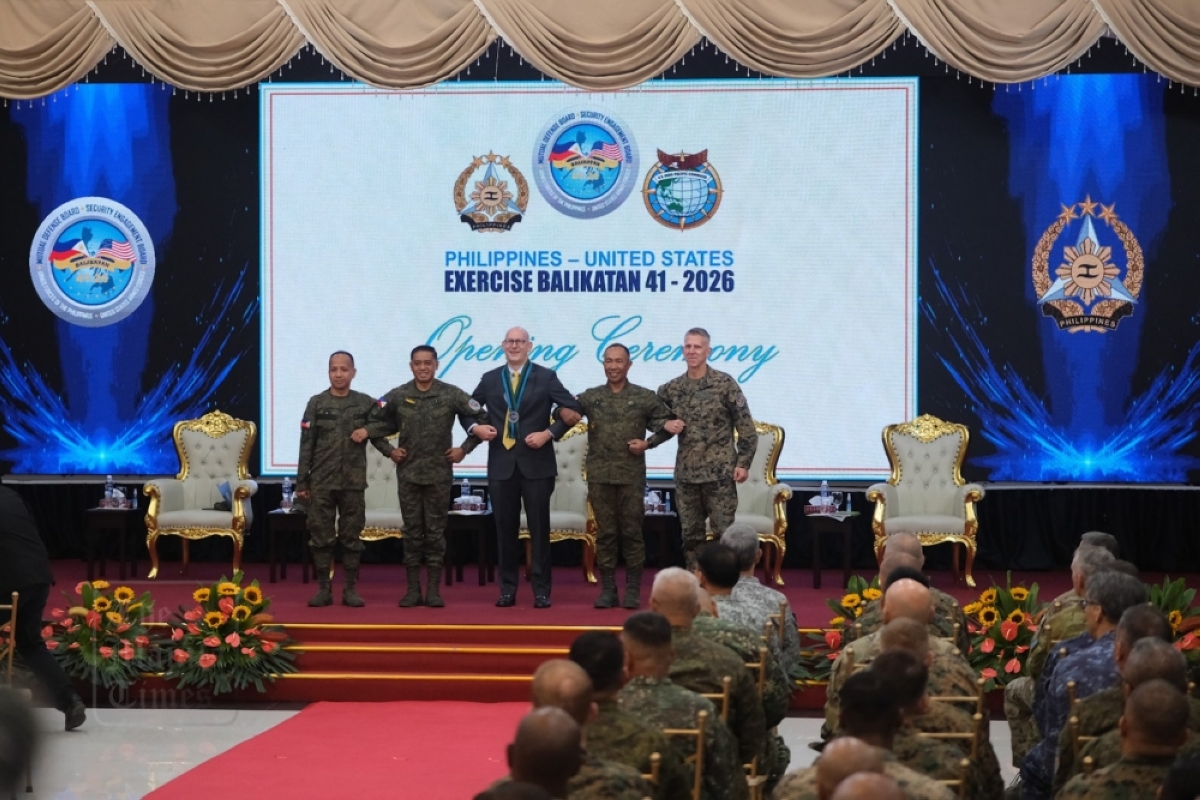
THE Indian-made BrahMos cruise missile system, considered the most powerful weapon in the Philippine arsenal, will be subjected to simulation firing during the maritime strike phase of the Balikatan military exercises, which opened Monday.
The BrahMos is a shore-based, supersonic anti-ship cruise missile system procured from India under a $375-million deal signed in January 2022 to enhance maritime deterrence, particularly in the West Philippine Sea (WPS).
Operated by the Philippine Marine Corps' Coastal Defense Regiment, the missile can travel at speeds up to Mach 2.8 and has a range of 290 km, with the first units delivered in April 2024 and unveiled in November 2025.
Some 17,000 troops from the United States, the Philippines, Australia, Canada, France and New Zealand will train together in the biggest Balikatan to date. Representatives from the United Kingdom, the Netherlands, Poland, Czechia, Lithuania, Germany, Singapore, Thailand, Brunei, Vietnam, Indonesia, Malaysia, South Korea and India are listed as observers.
Maj. Gen. Francisco Lorenzo Jr., Philippine exercise director, said the missile system would be used in simulation during a live fire maritime strike exercise in which troops from the Philippines, the United States and Japan would fire at a decommissioned patrol ship to sink it.
In its simulation firing, all sensors and fire control systems of the BrahMos system will be activated as if in an actual scenario, except that no missiles will be launched.
Lt. Gen. Christian Wortman, commanding general of the I Marine Expeditionary Force, said the exact systems to be used by all participating nations are yet to be finalized but everyone is expected to bring in capabilities that will directly support combined and joint operations.
He confirmed the presence of the Typhon Medium Range Capability (MRC) missile system in the Philippines, and said it would be incorporated “at some level” during the course of the exercise.
Wortman added that they are also looking forward to the incorporation of the BrahMos, Typhon, NMESIS (Navy-Marine Expeditionary Ship Interdiction System) and other-end systems into Balikatan.
"We think it's important that we gain experience planning, coordinating and integrating these capabilities, which have the potential to be more powerful when incorporated or applied together," he said.
The Typhon MRC was first deployed in the Philippines during the April 2024 “Salaknib" Army to Army exercise. It is a weapons platform capable of firing long-range missiles like Tomahawk Land Attack Missile and the Standard Missile-6, believed to have a range at least 1,000 nautical miles. China has objected to its presence in the Philippines.
Meanwhile, NMESIS, a mobile anti-ship missile system with a range of 100 nautical miles, was first used in last year's Balikatan.
Wortman also highlighted the participation of BRP Quezon (PS-70), the decommissioned Philippine Navy patrol ship whose final fate is to be the target for the maritime strike activities.
Originally a wartime US Navy Auk-class minesweeper, the 77-year-old PS-70 is nearly as old as the 74-year-old Mutual Defense Treaty (MDT) between the Philippines and the United States, making its final act of service.
Balikatan not against China
Both Philippine and US military officials emphasized that Balikatan is not in any way a form of provocation against China, which has objected to military exercise staged by the Philippines and its defense partners in the WPS.
“Emphatically no,” Wortman said when asked if the Balikatan was aimed at China.
He emphasized that the exercise is simply about reinforcing the alliance between the US, the Philippines and its growing partners showing both nations' iron-clad commitment to the MDT.
“There is no target nation in terms of an adversary force that we're exercising against. Our exercise objectives are really defined by that interoperability and readiness and our ability to support stability and a full range of operations from humanitarian assistance to security operations,” Wortman said.
Wortman also said the US forces “do not have any plans” of expanding its presence in the country following President Ferdinand Marcos Jr.’s statement that the Philippines would surely be dragged into a conflict if Taiwan would be invaded by China.
Lorenzo said US forces are expected to leave after the conclusion of exercise Balikatan on May 8.
Both exercise directors also clarified that the military drills of both US and Filipino forces will not make the Philippines a target of retaliatory attacks by Iran because Balikatan is “not related” to the ongoing regional tensions within the Gulf states.
Cornerstone
At the Balikatan opening ceremony, US Embassy Chargé d’Affaires, ad iterim Y. Robert Ewing described the 75-year-old MDT as “a cornerstone of peace and stability that has remained not only relevant, but essential, to the security architecture of the Indo-Pacific.”
“For three-quarters of a century, this treaty has stood as a living testament to the enduring strength of the US-Philippines relationship — adapting to meet new challenges while remaining firmly grounded in our shared values, democratic principles, and common purpose,” he said.
Ewing confirmed that the 2026 iteration is the largest in Balikatan’s history. Alongside US and Philippine forces, troops from the United Kingdom, Australia, Canada, France, Japan, and New Zealand are participating in combined and joint operations.
The exercise will cover all domains — land, sea, air, cyber, and space — reflecting what Ewing called “the complexity of today’s security environment” and the allies’ commitment to “readiness, interoperability, and collective defense.”
“The very name ‘Balikatan,’ meaning ‘shoulder to shoulder,’ captures the essence of our alliance. We do not merely stand beside one another — we stand with one another, sharing responsibilities, facing challenges together, and supporting each other in times of need, whether in response to natural disasters, humanitarian crises, or security threats,” Ewing said.
Beyond military drills
Ewing stressed that Balikatan extends beyond military training. He pointed to the exercise’s humanitarian civic assistance programs, which will construct classrooms, health facilities, and multi-purpose structures in partnership with local communities.
Community health engagements are also scheduled, providing medical services, training, and education in trauma care, preventive medicine, and public health.
“These efforts — alongside our civil-military engagements — help strengthen trust, deepen relationships, and improve lives across communities. They reflect a whole-of-society approach, ensuring that our work reaches from national leadership to the barangay level and responds to real needs on the ground,” he said.
“This is our alliance in action — delivering meaningful impact where it matters most: in the daily lives of the Filipino people.” Over the coming weeks, Ewing said the two nations will reaffirm their “ironclad alliance both through words and action.” He noted that the professionalism, dedication, and capability of joint and combined forces will demonstrate commitment to regional security and to a free and open Indo-Pacific.
Balikatan, which began in 1981, is the largest annual bilateral training exercise between the Armed Forces of the Philippines and the US military. It has evolved from traditional field training to include maritime security, cyber defense, and humanitarian assistance components. The 2026 exercise comes amid heightened attention to security cooperation in the Indo-Pacific.
Post a Comment for "BrahMos simulated firing part of Balikatan exercise"