
Black Voices Rise in Montgomery Amid Voting Rights Fears
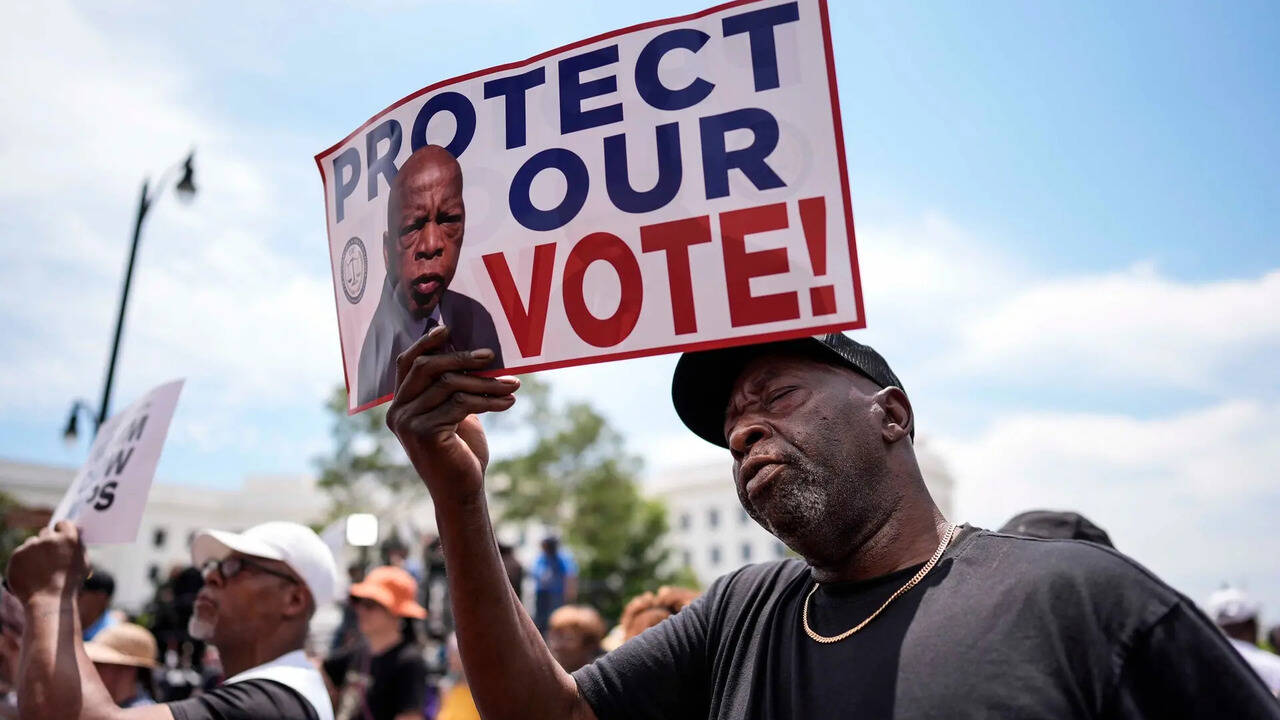
The Rally for Voting Rights in Montgomery
On Saturday, thousands of people gathered in Montgomery, Alabama, the birthplace of the Civil Rights Movement, to advocate for a new era of voting rights. This event took place as conservative states continue to reshape congressional districts that undermine Black political representation.
U.S. Senator Cory Booker of New Jersey described Montgomery as “sacred soil” in the ongoing struggle for civil rights. He emphasized the urgency for action to preserve the rights won by previous generations.
Call to Action from Civil Rights Leaders
During the rally, participants chanted phrases such as “we won’t go back” and “we fight,” expressing their determination to resist regressive changes to voting rights. Shalela Dowdy, a plaintiff in the Alabama redistricting case, declared, “We are not going down without a fight. We are not going down to Jim Crow maps.”
Recent rulings by the U.S. Supreme Court, particularly one involving Louisiana, have significantly weakened voting rights protections. These decisions have facilitated the implementation of stricter voter ID laws and registration restrictions. These changes have affected states that historically required federal oversight due to past discrimination against Black voters.
The Rev. Bernice King, daughter of the late civil rights leader Martin Luther King Jr., articulated that the Supreme Court's decisions constitute an attack on the legacy of those who endured extreme violence to secure voting rights for marginalized communities.
Historic Significance of the Rally Location
The rally took place in front of the Alabama Capitol, a site historically significant for its connection to the Confederacy and the Civil Rights Movement. This location was where the elder King delivered his famous speech at the conclusion of the Selma-to-Montgomery Voting Rights March in 1965.
Speakers noted the juxtaposition of statues honoring Confederate President Jefferson Davis and civil rights icon Rosa Parks, representing a complex history of oppression and resilience. Many attendees reflected on the current political climate, drawing parallels to the past.
Camellia A. Hooks, 70, expressed, “We lived through the '60s. It takes you back. When you think that Alabama’s moving forward, it takes two steps back.”
Concerns Over Voting Rights Rollbacks
Veterans of the Civil Rights Movement voiced alarm at the rapid erosion of protections that were achieved through decades of struggle. Kirk Carrington, 75, recalled his experiences from the 1965 Selma march, stating, “It’s really just appalling to me and all the young people that marched during the ’60s, fought hard to get voting rights, equal rights and civil rights.”
The rally featured remarks from civil rights leaders, members of Congress, union leaders, and pastors, lasting approximately four hours. U.S. Representative Alexandria Ocasio-Cortez warned, “They think they can draw us out of power. They do not know the sleeping giant that they just awakened.”
Impact of Supreme Court Rulings on Montgomery
Montgomery is directly affected by a recent Supreme Court ruling regarding congressional district maps. A federal court ruled in 2023 that Alabama's 2nd Congressional District had intentionally diluted the voting power of Black residents, who comprise approximately 27% of the district's population.
The court mandated the creation of a district where Black voters could elect a candidate of their choice, yet the Supreme Court's decision has allowed a map that could benefit the Republican Party. Despite ongoing litigation, Alabama plans to hold special primaries on August 11 under the newly proposed map.
Democratic Representative Shomari Figures emphasized that the dispute transcends individual representation, stating, “When Republicans are literally turning back the clock on what representation looks like, it starts to resonate with people in a little bit of a different way.”
Responses from Political Leaders
Alabama House Speaker Nathaniel Ledbetter, a Republican, indicated that the Supreme Court ruling provided an opportunity to reconsider the congressional map imposed by federal courts. He remarked, “People tend to forget what happened. When this thing went to court, the Republican Party had that seat.”
Evan Milligan, the lead plaintiff in the Alabama redistricting case, acknowledged the grief surrounding the decline of the Voting Rights Act but stressed the need for renewed commitment to advocacy. “We have to accept that this is the new reality, whether we like it or not,” he stated. “We don’t have to accept that this will be the reality for the next 10 years or forever.”
Post a Comment for "Black Voices Rise in Montgomery Amid Voting Rights Fears"