
Black Voices Rise in Montgomery to Protect Voting Rights
A Rally for Voting Rights in the Heart of Civil Rights History
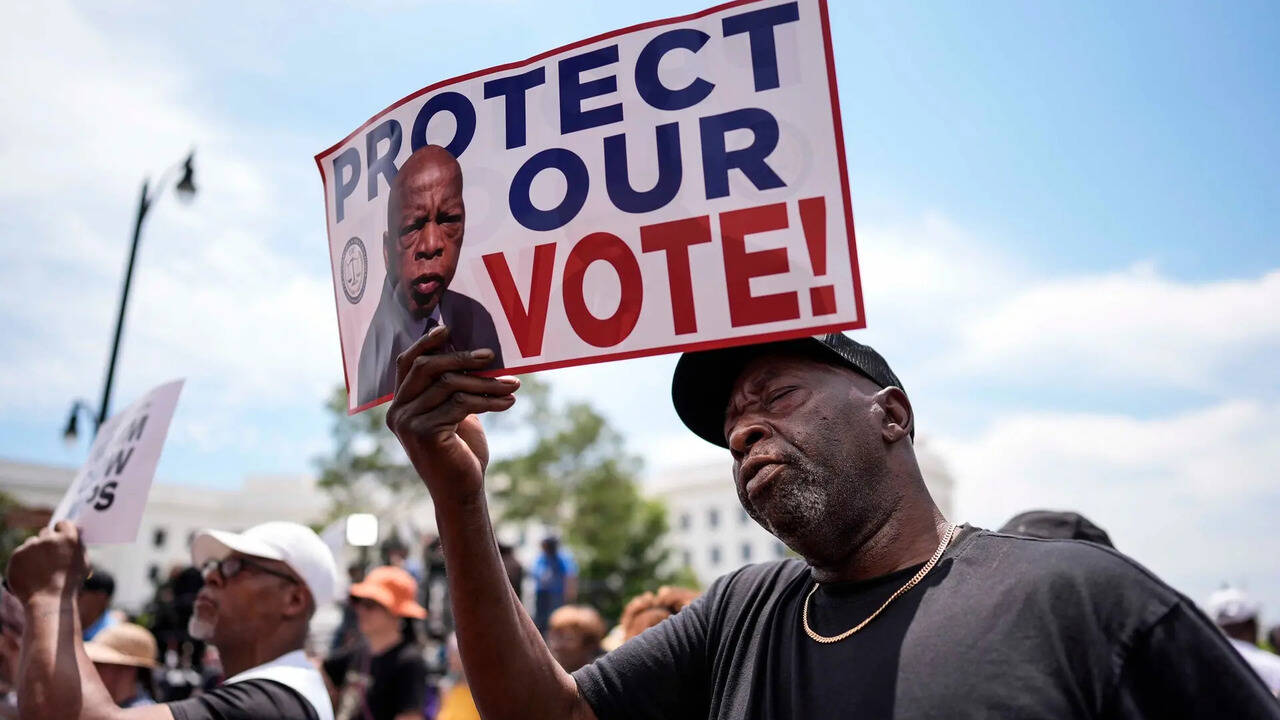
Thousands of people gathered on Saturday in Montgomery, Alabama, a city deeply intertwined with the history of the modern Civil Rights Movement. The rally was held to advocate for a new era of voting rights as conservative states continue to implement changes that threaten Black political representation.
U.S. Senator Cory Booker of New Jersey described Montgomery as “sacred soil” in the ongoing struggle for civil rights. During the event, he emphasized the importance of current generations protecting the rights and liberties gained by their ancestors. “If we in our generation do not now do our duty, we will lose the gains and the liberties that our ancestors afforded us,” he said. The crowd responded with chants of “we won’t go back” and “we fight.”
Shalela Dowdy, a plaintiff in the Alabama redistricting case, declared, “We are not going down without a fight. We are not going down to Jim Crow maps.” The gathering took place in front of the historic Alabama Capitol, a site where the Confederacy was established in 1861 and where Rev. Martin Luther King Jr. delivered his famous “How Long, Not Long” speech in 1965 at the end of the Selma-to-Montgomery Voting Rights March. The stage at the rally was flanked by statues of Confederate President Jefferson Davis and civil rights icon Rosa Parks, symbolizing the contrasting legacies of oppression and progress.
Speakers highlighted the historical significance of the location, noting its transformation from a temple of the Confederacy to a symbol of the civil rights movement. Some attendees expressed that the current redistricting efforts evoke memories of past struggles. Camellia A Hooks, 70, of Montgomery, remarked, “We lived through the '60s. It takes you back. When you think that Alabama’s moving forward, it takes two steps back.”
The rally began in Selma, where a violent confrontation between law enforcement and voting rights activists in 1965 galvanized support for the Voting Rights Act. It then proceeded to the state Capitol, where King delivered his pivotal speech.
A recent U.S. Supreme Court ruling related to Louisiana has significantly weakened voting rights protections, which have been eroded since a 2013 decision. This has facilitated the implementation of stricter voter ID laws, registration limitations, and changes to early voting and polling locations, particularly in states previously required to seek federal approval for changes to voting laws due to historical discrimination against Black voters.
Veterans of the Civil Rights Movement expressed concern about the rapid rollback of protections, emphasizing that rights secured through decades of struggle have been undermined in a relatively short period. Kirk Carrington, 75, who experienced the violent events of “Bloody Sunday” in Selma as a teenager, lamented, “It’s really just appalling to me and all the young people that marched during the ’60s, fought hard to get voting rights, equal rights and civil rights. It’s sad that it’s continuing after 60-plus-odd years that we are still fighting for the same thing we fought for back then.”
Montgomery is among the cities affected by the Supreme Court ruling. A federal court in 2023 redrew Alabama's 2nd Congressional District, concluding that the state intentionally diluted the voting power of Black residents, who comprise approximately 27% of the district's population. The ruling mandated the creation of a district where Black residents would constitute a majority or near-majority, ensuring their opportunity to elect candidates of their choice.
However, the Supreme Court has permitted a new map that may enable the GOP to regain the congressional seat. While the issue remains under litigation, the state plans to conduct special primaries on August 11 under this new map.
Democratic Representative Shomari Figures, who was elected in the district in 2024, stated that the ongoing dispute transcends his personal situation and centers on the community's right to representation. “When Republicans are literally turning back the clock on what representation, what the faces of representation, look like, what the opportunities, legitimate opportunities for representation look like across this country, then I think it starts to resonate with people in a little bit of a different way,” Figures remarked.
Alabama House Speaker Nathaniel Ledbetter, a Republican, argued that the ruling from Louisiana provides an opportunity to reevaluate the congressional map imposed by the federal court. “People tend to forget what happened. When this thing went to court, the Republican Party had that seat, congressional seat two,” Ledbetter said. “There’s been a push through the courts to try to overtake some of these red state seats, and that’s certainly what happened in that one.”
Evan Milligan, the lead plaintiff in the Alabama redistricting case, expressed sorrow over the erosion of the Voting Rights Act but stressed the importance of recommitting to the struggle. “We have to accept that this is the new reality, whether we like it or not,” Milligan stated. “We don’t have to accept that this will be the reality for the next 10 years or two years or forever.”
Stay informed with ET Now’s in-depth coverage of
Business News,
Stock Market updates,
IPO announcements,
Company News, and
Personal Finance Updates. Track live
Share Market data,
Mutual Funds, and the
latest news events in real time.
Post a Comment for "Black Voices Rise in Montgomery to Protect Voting Rights"