
Boneyard Files: Grumman F-9F Cougar – The Swept-Wing Panther in Arizona Sand
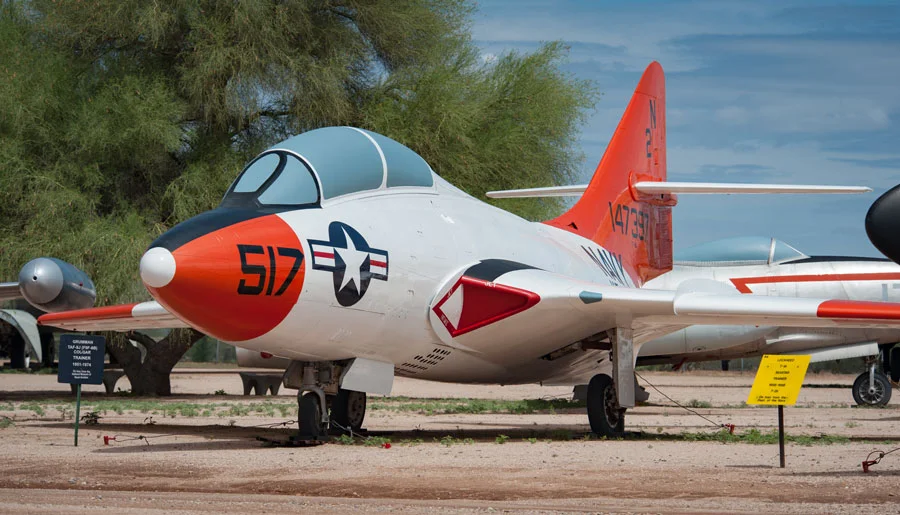
As we proceed with the Boneyard Files series, which highlights some of the retired aircraft located at Davis-Monthan Air Force BaseIn Tucson, Arizona, during the late 1960s, today's story showcases the Grumman F-9F Cougar as captured by Neil Aird’s “Monthan MemoriesPhotos. The Cougar was the first U.S. Navy fighter jet to feature a swept-wing design for aircraft carriers. In October 1946, the Navy gave Grumman a contract to create the F9F Panther, which included a request for design blueprints for a swept-wing variant of the fighter. Grumman had concerns about the weak low-speed performance of swept-wing planes, so they requested the Navy to delay the development of the swept-wing Panther. However, the necessity for a swept-wing Panther grew more pressing when Soviet MiG-15s started flying over Korea in November 1950. The MiG-15 was equipped with an engine similar to that of the Panther, yet it was nearly 100 mph faster.By Christmas 1950, the Navy and Grumman decided to speed up the creation of a swept-wing variant of the Panther, and on March 2, 1951, they entered into an agreement to alter three Panther aircraft for this goal.
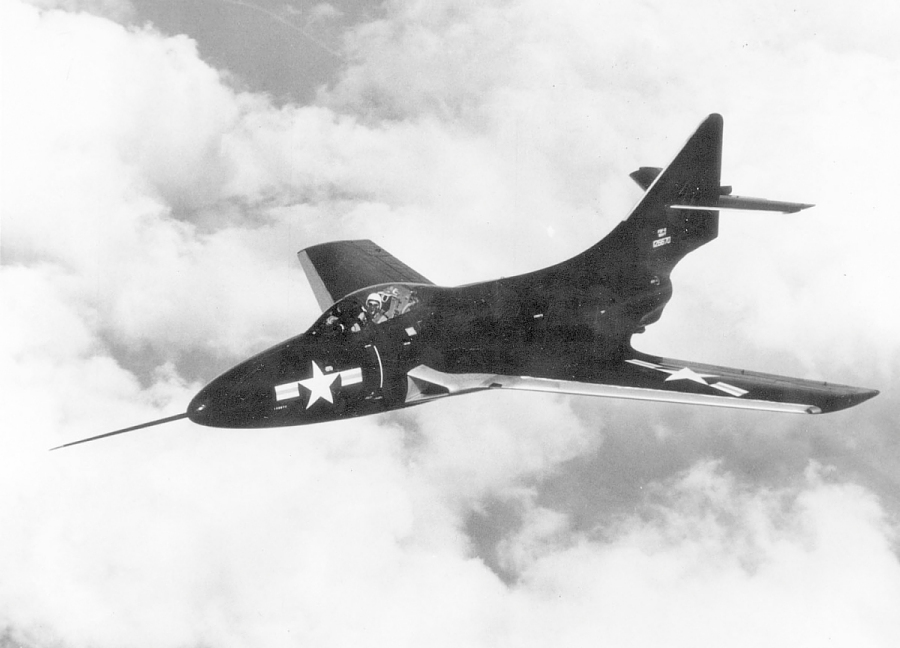
Grumman kept the F9F-5 Panther's fuselage, vertical tail, engine, and landing gear, while incorporating new wings and a 35-degree-swepthorizontal tail. To enhance the aircraft's efficiency during low-speed operations, the company increased the wing size by incorporating extended leading-edge slats and more substantial split flaps beneath the fuselage. Engineers also extended the fuselage by two feet, shifted the wing-root-mounted air intakes forward, and increased the size of the wing-root fillets. The top portion of the rudder remained unchanged, but it was linked to a yaw damper to improve handling. In order to preserve performance, Grumman had to eliminate the wingtip fuel tanks, which resulted in a decrease in fuel storage.The latest version was originally named the F9F-6 Cougar, and later renamed the Grumman F-9F Cougar in 1962. The first F-9F Cougar was prepared for flight just six months following the contract's signing, and it made its initial flight on September 20, 1951. This single-pilot aircraft measured 40.11 feet in length, 12.3 feet in height, with a wingspan of 34.6 feet and a wing area of 300 square feet. The aircraft had an empty weight of 11,483 pounds, a maximum takeoff weight of 21,000 pounds, and a gross weight of 15,800 pounds. The Grumman F-9F Cougar was equipped with a Pratt & Whitney J48-P-8 centrifugal-flow turbojet engine, which generated 7,250 pounds of thrust at 11,000 rpm for takeoff and 5,600 pounds of thrust at 10,450 rpm for continuous operation at sea level.
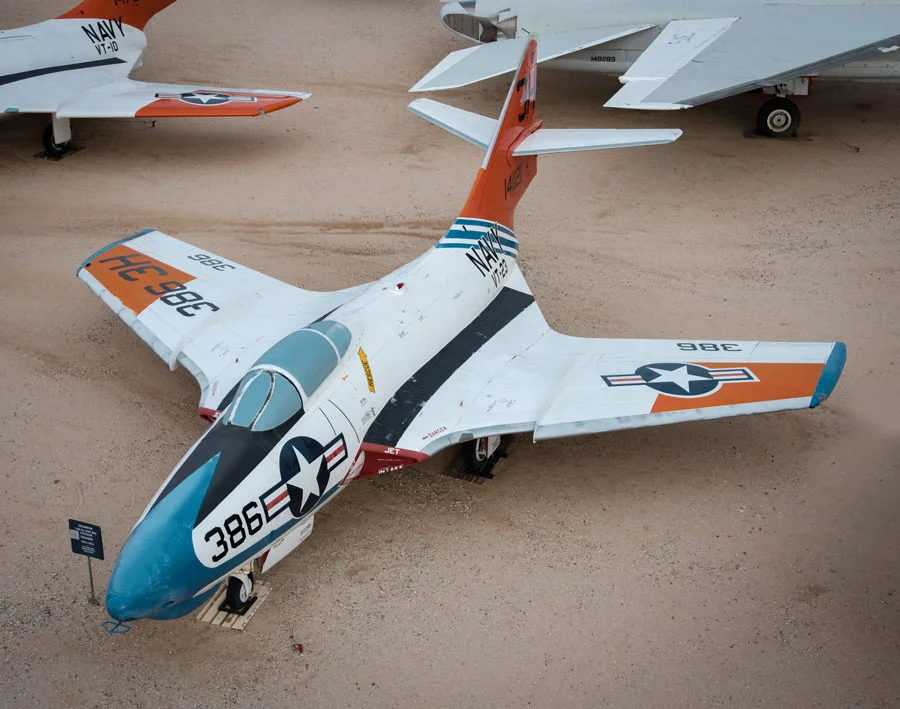
The highest velocity of the airplane was 654 mphAt sea level, the aircraft's cruising speed reached 541 miles per hour. It was equipped with four 20 mm cannons, six 127 mm rockets, and two 1,000-pound bombs mounted on internal pylons, along with two 500-pound bombs on the outer pylons.The Grumman F-9F Cougar was introduced into the U.S. Navy in 1953, but it arrived too late to participate in the Korean War. Its sole combat involvement occurred in Vietnam, where four two-seat training models were briefly utilized as forward air control aircraft. The F9F-8 Cougar was the final fighter variant and later functioned as an advanced jet trainer. On April 1, 1954, three F9F-6s from Fighter Squadron 21 made the first transcontinentalFlights lasting less than four hours. Their fastest times for the 2,438-mile journey from San Diego to Floyd Bennett Field in New York were 3 hours, 35 minutes, and 30 seconds; 3 hours, 46 minutes, and 49 seconds; and 3 hours, 48 minutes. The Cougar was also the first swept-wing aircraft used by the Blue Angels flight demonstration team. Nearly 2,000 Cougars were produced for the Navy and Marine Corps, operating as fighter planes, ground-attack aircraft, photo-reconnaissance planes (such as the RF-9F and RF-9J), and training aircraft. In the mid-1960s, the US Navy started phasing out the Grumman F-9F Cougar, and some were sent to Davis-Monthan Air Force Base, known as "The Boneyard." Learn more about Boneyard Files articles HERE.
 If you liked this piece and want to keep up-to-date with, please click the Followbutton located at the top of this page.
Post a Comment for "Boneyard Files: Grumman F-9F Cougar – The Swept-Wing Panther in Arizona Sand"