
Measles outbreak threatens India as Bangladesh grapples with epidemic
The Measles Outbreak in Bangladesh: A Public Health Crisis
A rapidly escalating measles outbreak in Bangladesh has raised serious concerns about the country's immunisation framework. The situation has been exacerbated by a controversial change in vaccine procurement policy introduced by the former interim administration led by Muhammad Yunus. This shift has led to significant disruptions in vaccine supply and routine immunisation drives, contributing to one of the most severe health emergencies in recent years.
According to official health figures and international agencies, Bangladesh has recorded more than 32,000 suspected measles cases and over 250 suspected deaths since mid-March 2026. Children are the majority of victims, with many experts estimating that the actual death toll may have exceeded 400 due to vaccination gaps and delayed emergency response measures.
The outbreak first emerged in January inside Rohingya refugee camps near the border with Myanmar before rapidly spreading across the country. It has now affected 58 out of Bangladesh's 64 districts and resulted in more than 21,000 hospital admissions. Highly congested settlements in capital Dhaka are among the areas worst impacted by the crisis.
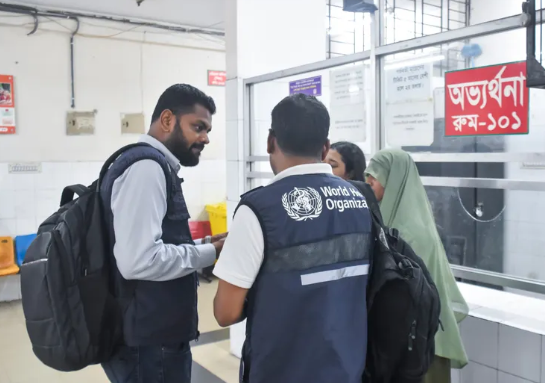
In an update issued on April 23, the World Health Organization warned that the outbreak carried a significant risk of cross-border transmission into India and Myanmar. The WHO stated that the highest concentration of suspected infections since March 15 had been reported in Dhaka, Rajshahi, and Khulna divisions.
Children under the age of five make up the majority of reported infections, with infants younger than nine months facing the highest vulnerability. Medical experts say the outbreak has been worsened by widespread malnutrition, interruptions in Vitamin A distribution campaigns, and weaknesses in the healthcare system.
For years, Bangladesh's vaccination programme had been regarded internationally as a successful model of public health management. Under the Expanded Programme on Immunisation (EPI), vaccines including the measles-rubella (MR) vaccine were procured through UNICEF with substantial financial support from Gavi, the Vaccine Alliance, alongside contributions from the Bangladesh government. Children were routinely administered MR vaccine doses at nine and 15 months, while nationwide campaigns were organised every four years to maintain immunisation coverage above 95%.
The system remained largely effective even during the Covid-19 pandemic, when Bangladesh earned praise for efficiently rolling out mass vaccination campaigns. However, the political turmoil that followed the anti-government protests of 2024 significantly disrupted the country's public health administration.
Former Prime Minister Sheikh Hasina was removed from office after months of political unrest and violent demonstrations that reportedly claimed the lives of hundreds of students. The transition eventually led to the installation of an interim administration headed by Nobel Laureate economist, Dr Muhammad Yunus.
In September 2025, the interim government ended the long-standing practice of procuring vaccines through UNICEF and shifted to an open tender procurement system. UNICEF reportedly objected to the decision and warned that the change could interrupt vaccine supplies and weaken the country's immunisation coverage.
Under the revised mechanism, the government invited suppliers to participate in a bidding process before awarding contracts. However, bureaucratic complications and procurement delays caused vaccine stocks to run low, disrupting routine immunisation schedules nationwide. A supplementary measles-rubella vaccination campaign, which had already been postponed from 2024 to 2025 because of political instability, was eventually scrapped entirely.
Government data released in late March indicated that only 59% of eligible children had received measles vaccinations in 2025, significantly below the coverage level needed to prevent outbreaks. The figures were later removed from official platforms, adding to concerns over transparency and accountability.
The outbreak has since evolved into a politically sensitive issue. Shafiqul Alam, who served as press secretary to Yunus during the interim administration, recently alleged that billions of dollars had been siphoned off through vaccine procurement during the tenure of the Awami League government. He claimed that Yunus' interim administration abandoned the UNICEF-facilitated procurement because of alleged corruption involving officials linked to the previous government and international agencies.
Alam further alleged that organisations such as UNICEF, WHO, and Gavi were connected to irregularities in vaccine purchases under the Awami League administration. However, he did not provide documentary evidence to substantiate the allegations.
His remarks have intensified political tensions because the interim administration had earlier released a controversial corruption "white paper" under the leadership of economist Debapriya Bhattacharya, claiming that nearly $234 billion had been laundered from Bangladesh between 2009 and 2023 during the Awami League government's tenure. Critics argue that despite being in office for over a year, the interim administration has failed to present verifiable evidence supporting those large-scale allegations.
Political analysts and health experts now see the vaccine procurement controversy as part of a wider political struggle over responsibility for the measles epidemic and the collapse in immunisation coverage.
At the same time, scrutiny continues to grow over whether the decision to move away from UNICEF-led procurement despite repeated warnings from international agencies played a direct role in triggering the outbreak. Public health experts maintain that, irrespective of political disputes, delays in vaccine delivery and interruptions in immunisation drives created dangerous immunity gaps that left thousands of children exposed to infection.
With measles infections continuing to rise and concerns over regional spread intensifying, Bangladesh is facing mounting international pressure to stabilise vaccine procurement mechanisms and restore public confidence in its immunisation system before the crisis deepens further.
India's former High Commissioner to Bangladesh, Veena Sikri, told The Sunday Guardian that the measles outbreak in Bangladesh has turned into a serious humanitarian crisis, with hundreds of children dying and the actual toll being possibly much higher than official estimates. She said the situation has received little attention in India despite its possible regional impact.
Sikri said that during former Prime Minister Sheikh Hasina's tenure, Bangladesh had an effective vaccination programme supported by UNICEF and Gavi, the Vaccine Alliance, which ensured high immunisation coverage. However, after Muhammad Yunus took charge of the interim government, the programme was allegedly discontinued in favour of an open tender system that never became operational, leading to vaccine shortages.
According to Sikri, the disruption has severely affected children across Bangladesh, including in the Rohingya camps in Cox's Bazar. She warned that the outbreak could also impact neighbouring countries such as India and Myanmar.
Speaking on the allegations of a vaccination scam involving UNICEF and the Awami League, Sikri said any suspected irregularities should have been investigated without halting vaccine distribution. She criticised the decision to stop a critical immunisation programme, calling it inhumane and dangerous for children, especially in a densely populated country vulnerable to rapid disease spread.
She further remarked that the present administration had largely continued the policies introduced by the interim regime and had not reversed key decisions related to the vaccination programme. According to her, unlike other policy areas such as trade and bilateral relations with India where changes were introduced, the government had failed to restore a healthcare initiative that had earlier succeeded in keeping measles cases under control.
Sikri maintained that even if allegations of irregularities existed, halting a critical immunisation programme without an alternative arrangement was an inhumane response, especially when children's lives were at stake.
Post a Comment for "Measles outbreak threatens India as Bangladesh grapples with epidemic"