
Montgomery: Where the Civil Rights Movement Began, Thousands Rally for Voting Rights
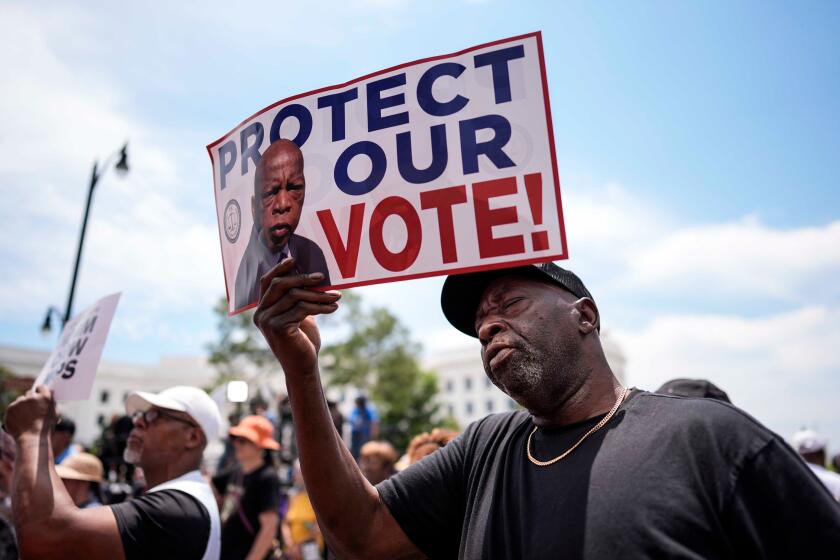
Tens of thousands gathered on Saturday in the birthplace of the modern civil rights movement, aiming to spark a new era for voting rights, as conservative states continue to reshape congressional districts that previously supported Black political influence.
U.S. Senator Cory Booker from New Jersey referred to Montgomery as "sacred ground" in the struggle for civil rights.
"If we in this generation fail to fulfill our responsibilities, we will lose the achievements, rights, and freedoms that our forefathers secured for us," Booker stated in the Alabama capital.
The audience was guided in shouting "we won't retreat" and "we stand firm."
"We won't go down without a struggle. We won't accept the Jim Crow maps," stated Shalela Dowdy, a plaintiff involved in the Alabama redistricting case, referencing racial gerrymandering in various states that has occurred following the recent Supreme Court ruling that weakened the Voting Rights Act.
Thousands of people assembled in front of the city's historic Alabama Capitol, the site where the Confederacy was established in 1861 and where Rev. Martin Luther King Jr. delivered a speech in 1965 at the conclusion of the Selma-to-Montgomery voting rights march. A stage was positioned in front of the Capitol, with statues of Confederate President Jefferson Davis and civil rights figure Rosa Parks behind it — opposing memorials built almost nine decades apart.
Individuals stated that the location was formerly the temple of the Confederacy and later became sacred ground for the civil rights movement.
Some people in the audience mentioned that the attempt to redraw boundaries resembles previous efforts.
"We experienced the '60s. It brings back memories. When you consider that Alabama is progressing, it seems to take two steps backward," said Camellia A. Hooks, a 70-year-old Montgomery resident.
The event started in Selma, where a fierce confrontation between police and voting rights advocates in 1965 sparked widespread backing for the Voting Rights Act. It later continued to the state Capitol, where King delivered his "How Long, Not Long" speech that same year.
The Supreme Court's decision regarding Louisiana undermined a core part of the Voting Rights Act, which had already been weakened by a prior high court ruling in 2013 and had continued to be reduced over time. This allowed for more stringent voter identification requirements, restrictions on registration, and limitations on early voting and changes to polling locations, particularly in states that previously required federal approval before altering their voting laws due to past discrimination against Black voters.
Individuals who were part of the civil rights movement are concerned about the rapid pace of these reversals, pointing out that safeguards achieved through years of struggle have been significantly reduced in just over ten years.
Kirk Carrington, 75, was a teenager in 1965 during the violent clash between law enforcement and demonstrators in Selma, an event now referred to as Bloody Sunday. According to Carrington, a white man on horseback with a stick pursued him through the streets on that day.
It's truly shocking to me and all the young people who marched in the '60s, who worked hard to secure voting rights, equal rights, and civil rights," Carrington stated. "It's unfortunate that after more than 60 years, we're still battling for the same causes we fought for back then.
The effect in Montgomery
Montgomery is the location of one of the congressional districts that is undergoing changes following the Supreme Court's decision.
In 2023, a federal court adjusted Alabama's 2nd Congressional District, stating that the state had deliberately weakened the voting influence of Black residents, who constitute roughly 27% of the district's population. The court determined that there should be a district where Black individuals form a majority or close to a majority, allowing them the chance to elect their preferred candidate.
However, the Supreme Court allowed for an alternative map that might enable the GOP to regain the seat. Although the issue is still being litigated, the state will hold special primaries on August 11 according to the new map.
Democratic Representative Shomari Figures, who secured victory in the district during the 2024 election, stated that the conflict is not personal but concerns the chance for individuals to gain representation.
"When Republicans are actually reversing the progress made in terms of representation, the diversity of those who represent, and the genuine opportunities for representation throughout the country, I believe it begins to strike people in a somewhat different manner," Figures stated.
Alabama House Speaker Nathaniel Ledbetter, a member of the Republican party, stated that the Louisiana decision offered a chance to reconsider a voting district plan that was imposed on the state by a federal court.
People often forget what occurred. When this matter went to court, the Republican Party held that congressional seat," Ledbetter stated recently. "There has been an effort through the courts to take over some of these red state seats, and that's exactly what happened in this case.
Evan Milligan, the main plaintiff in the Alabama redistricting lawsuit, mentioned that there is sorrow regarding the weakening of the Voting Rights Act, but it's important for individuals to renew their dedication to the struggle.
We must acknowledge that this is the new reality, regardless of our preferences," Milligan stated. "We don't need to accept that this will remain the case for the next ten years, or two years, or indefinitely.
Chandler contributes to the Associated Press.
This narrative first was published inLos Angeles Times.
Post a Comment for "Montgomery: Where the Civil Rights Movement Began, Thousands Rally for Voting Rights"