
Studio Puyu: Transforming Ruins into a Creative Haven in Langkawi
A Hidden Gem Transformed into a Creative Haven
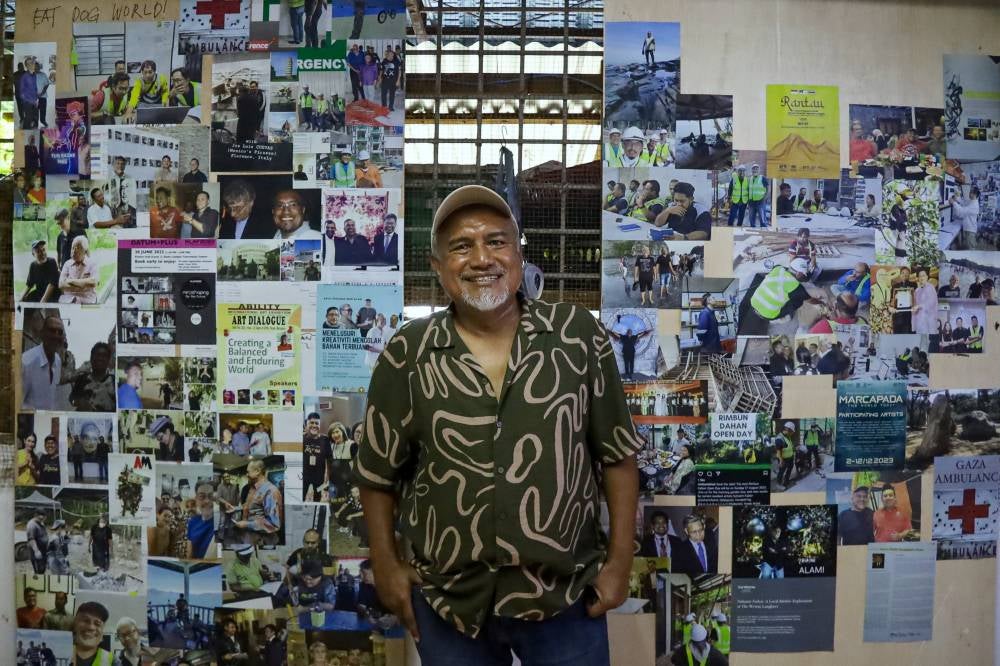
Eight years ago, a house nestled in the overgrown bushes and covered in mud in Kampung Bohor Merah might have gone unnoticed by most people. However, for artist Suhaimi Fadzir, this abandoned structure was a hidden treasure waiting to be revitalized. Today, it has been transformed into Studio Puyu, a private creative space where Suhaimi, 60, experiments with paintings, sculptures, and unique art installations.
Born in Gerik, Perak, Suhaimi began actively producing artworks in the 1980s. His journey to creating Studio Puyu started unexpectedly during a renovation project at a prominent resort on Langkawi. With a background in architecture, the assignment brought him to the island, but his need for a personal creative space led him to search for a suitable studio before discovering a semi-detached rental house for about RM500 a month.
"I am always painting, carving, and doing this kind of work that involves the smell of paint, so I needed a more suitable personal space. At that time, it was difficult for my family to stay at the project site whenever they visited, so I started looking for a house that could function as a studio," he shared during a recent visit to his studio.
Eventually, he found this semi-detached house, which at the time looked like it was in the middle of a jungle, long abandoned and filled with mud. They cleaned it up little by little, and over time, more paintings, sculptures, and installation pieces from his artistic experiments began to fill the space.
Art Made from Discarded Objects
Through Studio Puyu, Suhaimi proves that art does not necessarily require expensive materials. By using discarded objects such as coconut shells, tree branches, and worn-out cloth, he transforms them into artworks rich with meaning. The father of three believes the value of an object does not lie in its original appearance, but in the hidden potential that can be brought to life through creativity.
"To ordinary people, these objects may seem meaningless, but as artists, we see them as having their own worth and value. When collected and arranged in a certain way, they can eventually become part of an artwork," he said.
Unlike commercial galleries, Studio Puyu retains the identity of a traditional village house and only accepts visitors by appointment. This approach allows visitors to immerse themselves in the creative process and witness firsthand how discarded objects are arranged as part of his experimental artistic space.
A Unique Approach to Art
Although he also has studios in Bukit Antarabangsa, Selangor, and St Louis in the United States, Suhaimi chooses to remain based in Langkawi because of the island’s unique atmosphere. "Langkawi feels empty in a good way, so ideas come more peacefully. When creating art, the environment here is enjoyable because the mind is calmer and there are fewer distractions, making it easier for me to think and experiment with my work," he said.
Suhaimi's artistic approach revolves around the concept of ‘archipainting’, which combines elements of architecture and painting through a fusion of two-dimensional and three-dimensional forms to create works with raised textures, structures, and visual layers. "Painting is two-dimensional, while architecture is three-dimensional, like houses or structures. So I combine those two elements and call it ‘archipainting’. Although it starts as a painting, the artwork includes added three-dimensional, layered and raised elements," he explained.
Challenges and Optimism
Acknowledging that the art market in Langkawi is more limited compared to Kuala Lumpur and relies heavily on overseas collectors and foreign tourists, Suhaimi remains optimistic about continuing to create art from his quiet corner in Kampung Bohor Merah. He added that smaller artworks are generally more appealing to buyers because they are easier to carry home, while large-scale works or installations present their own challenges in terms of space, cost, and logistics.
Post a Comment for "Studio Puyu: Transforming Ruins into a Creative Haven in Langkawi"