
Tens of Thousands Protest in London for Immigration and Palestinian Rights
Protests in London Highlight Divided Views on Immigration and the Middle East Conflict
Tens of thousands of people gathered in central London on Saturday for two distinct protests. One focused on concerns about immigration and the perceived threat of Islam to British identity, while the other supported the Palestinian cause. These events reflected deep divisions within the city and raised questions about public safety and social cohesion.
The police deployed 4,000 officers, including reinforcements from outside the capital, as part of what they described as their largest public order operation in recent years. They emphasized their commitment to using "the most assertive possible use of our powers" to manage the situation. By 3:30 p.m. local time, four hours after both marches began, authorities reported 31 arrests for various offenses. They characterized both protests as "largely without significant incident," though earlier estimates had predicted turnout of at least 80,000.
Prime Minister Keir Starmer criticized the organizers of the Unite the Kingdom march, calling them "peddling hate and division, plain and simple." The protest was organized by anti-Islam activist Stephen Yaxley-Lennon, known as Tommy Robinson. The government also barred 11 individuals it described as "foreign far-right agitators" from entering Britain to participate in the event.
A History of Controversy and Public Outcry
Robinson's previous protest in September drew around 150,000 attendees, with a video address from Elon Musk. That event saw scuffles that left 26 officers injured, including four seriously. On Saturday, his supporters gathered in central London, waving mainly British and English flags.
Allison Parr, one of the protesters, expressed concerns about migration, stating, "I think that too much migration – not migration, but too much migration – is causing a lot of problems, upsetting a delicate balance here." She also criticized net-zero environmental policies. Annual net migration in England and Wales approached 900,000 in 2022 and 2023, but dropped to around 200,000 last year after stricter work visa rules were introduced.
Concerns over immigration, particularly the arrival of asylum seekers via small boats, have affected Starmer's popularity and contributed to the rise of the right-wing Reform UK party. Its leader, Nigel Farage, has distanced himself from Robinson. Some protesters chanted abuse directed at Starmer.
Robinson, who has prior convictions for assault and stalking, claimed during the march that "we are awakening Great Britain - the cultural awakening, the cultural revolution, the spiritual awakening, it's all underway." Earlier this year, he traveled to the United States, where he met a State Department official and spoke about "the dangers of Islam" and "the Islamification of Great Britain."
Census data from 2021 showed that 6.5% of people in England and Wales identified as Muslim, up from 4.9% in 2011.
Diverse Voices and Symbols
Among those on the main stage at the end of the march were three French women from the anti-immigration feminist group Nemesis. They wore Islamic-style face veils and encouraged jeers before removing the veils to cheers from the crowd. They gave a short speech critical of Muslims and immigration. Later, a cellist performed with what appeared to be rashers of raw bacon on his shoulders.
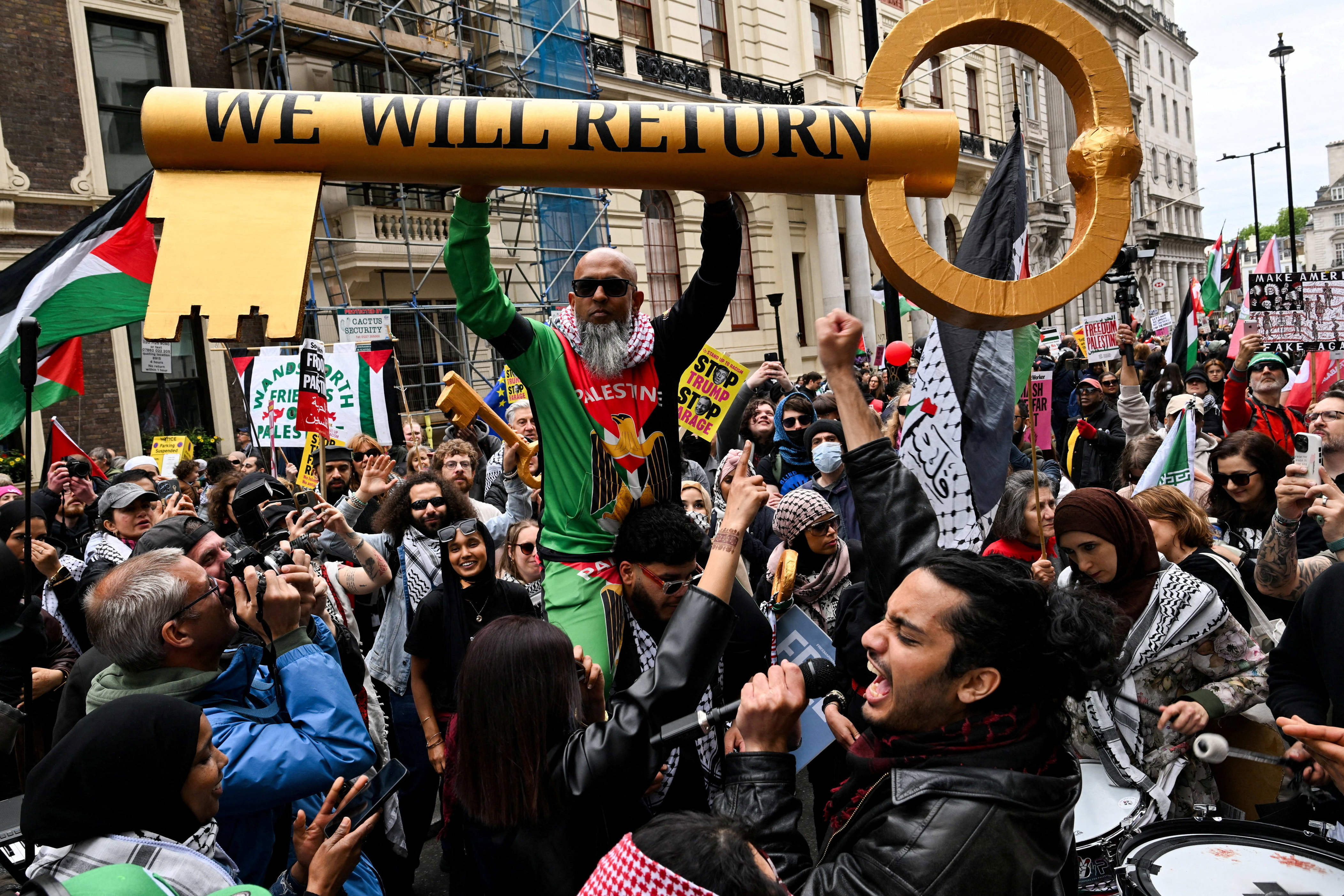
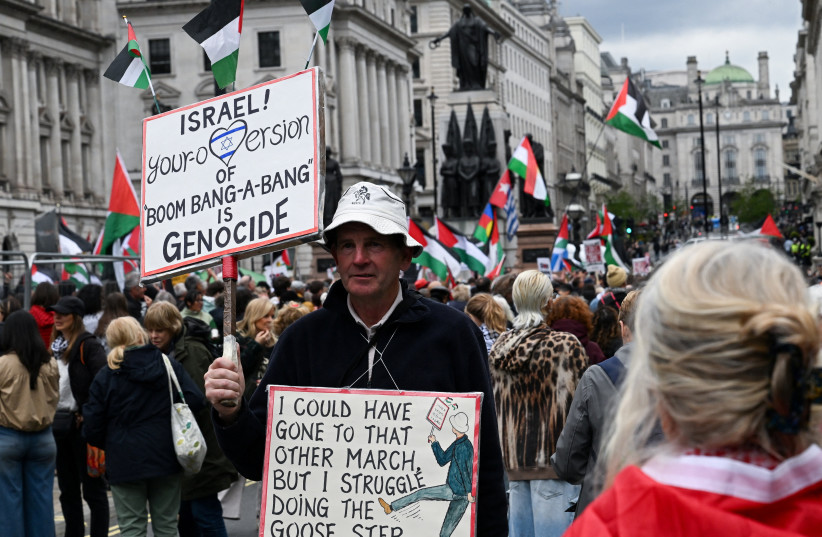
Nearby, demonstrators carrying Palestinian flags and placards calling for an end to the conflict in Gaza held a march to mark Nakba Day. This day commemorates the loss of land by Palestinians in the 1948 war that followed the creation of Israel. "Nakba" means catastrophe in Arabic.
Sharon De-Wit, a protester, stated, "Israel, its behavior is unjust beyond belief. After the Holocaust, etc., all you can do is wish the Jewish people all the best. But they won't be able to live in peace until they allow the Palestinian people to form their own state."
London has recently experienced a series of arson attacks on Jewish sites, and two Jewish men were stabbed last month in an incident being treated as terrorism. Police noted that repeated large pro-Palestinian marches—33 since the Hamas-led attack on Israel in October 2023—have left many Jewish people feeling too intimidated to enter central London.
While protesters held a range of views, police said the marches routinely led to arrests for racially and religiously aggravated public order offenses. Some protesters on Saturday chanted "Death to the IDF," referring to the Israeli army—language that police previously said had been a reason for arrests when aimed at Jewish people.
Post a Comment for "Tens of Thousands Protest in London for Immigration and Palestinian Rights"