
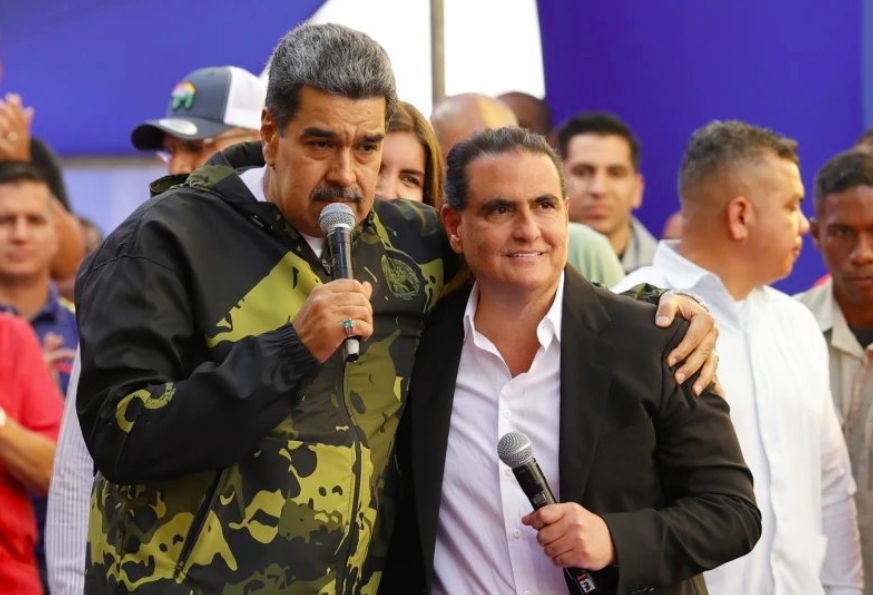
The Deportation of Alex Saab: A Major Shift in Venezuela-US Relations
India, May 17 — In a surprising turn of events, the Venezuelan government has announced the deportation of Alex Saab, a key figure in the administration of former President Nicolas Maduro, to the United States. Saab is set to face criminal charges in the U.S., marking a significant shift in the political landscape between Caracas and Washington.
This move comes less than three years after Saab was granted a pardon by former U.S. President Joe Biden as part of a high-profile prisoner exchange. The decision to deport him represents a dramatic reversal for the 54-year-old Colombian-born businessman, who had previously been seen as a central player in Maduro's inner circle.
Saab, often referred to by U.S. officials as Maduro's financial "bag man," has been at the center of a long-standing diplomatic conflict between Venezuela and the United States. Venezuelan authorities had previously fought to secure his freedom following his initial arrest in 2020. Now, as he is handed over to the U.S., there are concerns that he could be pressured to testify against Maduro himself, who is currently in U.S. custody awaiting trial on federal drug charges in Manhattan.
A Secret Deportation?
The Venezuelan immigration authority confirmed the deportation in a brief public statement, citing several ongoing criminal investigations in the U.S. as the basis for the decision. While the official communique did not explicitly name the final destination, it referred to Saab only as a "Colombian citizen."
This phrasing appears to be a strategic move, as Venezuelan constitutional law strictly prohibits the extradition of its own nationals. This contrasts with previous statements from Maduro and current acting President Delcy Rodriguez, who had defended Saab during his earlier detention. At that time, they presented a Venezuelan passport and claimed he was a high-level diplomat captured illegally during a humanitarian mission to Iran.
The Fall from Grace for a Venezuelan Official
Saab, who built a vast personal fortune through lucrative government contracts in Venezuela, fell out of favor following a sudden change in leadership after a U.S. military intervention. Since Rodriguez assumed executive power following Maduro's ouster, Saab was systematically stripped of his political influence, demoted, and removed from his Cabinet-level role as the primary gatekeeper for foreign investments.
His deportation to the U.S. is expected to deepen divisions within Venezuela's fragile ruling coalition of Chavistas. Rodriguez has gained significant support in Washington by showing a willingness to open the country's heavily sanctioned oil and mining industries to American corporate investments. However, these concessions have angered Maduro's supporters and security forces, many of whom face active U.S. indictments.
Unraveling a Corruption Conspiracy
The legal troubles facing Saab in the U.S. go far beyond the scope of his previous pardon. Federal prosecutors in Miami have been investigating his alleged involvement in a massive bribery conspiracy tied to Venezuela's state-subsidized food distribution network, known as the CLAP program.
The federal probe stems from a 2021 Department of Justice case against Saab's long-term business partner, Alvaro Pulido. According to a former law enforcement official familiar with the matter, the prosecution focuses on how the CLAP program, designed to provide basic food staples to impoverished citizens during an era of hyperinflation, was used for illicit enrichment.
Indictments identify Saab as "Co-Conspirator 1," alleging he used a complex network of shell companies to bribe pro-government officials in exchange for inflated food import contracts.
Political Deals and Backlash
The Biden administration's 2023 decision to grant Saab a limited pardon, which applied only to a 2019 housing contract indictment, faced strong domestic criticism. The White House authorized his release in exchange for several wrongfully detained Americans and the return of fugitive defense contractor Leonard Glenn Francis, known as "Fat Leonard."
The exchange drew sharp criticism from Trump-supporting Republicans. In a public letter to the Justice Department, Senator Chuck Grassley of Iowa warned that history would remember Saab as a "predator of vulnerable people."
While acting President Rodriguez once celebrated Saab's 2023 return to Caracas as a "resounding victory" over American intervention, his sudden deportation now signals that the new leadership in Caracas views the former insider as expendable in its pursuit of normalized relations with Washington.


No comments:
Post a Comment