
Asian Markets Dip as AI Stocks Tumble on Wall Street, Oil Rises

Global Markets React to AI Sell-Off and Rising Oil Prices
Asian stock markets experienced a mixed performance on Thursday, with most indices declining following a sharp sell-off in artificial intelligence (AI) stocks that impacted the U.S. market. The downturn in AI-related equities has created uncertainty among investors, leading to broader market volatility.
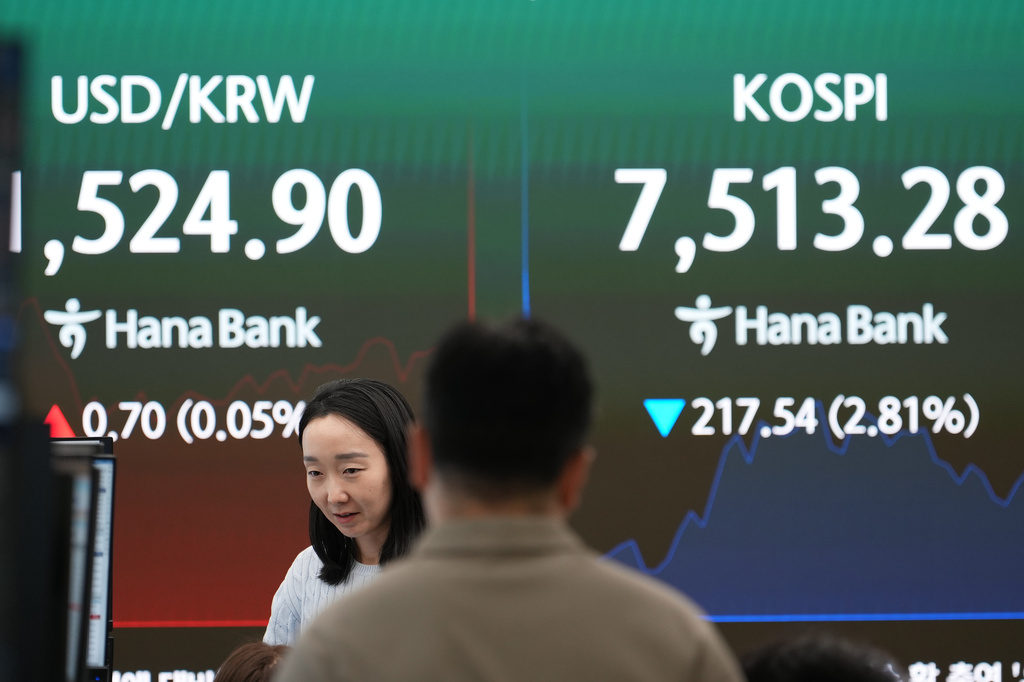
In Tokyo, the Nikkei 225 fell 0.5% to 63,878.60, while South Korea's Kospi index also dropped 0.2%, closing at 7,720.75. Hong Kong's Hang Seng managed a slight gain of 0.2%, reaching 24,468.82, but the Shanghai Composite slipped 0.2% to 3,983.80. Australia’s S&P/ASX 200 declined by 0.2% to 8,632.50, and Taiwan's Taiex dropped 0.4%.
The U.S. futures market showed some resilience, with gains observed, while oil prices rose by more than $1 per barrel. This increase in energy costs added pressure to already struggling sectors, particularly those reliant on fuel.
Wall Street Faces Continued Challenges
On Wednesday, Wall Street saw significant declines as former high-performing stocks faced heavy scrutiny. The S&P 500 fell 1.6%, marking its first back-to-back drop in three weeks. The index closed at 7,266.99, returning to levels seen in early May. The Dow Jones Industrial Average plummeted 953 points, or 1.9%, to 49,918.78, while the Nasdaq Composite dropped 2% to 25,169.50.
The decline was attributed to concerns over the rapid rise in AI stock prices, which many analysts believe may have been inflated due to speculative investing. Investors are now questioning whether this correction is a temporary pullback or the start of a longer-term downturn.
Super Micro Computer, a major player in AI server sales, saw its shares fall by 28% after announcing plans to raise $7 billion through the sale of additional shares. Such actions can dilute existing shareholders' stakes and signal potential financial strain for the company.
Micron Technology experienced extreme volatility, swinging from an early loss of nearly 4% to a modest gain and then falling again by 4.7%. Despite these fluctuations, the company’s stock remains up 212.5% for the year so far.

Key Players in the AI Sector Face Pressure
Nvidia, one of the largest beneficiaries of the AI boom, saw its stock drop 3.7% on Wednesday, making it the biggest drag on the S&P 500. Another AI leader, Broadcom, fell 5.1% during the same period. These declines highlight the growing unease among investors about the sustainability of AI stock valuations.
Part of the pressure on AI stocks could be linked to investors reallocating funds ahead of upcoming high-profile initial public offerings (IPOs). For example, SpaceX is expected to make its debut on the U.S. stock market soon, potentially drawing attention away from other AI-focused companies.
Impact of Rising Oil Prices
Rising oil prices also contributed to market instability. Brent crude oil increased by 1.8% to $93.10 per barrel on Wednesday, driven by tensions between the U.S. and Iran. President Donald Trump warned that Iran would "pay the price" for stalled negotiations, further escalating fears of conflict in the region.
The Strait of Hormuz, a critical shipping lane for global oil trade, has been effectively blocked due to the ongoing conflict, disrupting the flow of crude from the Persian Gulf. This has led to higher inflation, with U.S. consumer prices surging at the fastest rate in three years.
Traders are now anticipating that the Federal Reserve may need to raise interest rates at least once this year to combat inflation. Higher interest rates can slow economic growth and negatively impact various investment classes, including stocks and cryptocurrencies. Some critics argue that the AI sector is currently experiencing a bubble, with valuations inflated beyond sustainable levels.
Oil Prices Continue to Rise
Early Thursday, Brent crude oil climbed to $94.44 per barrel, an increase of $1.34 from the previous day. U.S. benchmark crude also rose by $1.50, reaching $91.53 per barrel.
Meanwhile, the U.S. dollar weakened slightly against the Japanese yen, trading at 160.44 yen compared to 160.56 yen late Wednesday. The euro gained ground, rising to $1.1555 from $1.1537.
As markets continue to grapple with the implications of rising oil prices, AI sector volatility, and potential interest rate hikes, investors remain cautious. The coming weeks will likely bring more clarity on whether these challenges represent short-term disruptions or the beginning of a more prolonged market shift.
Post a Comment for "Asian Markets Dip as AI Stocks Tumble on Wall Street, Oil Rises"