
Equities Drop as Oil Slides on Middle East Uncertainty
Market Volatility and Geopolitical Tensions
On Tuesday, the MSCI global equities index managed a modest gain despite a lack of support from Wall Street. The day was marked by mixed performances in major stock indices, with heavyweight technology stocks experiencing a decline. Investors opted for safer bets, reflecting concerns over geopolitical tensions and economic uncertainties.
The day began with a glimmer of hope as Iran and Israel announced they would cease hostilities. However, this optimism was quickly overshadowed by U.S. President Donald Trump's statement that Iran had shot down a U.S. Apache helicopter near the Strait of Hormuz. This incident raised fears of further escalation in the region. Additionally, Israel's attack on Tyre in southern Lebanon resulted in at least eight deaths, prompting Iran to warn of potential retaliation if Israel continued its attacks on Hezbollah.
Oil Prices and Energy Market Trends
Oil prices settled lower amid ongoing uncertainty in the Middle East. The U.S. Energy Information Administration reported that oil stockpiles in major economies were approaching their lowest levels since 2003. Moreover, the EIA revised its forecast, predicting a decline in global oil demand in 2026, a shift from previous expectations of growth.
In the equities market, trading was volatile, with the S&P 500's technology sector falling as much as 5.5% before closing with a 1.8% loss. Sahak Manuelian, managing director for global equities trading at Wedbush Securities, noted that investors were shifting their focus towards more defensive sectors such as real estate, utilities, and healthcare. He explained that this move was partly driven by the anticipation of Elon Musk's SpaceX IPO, which is scheduled for the following week.
Inflation Concerns and Federal Reserve Outlook
Investors were also preparing for the release of consumer inflation data on Wednesday. Gene Goldman, chief investment officer at Cetera, highlighted the growing concern over inflation and its potential impact on the Federal Reserve's interest rate policies. Higher-than-expected inflation could lead to increased scrutiny of the Fed's actions.
Since the release of a stronger-than-expected jobs report for May, traders have increased their bets on a potential rate hike. According to the CME Group's FedWatch tool, the probability of a 25-basis-point increase by December has risen to 43%, while bets on a 50-basis-point increase have climbed to nearly 21%.
Stock Market Performance
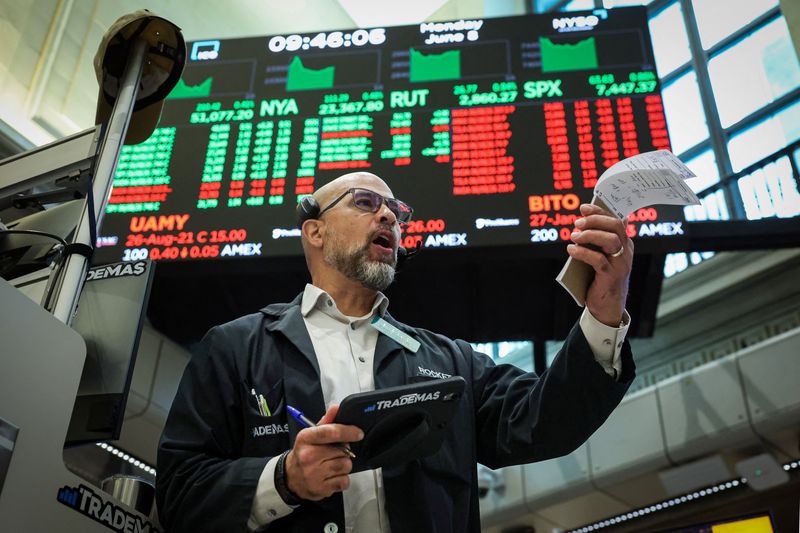
On Wall Street, the Dow Jones Industrial Average rose 84.93 points, or 0.17%, to 50,870.94. The S&P 500 fell 19.29 points, or 0.26%, to 7,386.44, while the Nasdaq Composite declined 250.84 points, or 0.97%, to 25,678.82. The MSCI global equities gauge increased by 1.94 points, or 0.18%, to 1,102.90.
The pan-European STOXX 600 index closed down 0.5% after an earlier rise. The CBOE volatility index, often referred to as the "fear gauge," ended the day up 0.95 points at 19.87, after reaching a high of 23.34, its highest level since April 7.
Currency and Cryptocurrency Movements
In the currency markets, the dollar pared earlier losses as uncertainty surrounding the ceasefire grew. The dollar index fell 0.1% to 99.94, with the euro rising 0.09% to $1.1544. Against the Japanese yen, the dollar strengthened 0.13% to 160.38.
In the cryptocurrency market, Bitcoin fell 2.08% to $62,154.00. U.S. Treasury yields dipped as traders awaited the May consumer inflation report for insights into ongoing price pressures.
Energy and Precious Metals Markets
U.S. crude oil settled down 3.4%, or $3.10, at $88.20 per barrel, while Brent crude fell to $91.45 per barrel, down $2.80 or 2.97% on the day. In the precious metals market, gold prices dropped due to rising expectations of a U.S. interest rate hike this year. Spot gold fell 1.59% to $4,259.89 an ounce, while spot silver declined 4.26% to $65.26 an ounce.
Post a Comment for "Equities Drop as Oil Slides on Middle East Uncertainty"