
FIFA Claims 'Market Rates' Justify World Cup Prices, But Economists Say the System Was Fixed
A Free Watch Party for the World Cup Final
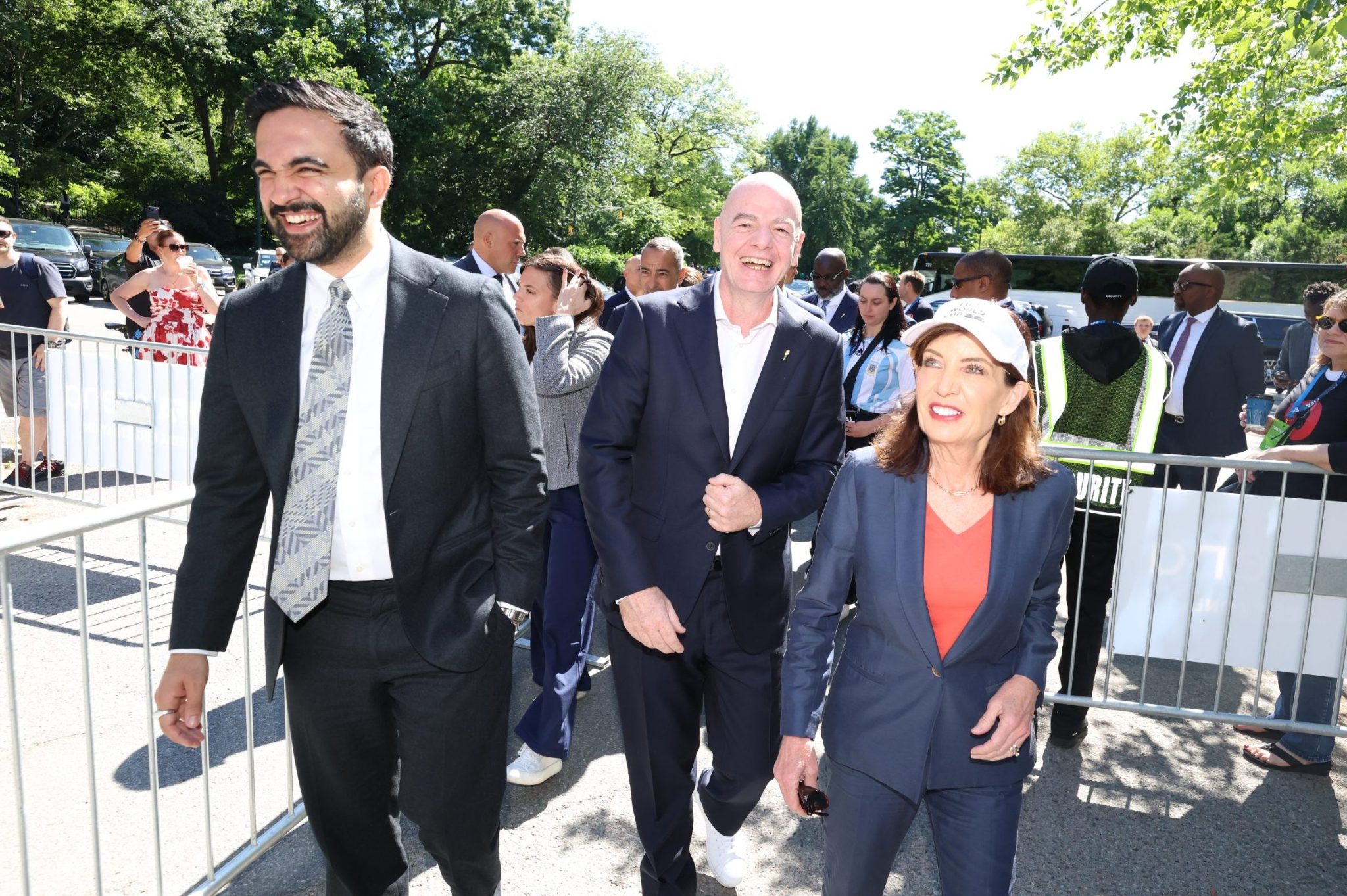
On Monday, New York Governor Kathy Hochul and Mayor Zohran Mamdani stood in Central Park to announce a free watch party for 50,000 New Yorkers in the park for the World Cup final. The State of New York is spending $6 million so that residents who cannot afford the most-watched sporting event on earth can at least watch it together on the Great Lawn. “In a moment where sports, experiences, and memories have grown increasingly unattainable for working people,” Mamdani said, “we will make this viewing party 100% free.”
Standing nearby was FIFA president Gianni Infantino, who last month defended the exorbitant costs of the world’s most prestigious sporting event and blamed them on “market rates” that apply in the U.S.
“We have to look at the market—we are in the market in which entertainment is the most developed in the world, so we have to apply market rates,” Infantino said at the Milken conference.
His comments mirror what some economists have pointed to as driving the World Cup’s pricing crisis, saying it’s a market deliberately designed—by FIFA, with full knowledge of the consequences—to generate revenue at every stage of a fan’s increasingly expensive journey to a seat. By offering the watch party to soccer fans who otherwise should be able to attend in person at a stadium just 20 minutes away, these economists say the governments of New York City and state are patching a hole that FIFA deliberately designed to enlarge.
The Hidden Market and Its Consequences
Those market rates have produced numbers without precedent in World Cup history. Face-value tickets to the July 19 final at MetLife Stadium started at $2,030 and ran to $6,730 for Category 1 seats—but under FIFA’s dynamic pricing model, they didn’t stay there. By early May, FIFA had tripled its best available final tickets to $32,970, up from a previous high of $10,990, on the same day members of Congress pressed the organization for transparency on its pricing. On FIFA’s own resale exchange, final tickets were listed at about $9,000—each transaction generating 30% in combined fees that flow back to FIFA. Four years ago in Qatar, the most expensive seat at the final cost roughly $1,600. Football Supporters Europe estimates that a fan following a single team from its opening match through the final would spend a minimum of $6,900 on tickets alone.
“We as customers and fans should look at those fees and be annoyed by them, the same way, potentially even more so, than we are annoyed by very high initial ticket prices,” said Judd Kessler, a professor of business economics and public policy at the Wharton School of the University of Pennsylvania and author of the new book Lucky by Design, which looks at how market designs force a hidden market that benefits only a select few at the cost of the many.
When a seller prices tickets below what the market would bear, the surplus doesn’t disappear, but rather, moves into queues, bots, and resale platforms. Tickets end up costing the same or more. That means when Bruce Springsteen, for example, prices tickets at $60 and they get bought by bots and resold at $4,000, that money goes straight into the speculators’ pockets.
“You kind of would prefer that the money go to the Boss, because you know he at least is performing at the show, as opposed to the speculators who buy the ticket and add nothing to the production,” Kessler said.
Secondary Markets and FIFA’s Strategy
For most of its history, FIFA ran a relatively conventional version of this system: face-value tickets, price caps on resale, fees of 10% or less. But this year, FIFA abandoned price caps for matches in the United States and Canada, defending the decision by claiming that restrictions would drive sellers to third-party platforms like StubHub. In their place, FIFA launched its own official resale marketplace—and charged both buyers and sellers a 15% fee, effectively collecting $30 for every $100 in resale transactions on its platform.
“Maybe they don’t raise prices because they’re worried about the backlash,” Kessler told The New York Times, “and being able to make 30% on the secondary market allows them to collect without as much backlash.” The optics of a $700 ticket feel different from a $500 ticket plus a $200 fee collected at the back end.
Mexico, where ticket resale laws are stricter and the government lobbied for consumer protections, got a different deal: FIFA agreed to limit resale prices to face value for matches held there. But for American fans, there’s a 30% fee and no cap.
The Real Cost of Fees
Kessler estimates platforms take between 25% and 35% of secondary market sales, split between buyer and seller fees. “That’s also why I worry that one of the reasons we haven’t seen innovation in hidden markets is because a lot of the players in these markets have an incentive to allow transactions on the secondary market, because they get to take a big cut of them.”
FIFA’s 30% fee puts it in the company of the platforms it once positioned itself against, but with the added caveat that it also controls the primary market. FIFA sets the rules of access and operates the official resale exchange. This phenomenon, which could control the box office and resale platforms, led the New York and New Jersey attorneys general to subpoena FIFA in late May.
A Free Lawn Watch Party
Mamdani and Hochul, who spent the morning alongside Infantino when announcing the watch party, have continued to point out the discrepancy in those who are some teams’ biggest fans and those who can afford to watch their teams play. Mamdani negotiated 1,000 affordable tickets from FIFA at $50 each, with free round-trip transportation, for New Yorkers who won a lottery. He announced a $6 million free watch party for 50,000 more and fan fests across all five boroughs.
What he did not say and could not say, at least while standing next to the FIFA president, is that the $6 million the state is spending to provide a free alternative is in effect a public subsidy for a pricing structure that FIFA designed to extract maximum revenue from a captive market.
For Kessler, the problem is structural: As long as secondary market platforms take 30% of transactions and primary sellers benefit from the opacity that gap creates, there is no incentive to fix the system. “I would like to see a world where artists, sports teams, and FIFA could sell tickets to real fans for reasonable prices, and those tickets would not then be resold at slightly higher prices. But that requires changes to the hidden market.”
Post a Comment for "FIFA Claims 'Market Rates' Justify World Cup Prices, But Economists Say the System Was Fixed"