
AI revolutionizes construction sites
The Rise of AI in the Real Estate Industry
The Korea Proptech Forum recently launched its ‘2026 Proptech Member Directory,’ featuring a groundbreaking ‘AI Map for Proptech’ that categorizes the entire real estate industry into five units. This map highlights 75 companies offering AI services, covering areas such as development, construction, transactions, marketing, operations, asset management, and data platforms. This initiative marks the first time the Proptech Forum, which has been publishing this directory since 2019, has released a dedicated ‘AI Edition.’ It reflects the growing importance of AI in the real estate sector, transitioning from an experimental tool to a core competitive force.
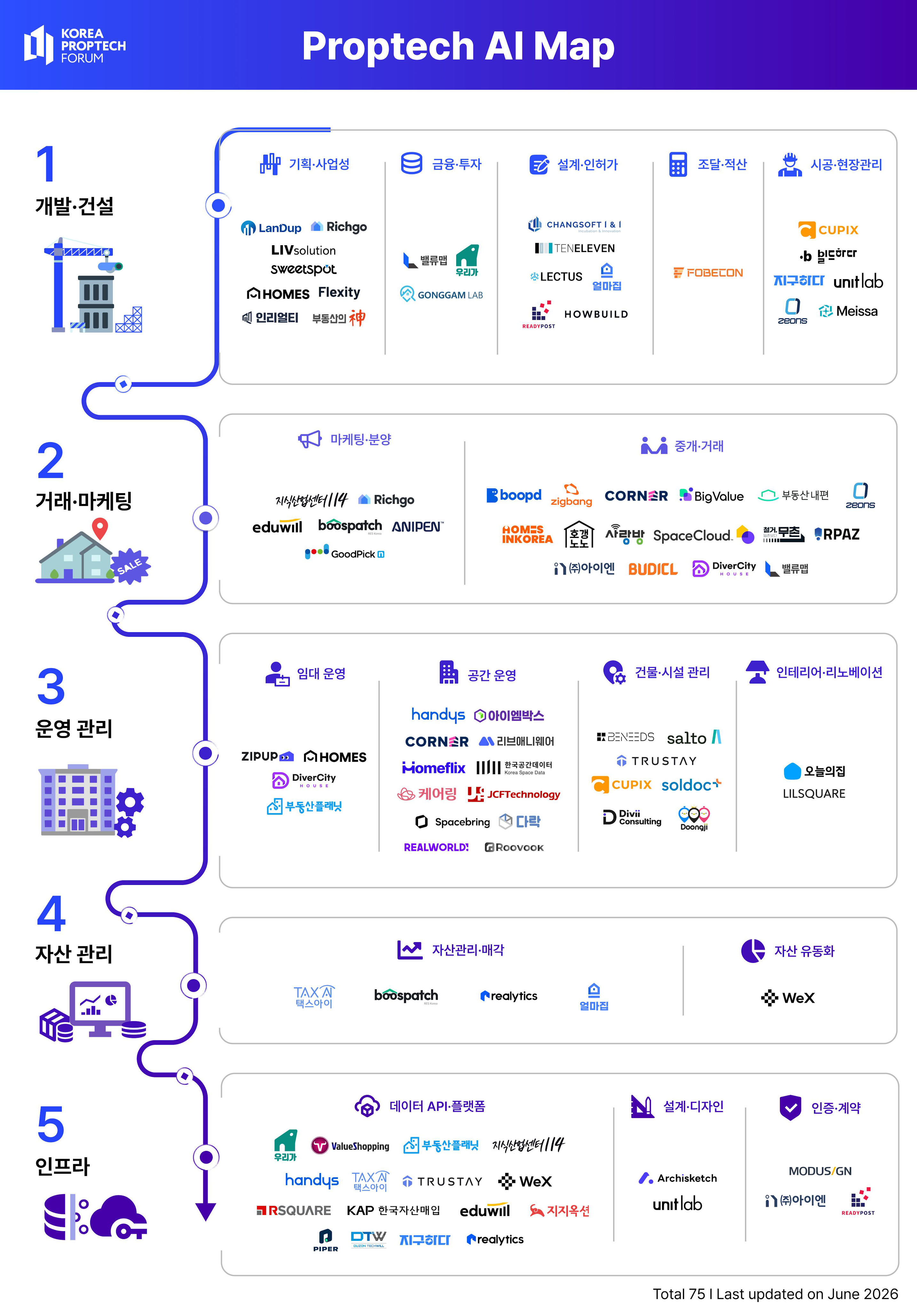
AI Integration Across Real Estate Processes
AI is now deeply embedded in every stage of the real estate industry. From feasibility analysis and design during the development phase, to quality control and safety management during construction, AI plays a crucial role. In transactions, it supports brokerage, sales marketing, and price recommendations. Post-completion, AI handles leasing operations, smart building management, asset analysis, and liquidation services. Every process—from planning and construction to sales—is now interconnected with AI.
AI Adoption in Construction: A Shift from ‘Hard Labor’
Construction, traditionally seen as labor-intensive, is witnessing a significant shift with AI adoption. Unlike manufacturing, where automation is more straightforward, construction sites are varied and complex. However, AI applications are rapidly expanding, particularly in quality control, contract reviews, and safety management.
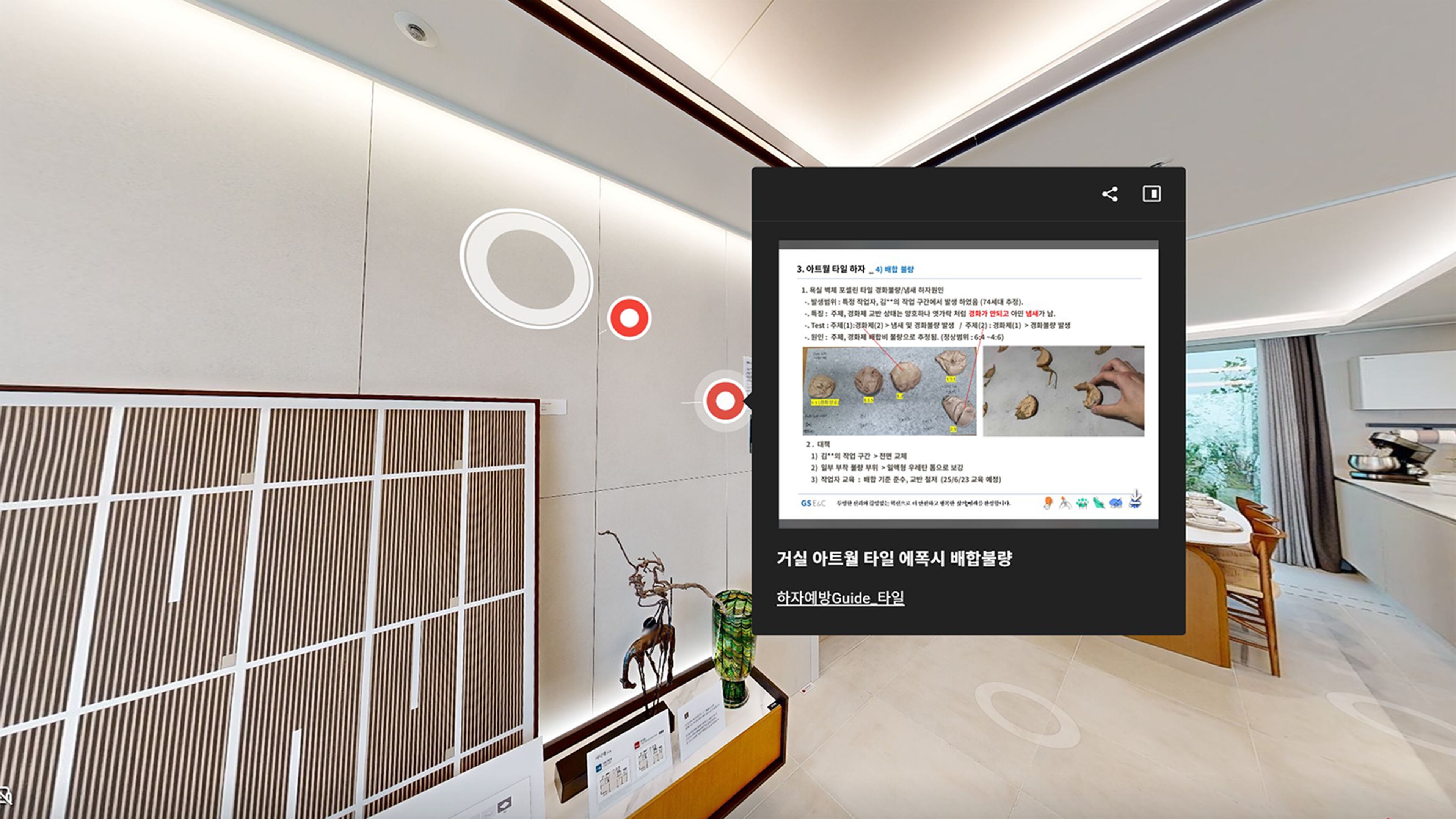
GS Engineering & Construction has integrated its self-developed ‘AI Defect Prevention Platform’ into its quality management system. This platform analyzes defect types and causes using accumulated construction data, allowing on-site staff to reference it during construction. It visualizes defect cases in 3D for easy understanding, even by foreign workers. The company reported achieving zero defect judgments in two consecutive reviews by the Ministry of Land, Infrastructure and Transport’s Defect Review and Dispute Mediation Committee over the past year.
Daewoo Engineering & Construction uses ‘Barodap AI,’ a vertical AI service trained on contracts and specifications, and ‘Baro Letter AI’ for document drafting. These tools are designed to provide answers based solely on internal documents, reducing the risk of ‘hallucinations’—plausible but incorrect answers—common in general-purpose generative AI.
Samsung C&T is deploying an AI agent co-developed with AWS (Amazon Web Services), while Hyundai Engineering & Construction operates a generative AI-based sales consultation service.
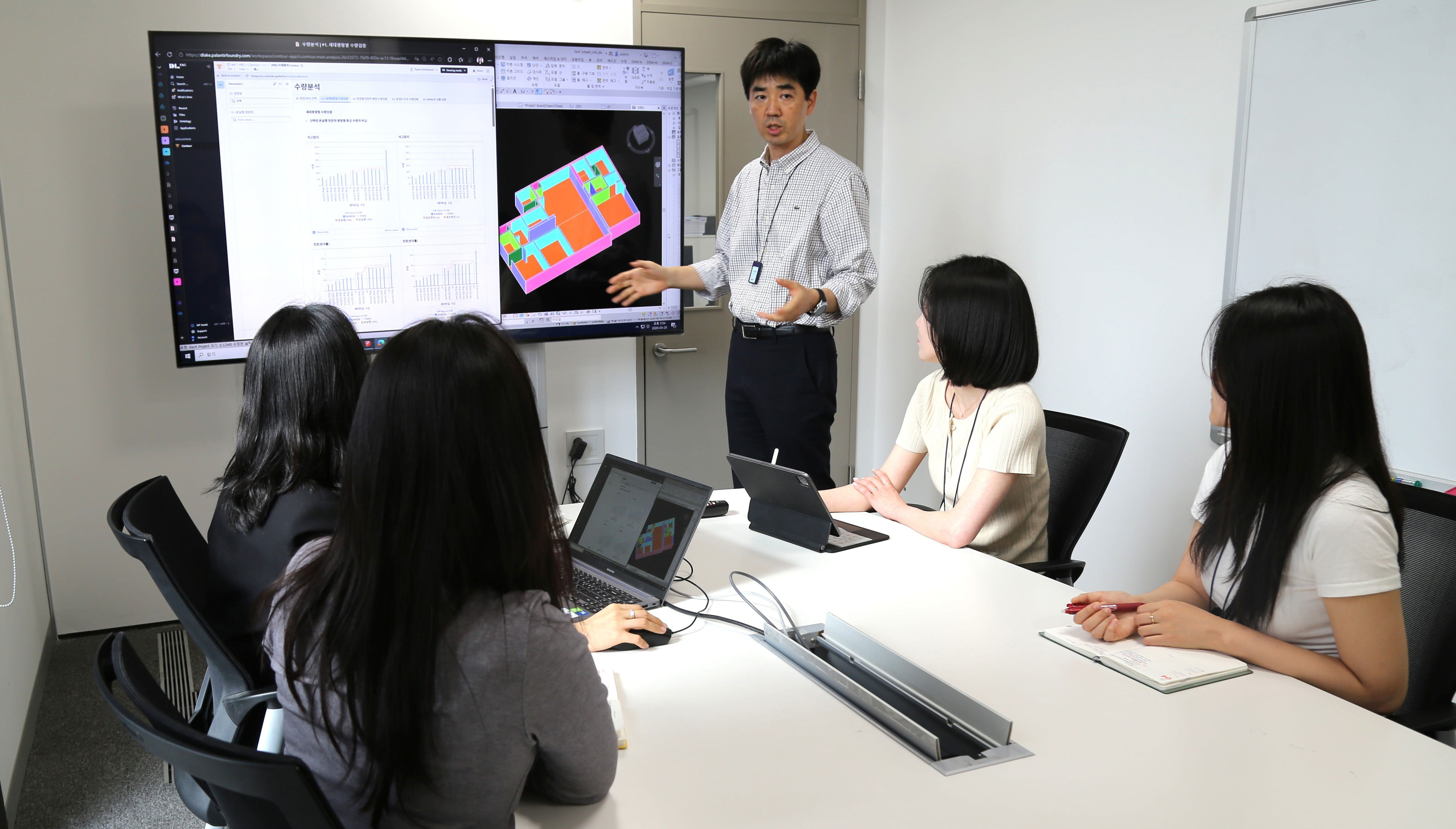
DL E&C became the only domestic construction company to present an AI-driven construction operation innovation case at Palantir Technologies’ ‘APAC Summit Korea 2026’ in Incheon. Palantir leads enterprise AI transformation with its platform ‘Foundry,’ which integrates corporate data and decision-making processes into a single system, enabling real-time AI intervention in site operations.
DL E&C, the first in the industry to adopt Palantir’s data platform in 2022, built a ‘Flywheel ecosystem’ that integrates design, construction, and maintenance data. This creates a virtuous cycle where data generated on-site enhances AI analysis, and the refined analysis results further promote practical applications. Over time, this structure strengthens competitiveness.
Global AI Advancements: Safety and Unmanned Operations
AI utilization is advancing globally, with a focus on safety and unmanned operations. Skanska, a Swedish construction firm, uses its self-developed generative AI ‘Sidekick’ and a safety-focused version, ‘Safety Sidekick.’ Trained on the company’s EHS (Environment, Health, and Safety) manuals and OSHA (U.S. Occupational Safety and Health Administration) standards, it answers site questions. However, AI-generated responses undergo verification by safety officers.
Turner Construction, a U.S. construction giant, released its safety AI ‘SafeT Coach’ to the industry for free. When a site supervisor asks about permits, the safety AI reviews daily permit lists and regulations before providing recommendations. Supervisors then collaborate with subcontractors’ safety managers for checks.
Turner Construction, which previously signed an enterprise agreement with OpenAI to introduce ChatGPT Enterprise for its 11,000 employees, operates over 400 AI services for contract reviews and schedule management, saving over 70,000 work hours annually. The next version will be developed on Google Gemini, expanding customer options.
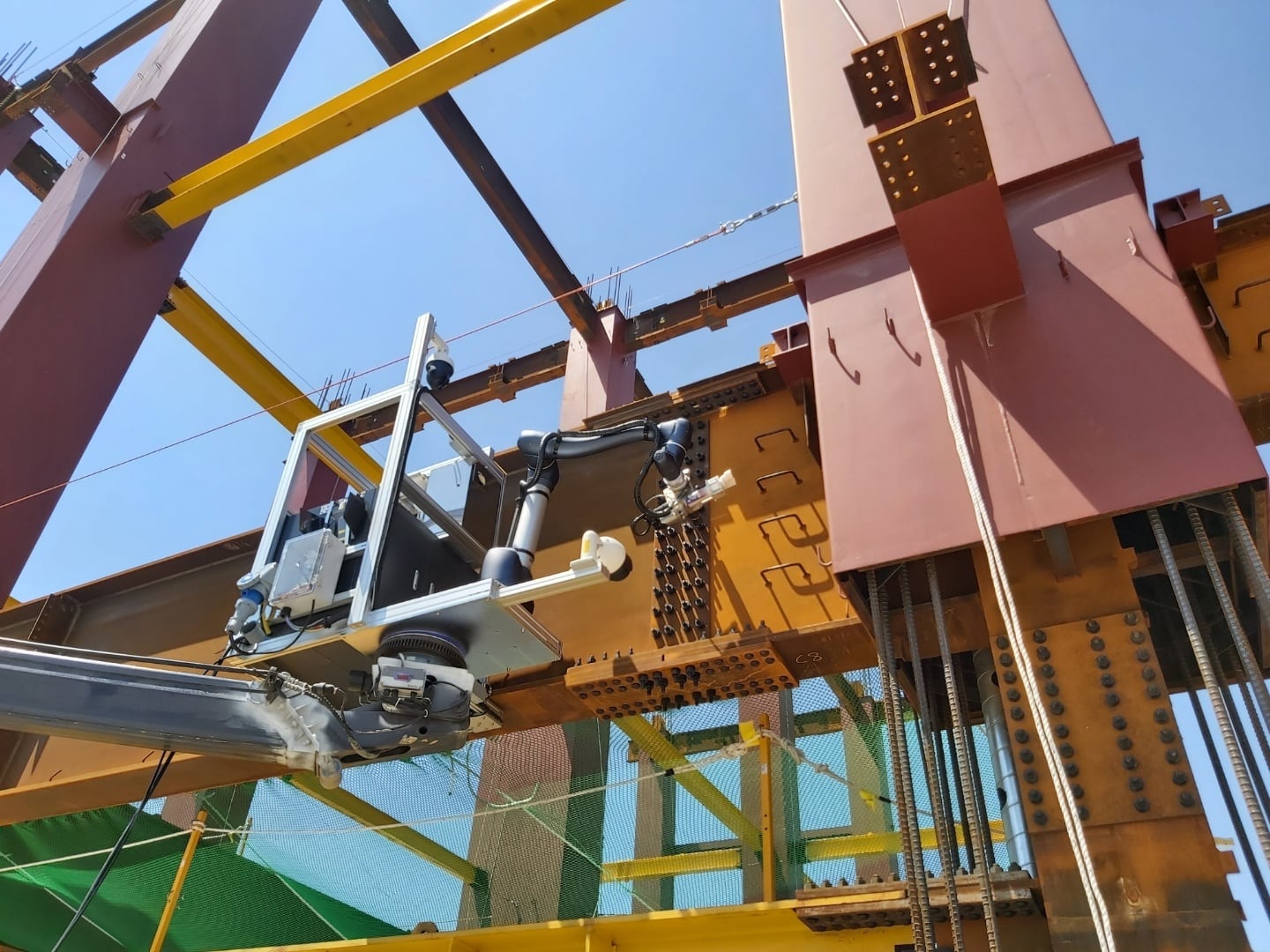
Japan and China are accelerating the replacement of hazardous tasks with AI and robots. Kajima Construction deploys remotely operated autonomous construction machinery, while Shimizu Construction reduced inspection times for rebar from five minutes to 20–30 seconds using an AI inspection system. Chinese construction firm CSCI named its AI service, which handles design reviews and drawing classifications, an ‘AI employee’ and announced its ‘hiring.’
Challenges and Future Prospects
According to Fortune Business Insights, the global construction AI market is projected to grow from $4.86 billion in 2025 to $35.53 billion in 2034, a 24.7% annual increase. This growth is driven by data-based process management that reduces errors and redundant work, predicts risks, and prevents accidents by minimizing human labor.
However, significant AI-driven changes in domestic construction are still concentrated among large firms. While robot dogs and drones are expanding on sites led by these companies, the ecosystem remains narrow. PwC Samil Institute of Management noted in a report that compared to rapid AI advancements, domestic construction still relies heavily on analog workflows.
The Construction and Economy Research Institute of Korea argued in its report ‘Rebirth of the Construction Industry 2.0’ that AI could transform the industry’s high uncertainty into manageable assets. However, it warned that leaving initial adoption costs to individual companies would hinder industry-wide digital transformation. Expanding AI use beyond large construction firms to small and medium-sized enterprises and subcontractors is essential to boost overall productivity and safety.
PwC Samil Institute added that Korean construction companies, traditionally strong in EPC (Engineering, Procurement, Construction) models, can expand their roles through smart construction technologies and AI, managing the entire lifecycle of facilities from planning and design to operations.
Post a Comment for "AI revolutionizes construction sites"