
Spontaneous Current Loops Reveal Hidden Quantum Order in Kagome Metal
The Mystery of Quantum Materials and Loop Currents
Quantum materials are a class of substances that display physical properties governed by the principles of quantum mechanics. These materials have shown great potential in the development of advanced technologies, including quantum computing, memory devices, and solar panels. In some of these materials, electrons can arrange themselves into unusual patterns, leading to states that defy classical physics explanations.
For over two decades, theoretical physicists have predicted the existence of a loop current order in certain quantum materials. This state is characterized by tiny electrical currents that circulate around microscopic loops within a crystal. However, these currents do not produce any measurable electric current through the material itself.
These loop currents were expected to form when electrons organize themselves into a less symmetrical pattern than the crystal structure, even if the atoms remain in similar positions. Despite extensive theoretical research, observing this phenomenon experimentally has proven challenging.
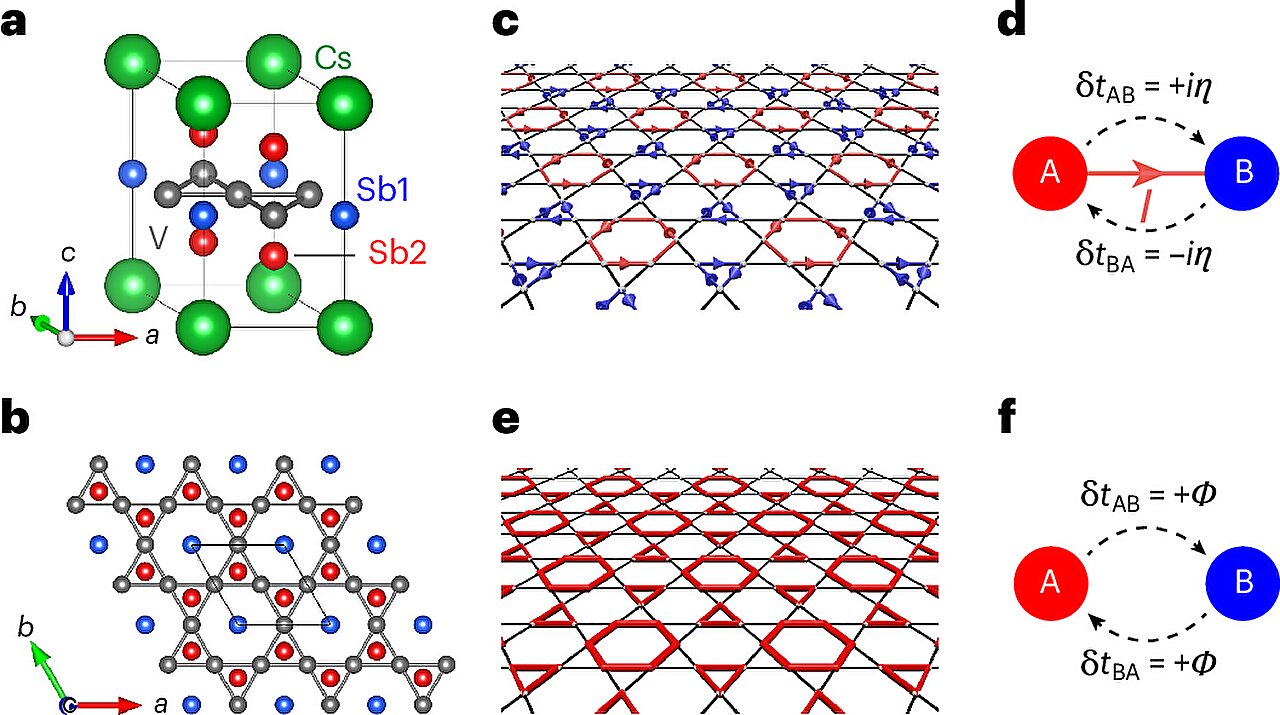
Recently, researchers from Kyoto University and other institutions have gathered evidence of this elusive electronic state in CsV₃Sb₅, a metallic material with a unique atomic arrangement known as a kagome lattice. Their findings, published in Nature Physics, could enhance our understanding of quantum current loops and open new possibilities for technology that utilizes this electronic state.
"This project was motivated by our earlier magnetic torque experiments on CsV₃Sb₅, which revealed an unexpected electronic phase above the conventional charge density wave transition," said Shota Suetsugu, the first author of the paper.
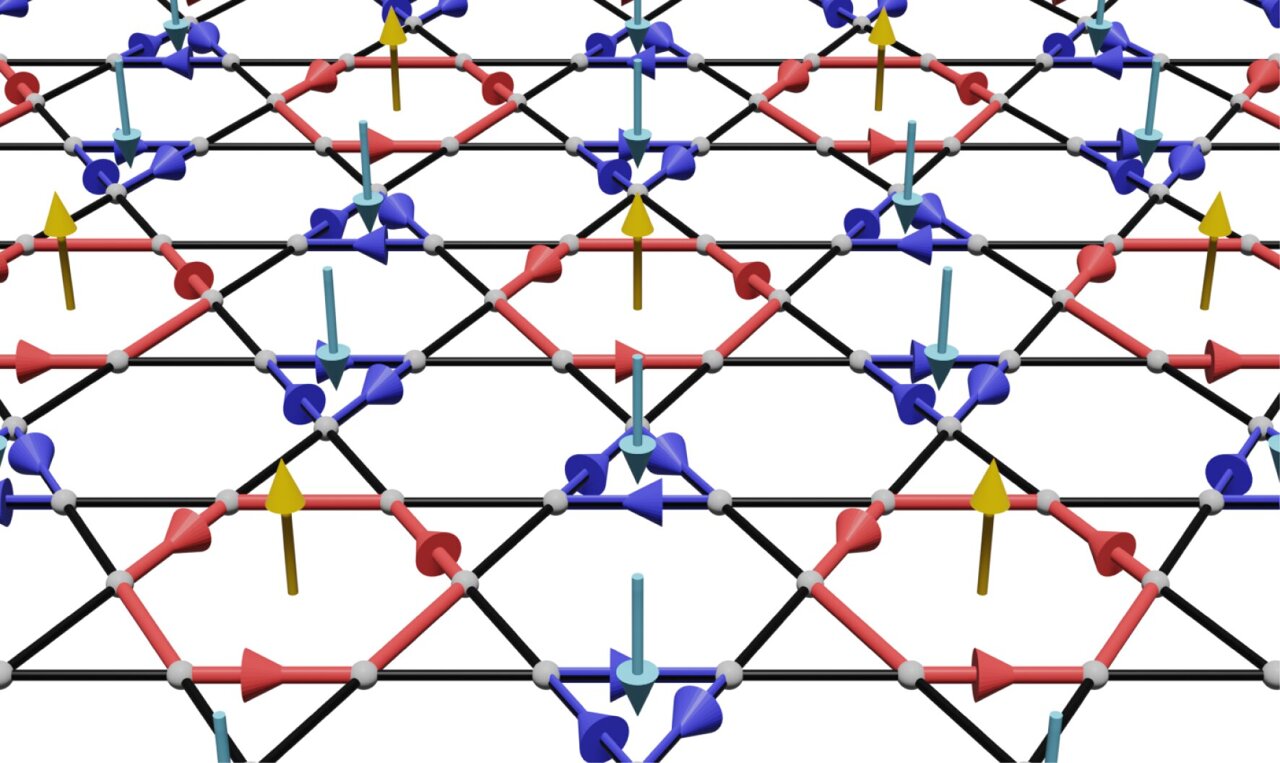
"This unexpected phase suggested the possible existence of an imaginary charge density wave, a state characterized by spontaneous microscopic loop currents within the crystal, even in the absence of an external magnetic field. Unlike conventional charge density waves, which involve a periodic modulation of charge density, an imaginary charge density wave is characterized by a modulation of electron motion, producing microscopic circulating currents."
Probing Spontaneous Loop Currents
Ring currents observed in various molecules, such as benzene, are typically induced by an external magnetic field. In contrast, the loop currents that Suetsugu and his colleagues aimed to observe arise spontaneously due to the collective behavior of electrons.
To probe these loop currents experimentally, the researchers used high-precision local spectroscopic techniques to examine the kagome metal CsV₃Sb₅. These techniques allowed them to study the arrangement of electrons at the microscopic level and detect the tiny internal magnetic fields generated by the loop currents.
"We performed nuclear quadrupole resonance (NQR) and nuclear magnetic resonance (NMR) measurements on antimony nuclei in CsV₃Sb₅," Suetsugu explained. "These techniques use atomic nuclei as extremely sensitive local probes of the electronic and magnetic environment inside a crystal. By combining measurements with and without an applied magnetic field, we were able to distinguish the tiny magnetic fields generated by spontaneous loop currents from the effects of a conventional charge density wave."
Implications of the Study and Next Steps
In their experiments, the researchers detected the tiny local magnetic fields predicted to be associated with spontaneous loop currents. Their study thus offers convincing evidence of these elusive loop currents, which are a defining feature of an unusual electronic state known as an imaginary charge density wave.
"While such loop-current states have long been predicted theoretically in strongly correlated electron systems, direct microscopic spectroscopic evidence has remained elusive," Suetsugu said. "Our findings provide strong evidence supporting the presence of an imaginary charge density wave accompanied by spontaneous time-reversal symmetry breaking in CsV₃Sb₅. Because the loop-current order has also been discussed in connection with the pseudogap phase of high-temperature cuprate superconductors, our work may provide a new perspective on this long-standing problem."
This recent study could soon inspire more efforts aimed at detecting signs of current loops in other quantum materials with similar characteristics. Suetsugu and his colleagues are now planning to further investigate the imaginary charge density wave and the associated emergence of spontaneous loop currents in CsV₃Sb₅.
"An important next step will be to understand how the imaginary charge density wave and its loop currents evolve at low temperatures and under magnetic fields, using complementary microscopic probes," Suetsugu added.
"We are also interested in exploring whether similar loop-current states exist in other kagome materials and strongly correlated electron systems. In the longer term, we hope these studies will reveal how widespread this hidden electronic order is and deepen our understanding of quantum materials."
Conclusion
The discovery of spontaneous loop currents in quantum materials represents a significant breakthrough in the field of condensed matter physics. As researchers continue to explore these phenomena, they may unlock new pathways for developing advanced technologies based on quantum materials. The work of Suetsugu and his team not only advances our understanding of these complex systems but also paves the way for future discoveries in the realm of quantum science.
Post a Comment for "Spontaneous Current Loops Reveal Hidden Quantum Order in Kagome Metal"