
Amadís Ma. Guerrero, the Unyielding Voice of Literature
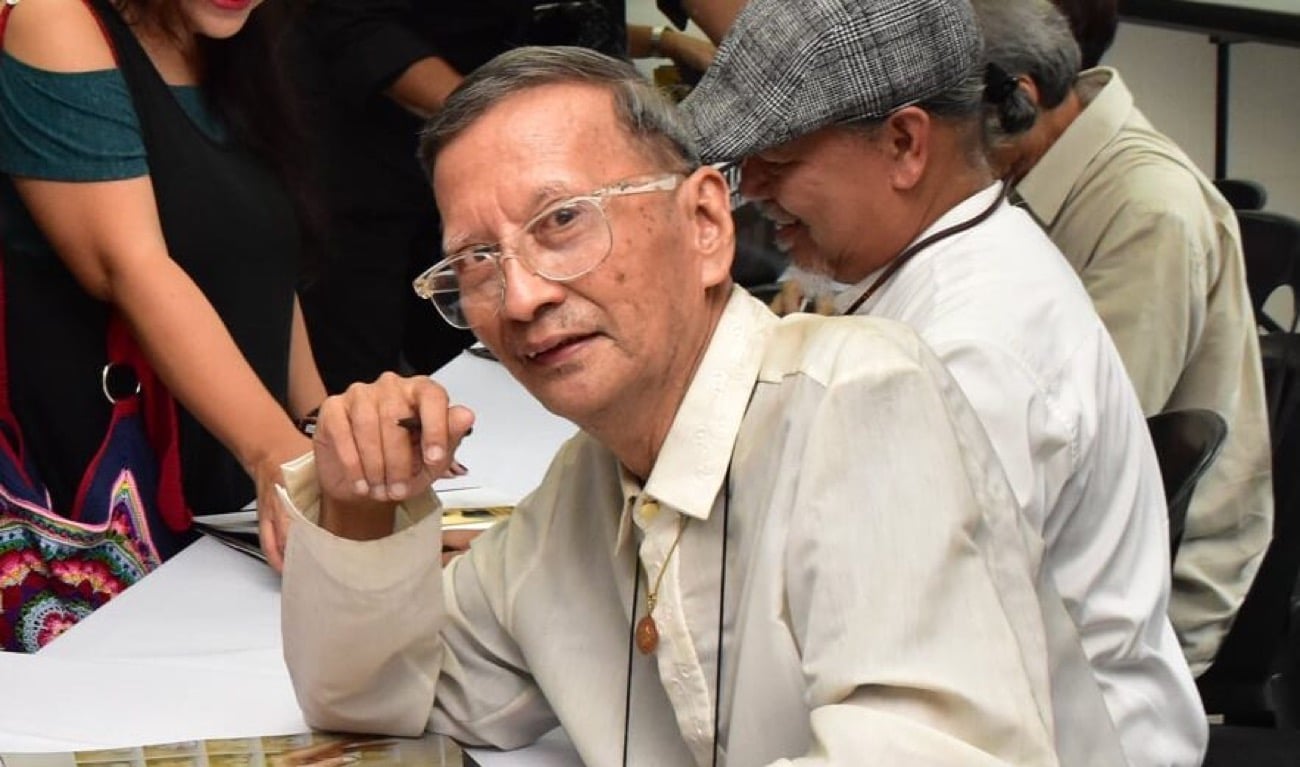
Amadís Ma. Guerrero, a name that echoes in the hearts of many as one of the most beloved contemporary Filipino writers, was more than just a wordsmith. He lived up to his claim of being "the lovable warrior," surpassing even the revolutionary Jose Ma. Sison who used the pen name Amado Guerrero. As I pieced together this tapestry of memories for Amadís, I found it astonishing that friends, colleagues, and his only sibling Claudette Silerio had nothing but warm recollections of this tireless freelance journalist, fictionist, art historian, singer, and traveler, who passed away on May 13 at the age of 85.
His one-day wake will be held today at Santuario de San Antonio’s Capilla de San Francisco in Forbes Park, Makati City. Inurnment is scheduled for May 18 after the 10 a.m. Mass.
Rosario Garcellano, editor of CoverStory.ph and former Travel and Opinion editor of the Philippine Daily Inquirer, shared her memories of Amadís. “My friendship with Amadís began with my first job. At the pre-martial law Graphic weekly magazine where he and I, along with others, were reporters—he already seasoned by a stint at The Associated Press and myself a straggler from university trying to find steady footing among the talents in the newsroom—we tried to protect our romance with the Word. We aimed to break out of the terse noun-and-verb formula and engage in storytelling pleasing to the reader while ensuring fidelity to the facts.”
Garcellano continued, “In leisurely moments—say after we had managed a difficult week and met the production deadline without our boss, the esteemed Luis ‘Morik’ Mauricio, having to issue a sarcastic memo on the staff—we heckled one another, the aspiration for good writing constantly underlying the exchange even if we didn’t say it out loud. I told him that years of straight reporting had fatally cramped his style; he had me know I wasn’t exactly God’s gift to journalism. But he won a Palanca award for a short story. He didn’t announce it, as though it were beneath him to crow. The staff learned it from a press release.”
She noted his tirelessness. “All these decades he continued to write, building a reputation among art groups, travel clubs, whatnot, maintaining his place in the tight writing circle that now mourns his passing. I kept touch with his work (although I suspect that he wasn’t diligently observing mine). How truly exhausting to live with the reality that in this country, good writing can barely keep you alive.” Garcellano’s children Liana and Lyra called him Tito Sluggo, a nickname drawn from an American cartoon character and referring to his spiky hair when he was little. This meant that she and Amadís “went back a long way.”
“Don’t worry about me”
She rued, “Yet I couldn’t visit the man as he lay restless in hospital, pneumonia-preyed and demanding to be brought home. I try to ease my feelings with the thought that he has burst out of the godawful noun-and-verb framework and is now telling wondrous stories in that great newsroom in the sky. It’s a story to soothe children and journalists grown old.”
Amadís’ only sibling Claudette said, “I am his only family. My mama spent her whole life taking care of him because I got married early, and our papa died when we were small. Amadís was always present in all our family activities. When mama died, I took over. He would always tell me, ‘Don’t worry about me. I’m fine.’ Every special occasion, he would be there. Though we attended all his book launchings, it is only now that I realize how much he was loved by his colleagues.”
The parents of Amadís were Dr. Tristan Ma. Guerrero and Estrella San Agustin, a schoolteacher. “My papa was a doctor and when he died during liberation, at 38 years, he was already head of pathology at San Juan de Dios hospital. Maybe mama had hoped Amadís would be a doctor, too,” Claudette said.
Instead, Amadís took double majors in history and English at the University of Santo Tomas.
Like most Guerreros, he veered toward writing, especially on cultural subjects.
Theater, French lessons
Theater and film director Anton Juan wrote of the reviewer-critic in Amadís: “I knew him since I was 16 when I acted in the University of the East Dramatic Guild’s “Escurial” … (He) wrote always rave reviews about my plays. But I was always afraid each time he would come. Because he was a hard one to please.”
Anton’s sister Jenny Juan, a cultural worker who studied at the University of Paris and lived in France, became the private tutor of Amadís in French. She recalled, “Amadís and I had two years together, with me mentoring him in conversational French and reading. He realized that written and spoken French are worlds apart. We focused on conversational, we used to read children’s comic books and moved on to ‘Le Petit Prince.’”
She said, “When he came to me, he actually had a smattering of French, but he wasn’t confident about it. But when he learned the conversational jargon and slang, that was fun for him, especially Parisian slang and pronunciation which is very colorful, even out of bounds. France for him was the quintessential Western civilization. The French Revolution was important to him—‘liberte, egalite, fraternite’ (liberty, equality, fraternity). It wasn’t just wine, cheese, St. Laurent and perfume. So I miss him. When I heard of his passing, I really cried. He was such a gentle soul.”
Virgilio “Billy” Lacaba, who was the president of our former employer, Raya Media Services Inc. (RMSI), for which Amadís and I worked the longest, he from 1983 to 2006, remembered him for his theater connections. “Señor Amadís never tired of giving me and my wife, Wilma, complimentary tickets to Repertory Philippines shows.”
Travel writing, but no to flying
Roderick Tolendo, another former RMSI officemate, said, “I remember Amadís most during our grueling hike to Batad, Ifugao, to view and photograph the rice terraces … Amadís, with his walking stick, braved the slippery, narrow trails. Amadís in the Cordilleras of my memory, Amadís visiting and loving and writing about every nook and cranny of our beautiful, benighted country to the very end.”
Former RMSI graphic artist Jaime Bandola said, “I remember working with Amadís on Saturdays. He would focus on his travel writing for the Inquirer. I joined him in a number of trips, and I’d ask him about historical places. I’m just so glad he didn’t get pikon (irritated) with my jokes. I really sure miss my amigo.”
Jocelyn Caba, former RMSI executive assistant and another frequent traveler in her retirement: “I cannot forget during our Raya years when, during coffee and lunch breaks, Amadís would vocalize several times by his office table … trying to modulate his voice. Years later, I was amused mostly by his comments which he wrote under my Facebook posts. ‘Hahaha, huhuhu! Lolang gala (peripatetic grandmother) strikes again.’ I miss you, Amadís.”
Amadís remained strictly a local traveler. He had a fear of flying which he was later able to conquer, but he refused to go abroad even if there had been opportunities to do so. He didn’t even consider stepping ashore as far as foreign countries were concerned. It was a mystery to me.
He also adamantly refused to learn to use a computer, to our boss Billy Lacaba’s chagrin. The refusal bordered on stubbornness as he cited that the light of the computer screen bothered him. And so he continued until the very end to use a portable typewriter, hiring an encoder. To this day, I can’t imagine how he wrote his over a dozen books that ranged in subjects from travel essay to short stories and more importantly, art history and profiles.
Artists’ ‘compass’
Of the latter, visual artist Jose “Bogie” Tence Ruiz evaluated Amadís’ contribution to the art scene, especially the support he gave to the Social Realist group.
In an online interview with the Inquirer, Ruiz wrote: “Amadís’ collaborations with Purita Kalaw-Ledesma in charting the life of the AAP (Art Association of the Philippines) were mandatory reading for most of us. We had to know, and know well, the community which we would belong to and use as a philosophical reference for our existence. We did still see ourselves not only as social activists but as proper artists … (and) Amadís helped very specifically to build our referential compass.’”
Speaking as another friend, Alma Cruz Miclat, freelance writer and retired corporate executive, posted on her Facebook wall: “Mourning the passing of my dear friend, the kind, quiet, unassuming, simple, loving and lovable Amadís! He’s a family friend who cared for each one of us: Mario’s and my writing, Maningning’s art, Banaue’s theater, even (my grandson) Raja’s early writing skills.”
Thelma Sioson San Juan of TheDiarist.ph and Amadís’ former Lifestyle editor, wrote on Facebook: “Amadís lived to write even if writing didn’t pay one enough to live it up. A writer’s writer to the very end.”
Post a Comment for "Amadís Ma. Guerrero, the Unyielding Voice of Literature"